Halkidiki with little ones
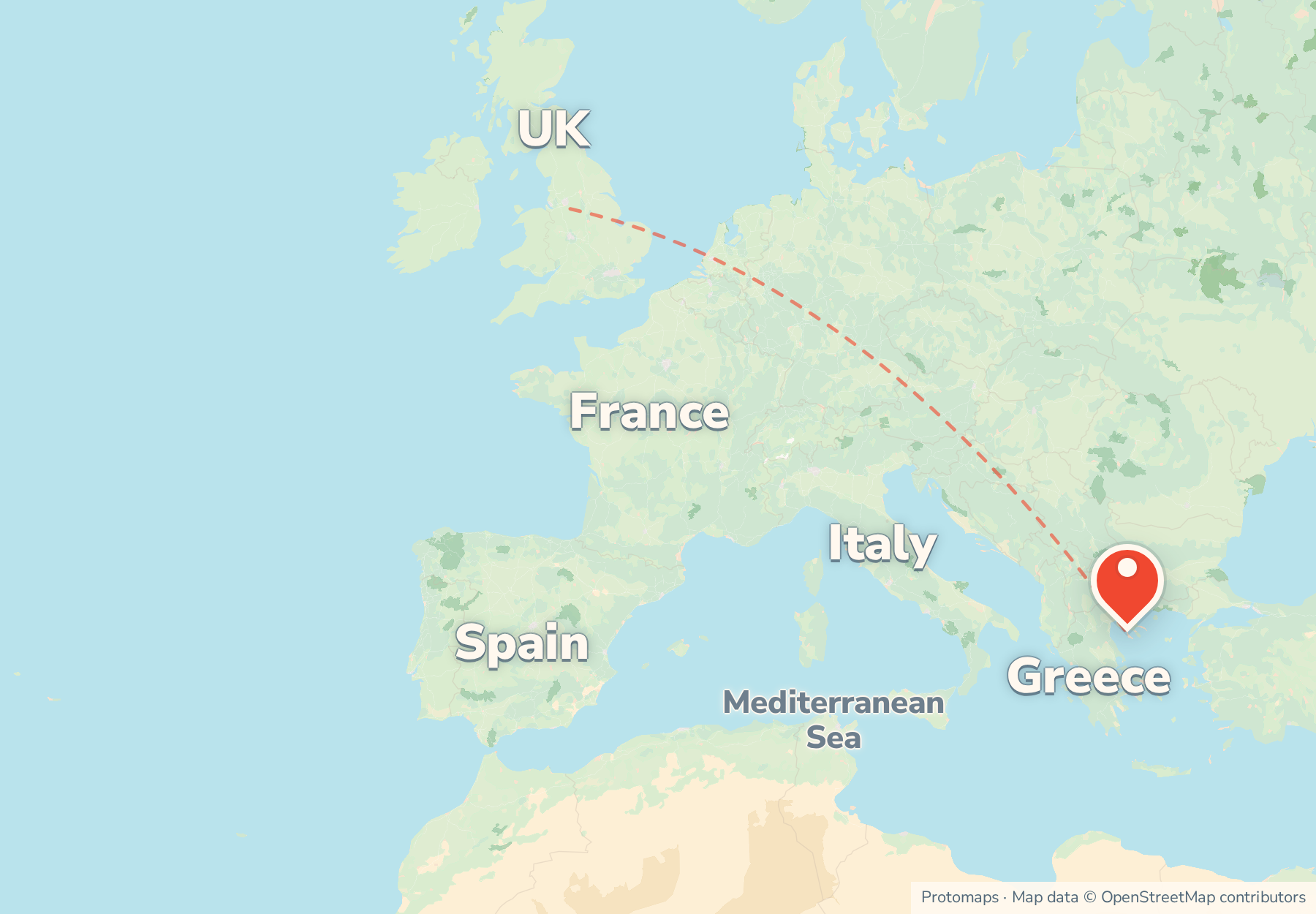
Halkidiki hangs off northern Greece in three long peninsulas, and which one you pick shapes the whole holiday. Kassandra, the first leg, has the resort villages and the shortest transfers; Sithonia, the second, has the quiet, the pine-backed coves and a lagoon where families captain their own little boats with no licence needed; Athos, the third, is a closed monastic republic you show the children from the deck of a cruise boat. The sand is long, shallow and sheltered by the gulfs, the supermarkets are mainland-sized and the crowds are Balkan and German self-drivers rather than UK package coaches.
On this page
A family verdict at a glance
The quick read before the detail: who Halkidiki suits, the season to aim for and what to nail down before you book.
Best for
Self-drive families who want long shallow sand, a lagoon boat day and proper days out when the beach needs a break.
Maybe not for
Anyone wanting a short transfer and a walk-everywhere week without a car, or autumn half-term warmth.
Best ages
Strong for young children, with shallow gulf water for crawlers and the boat day for everyone.
Best areas
Hanioti for the classic resort week, Nikiti or Vourvourou for the quiet leg, Sani for the splurge.
Why families pick it
Greek-island beaches at mainland value, with far fewer UK crowds than Rhodes or Corfu.
Check before you book
The transfer length to your chosen leg, and that the hire car is booked for more than a token day or two.
The three legs
Three peninsulas hang side by side, and they're very different. Kassandra has the resort villages and promenades, Sithonia the pines, coves and villas, and Athos is a closed monastic territory that ordinary visitors never enter and that women, under a ban written into Greek law in 1953, may not enter at all. You pick between the first two for the week and see the third from a boat deck.
This is also the mainland, not an island. Families here mostly arrive by car from Thessaloniki and the Balkans, so the area runs on big supermarkets, villas and apartments rather than transfer coaches, prices sit below island norms and UK accents are rare. That brings a few things an island doesn't: a second city with a long waterfront promenade, a waterpark, a prehistoric cave and a physics park, all within a day's loop of the beach.
A quick gut checkIs Halkidiki right for your family?
Worth comparing if
You're happy to drive, want shallow warm gulf water and like the idea of fewer Brits and better-value tavernas.
Weigh it up if
The transfer matters more than the destination, or the trip is pinned to October half term.
To sort out before booking
Kassandra or Sithonia, and which day of the week gets the lagoon.
The numbers, the basics and the ages
Everything you'd want to skim first: the quick facts, the everyday practicalities and how Halkidiki changes as children grow.
Quick facts for UK families
Money, plugs, language and the basics
- Halkidiki is the three-pronged peninsula south-east of Thessaloniki, Greece's second city; you holiday on the first two prongs.
- The currency is the euro and cards are accepted widely; markets, kiosks and some tavernas still prefer cash.
- Sockets are the round two-pin European type, so UK plugs need an adapter. The voltage matches the UK.
- The language is Greek, with English spoken readily in the resorts; German often comes first on menus, which tells you who holidays here.
- The clocks run two hours ahead of the UK, so a 7pm UK bedtime is 9pm here, right on Greek family dinner time.
- Tap water quality varies by resort; ask your accommodation, treat bottled as the default and use low-mineral bottled water for formula.
- Your GHIC card covers Greece's state system; 112 is the general emergency number and 166 calls an ambulance.
- Hotels add Greece's nightly climate fee per room rather than per person, scaled by star rating, paid at the accommodation and rarely shown in booking totals.
Halkidiki by age and stage
Babies
Warm, sheltered gulf water, shade from the pines and apartments with kitchens. The long transfer is the one early test.
Toddlers
Sand that shelves like a paddling pool, especially at Karydi, and a lagoon boat day that ends in waist-deep turquoise.
Preschoolers
Captaining the little boat, a waterpark pirate ship, whisper dishes at the physics park and monasteries from a cruise deck.
Young children
A prehistoric skull in a cave, snorkelling off the coves and a first proper Greek city along Thessaloniki's waterfront.
Where to base yourselves
The areas across the two family legs, an orientation map and which sand suits small swimmers.
Where to stay with young children
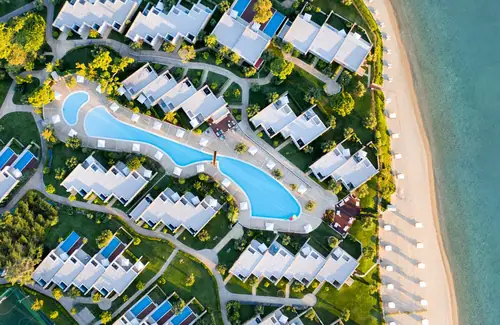
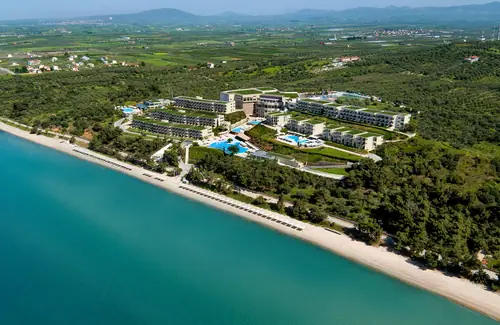
Kassandra is the resort leg and the usual first-trip answer. Hanioti makes the strongest family case: a long sandy beach, a pedestrianised centre and everything a small child needs within pram range, with Polychrono and Pefkochori offering the same formula at slightly different volumes along the coast. Afitos, up on its bluff, is the leg's handsome stone village for families who want character with their beach, accepting a slope down to the water. Sani, on the west coast, is a different thing again, the resort widely treated as the benchmark for premium family holidays in Greece, with kids' clubs, crèches and a marina, priced to match; it's the splurge option rather than the default.
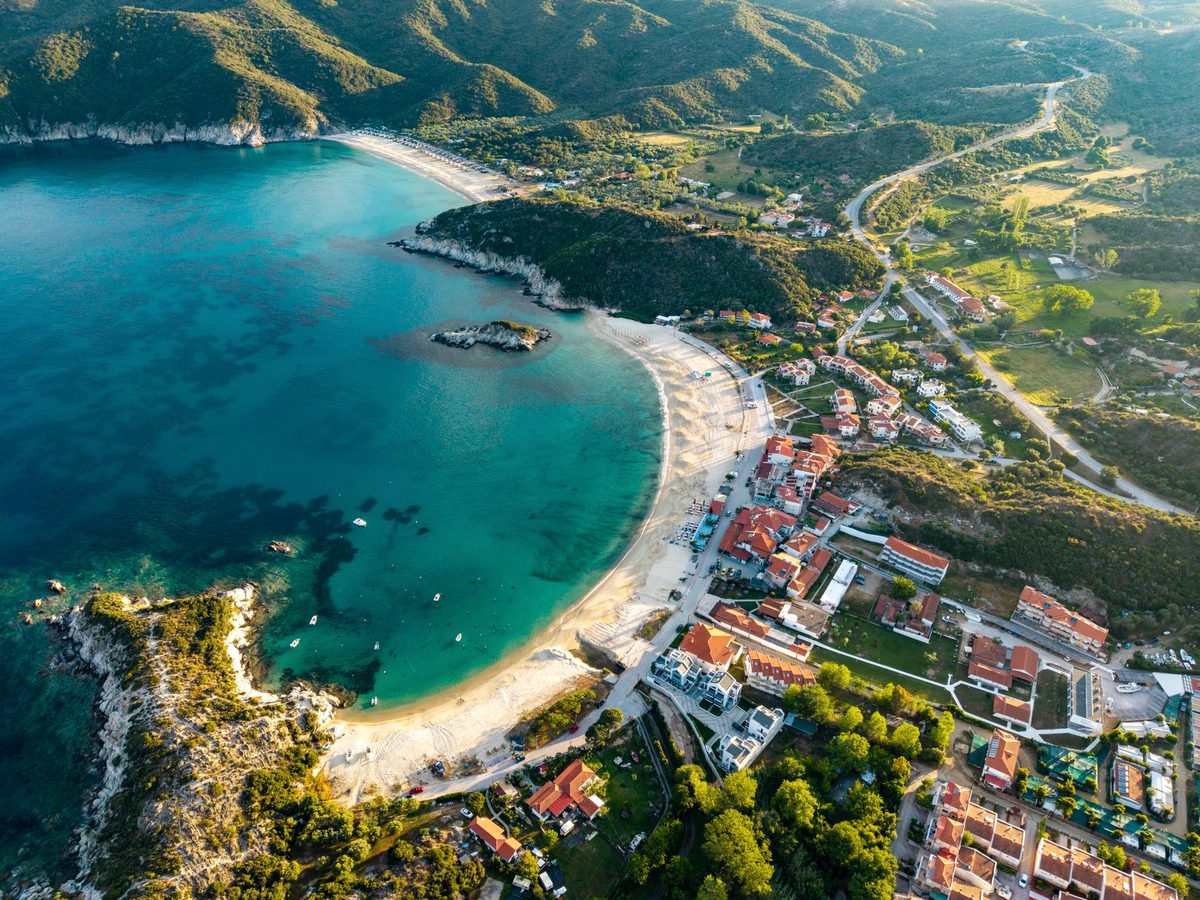
Sithonia is the quiet leg, half an hour further from the airport and a notch wilder all the way down. Nikiti is its practical base, a long beach with supermarkets and an old hill village behind, well placed for the whole peninsula. Vourvourou barely qualifies as a resort at all, a scatter of villas and small hotels around the lagoon facing Diaporos island, with Karydi's powdery, exceptionally shallow sand as the local beach; it suits self-caterers who want the best water on the peninsula outside their door. Neos Marmaras is the biggest town on the leg, wrapped around its harbour with town beaches and full amenities, and Toroni and Sarti serve families chasing long, quiet sand with a taverna or two and little else.
Either way, book the car for the whole stay rather than a day or two. The villages are self-contained for beach days, but the best of the week, the lagoon, the cruise, the cave, the city, sits a drive away.
| Area | Transfer | The swimming | The feel |
|---|---|---|---|
| Hanioti | 1 to 1½ hours | A long sandy beach off a pedestrianised village centre | The family hub of Kassandra: promenade, tavernas and shops all at toddler-walking distance. |
| Sani | 1 to 1½ hours | West-coast sand with a marina and wetlands behind | The premium option: the resort complex widely treated as Greece's family benchmark, priced like it. |
| Afitos | 1 to 1½ hours | Sand below a bluff; the walk down has a slope to manage | The handsome stone village of the leg, more character and fewer crowds than the strip. |
| Nikiti | 1½ to 2 hours | A long sandy beach with an old hill village behind it | Sithonia's practical gateway: supermarkets, tavernas and position for the whole quiet leg. |
| Vourvourou | 1½ to 2 hours | Karydi's powdery sand and a calm, pool-shallow lagoon | A scatter of villas around the calmest water on the peninsula, facing Diaporos island. |
| Neos Marmaras | 1½ to 2 hours | Town beaches around an amphitheatre of a harbour town | Sithonia's biggest town, with full amenities and the west-coast beaches in reach. |
Map of the main family areas
An orientation map of the areas above, the airport and the big days out. The numbers match the key beneath.
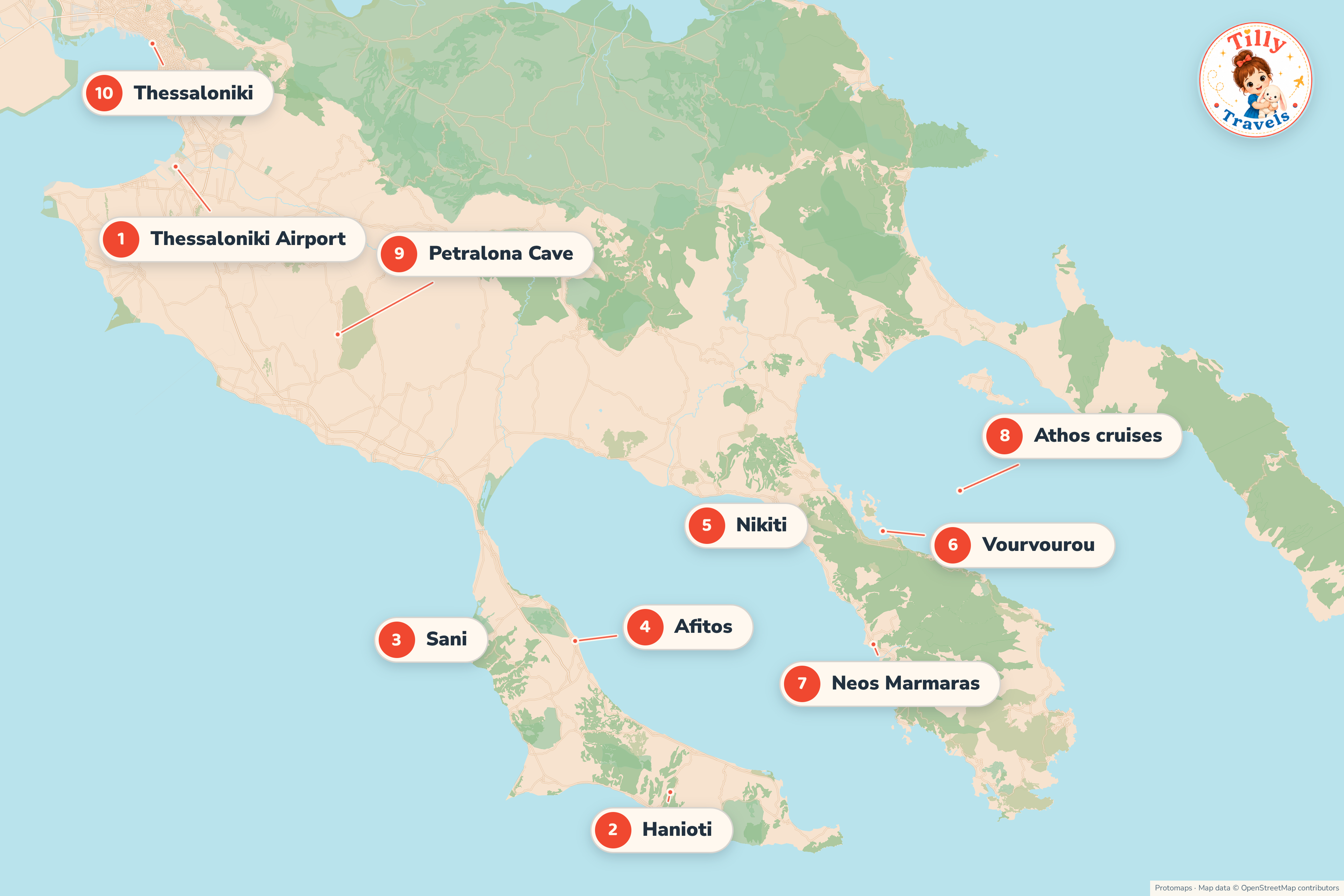
- 1Thessaloniki Airport The gateway
- 2Hanioti The Kassandra family hub
- 3Sani The premium resort
- 4Afitos The stone village
- 5Nikiti Sithonia's gateway
- 6Vourvourou The lagoon
- 7Neos Marmaras The harbour town
- 8Athos cruises The forbidden leg, from the sea
- 9Petralona Cave The prehistoric day out
- 10Thessaloniki The city day
The beaches, sorted for small swimmers
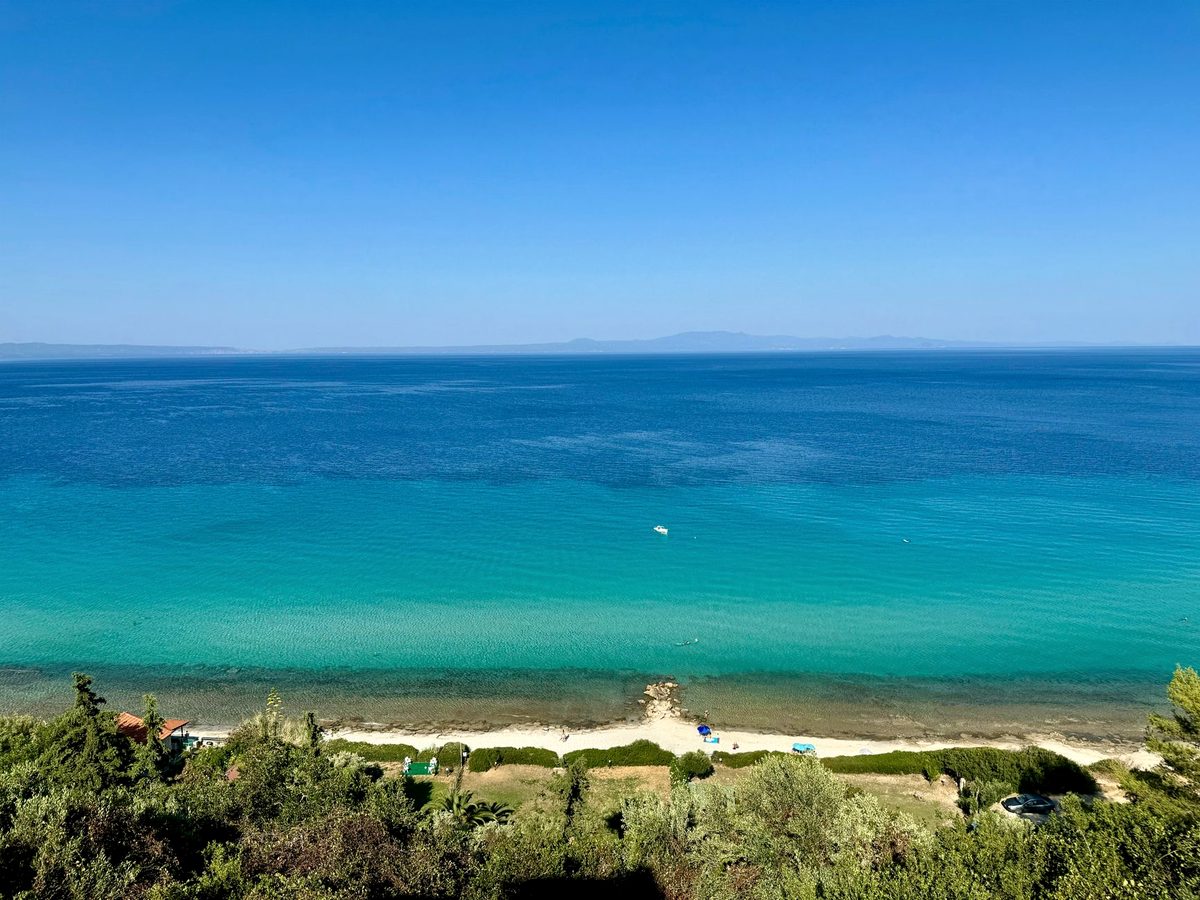
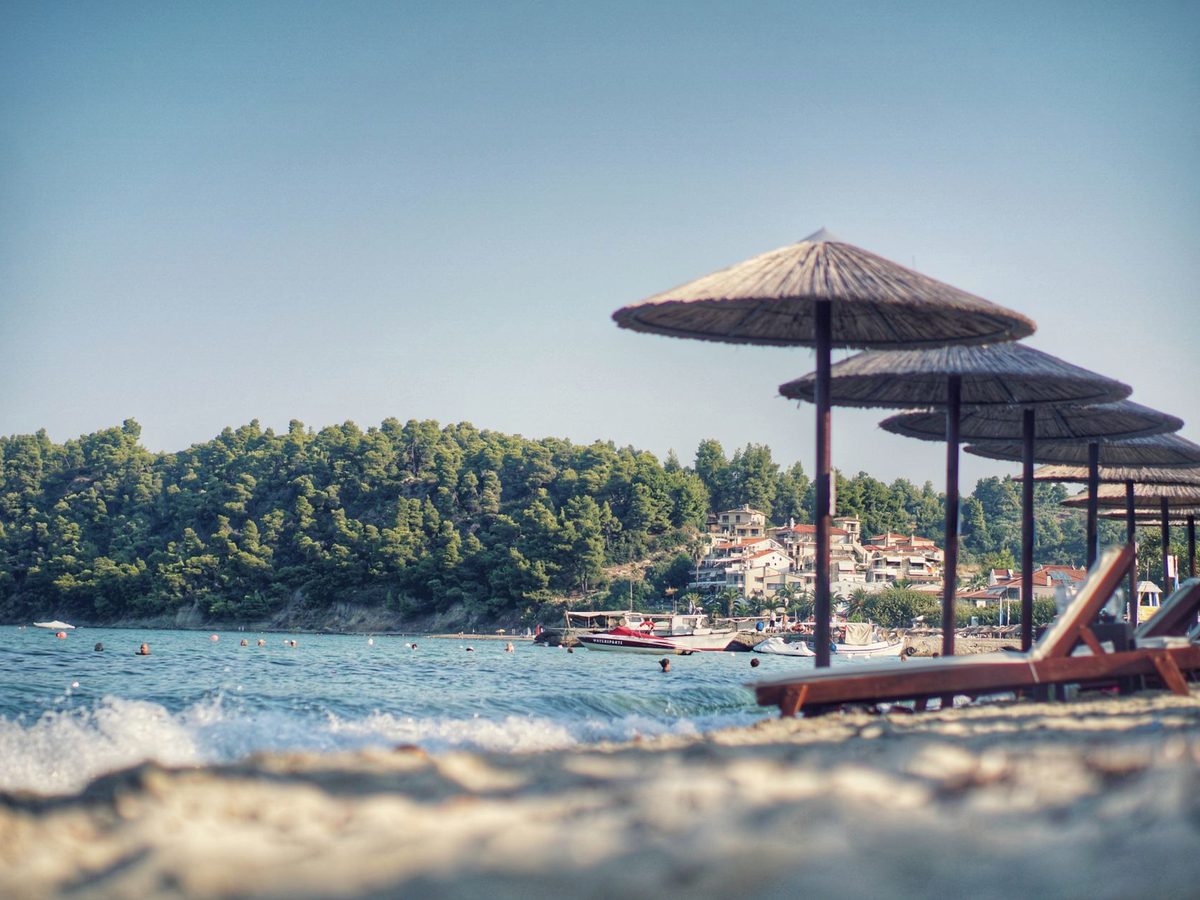
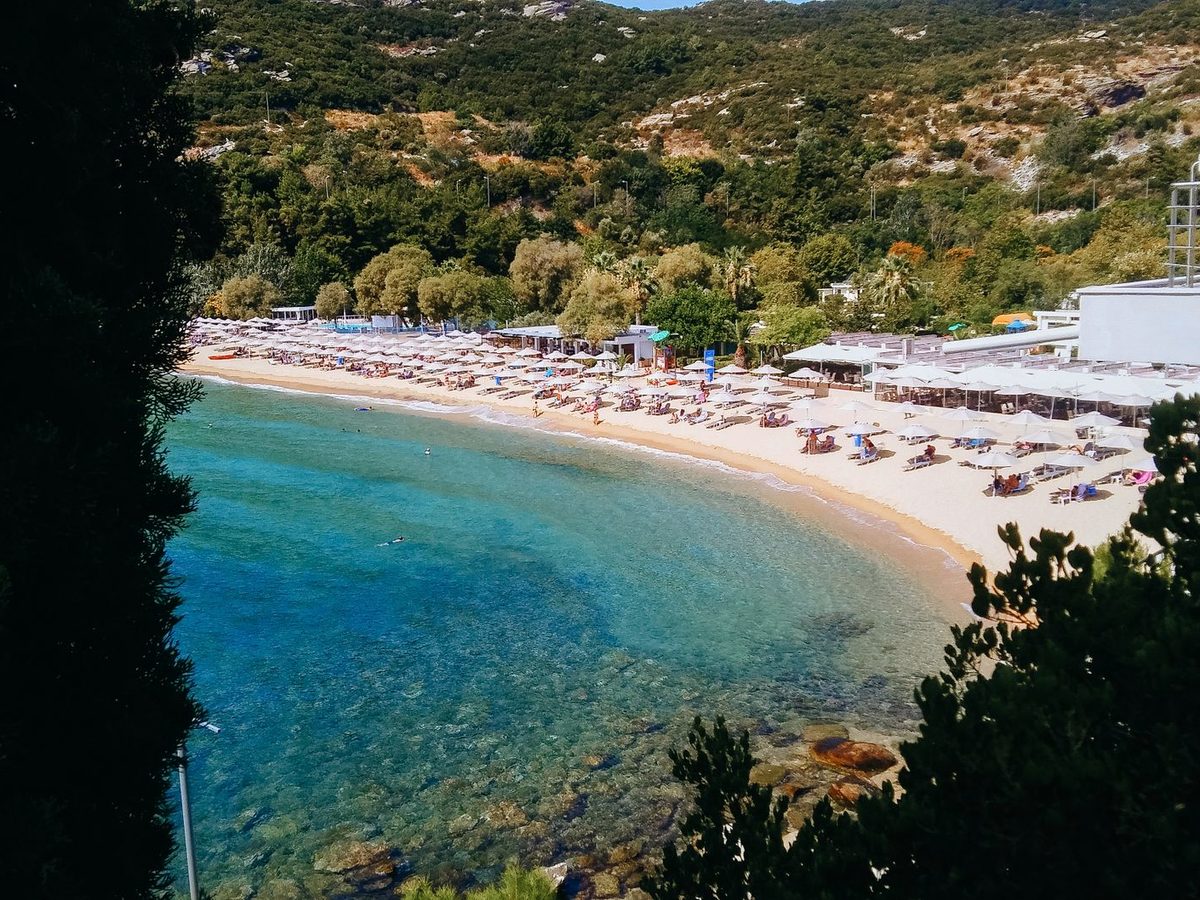
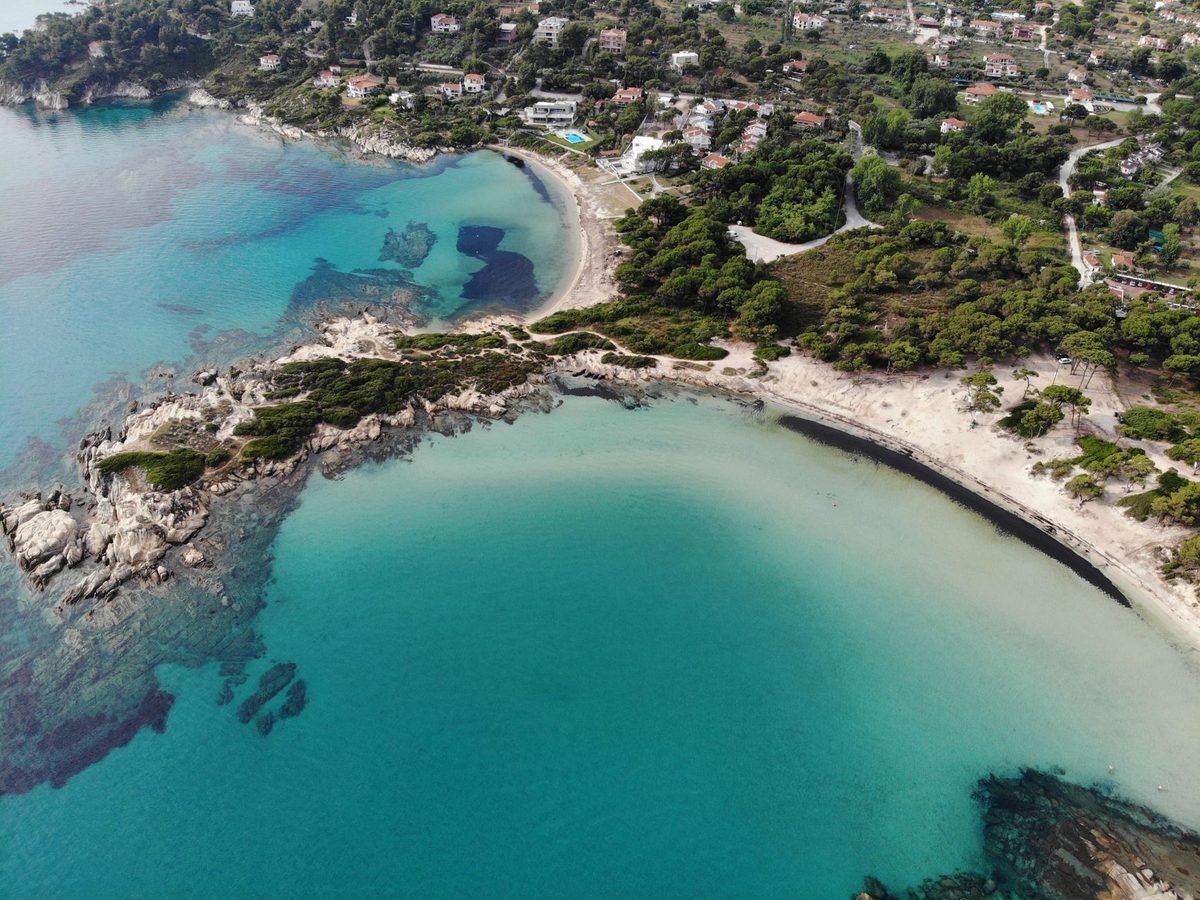
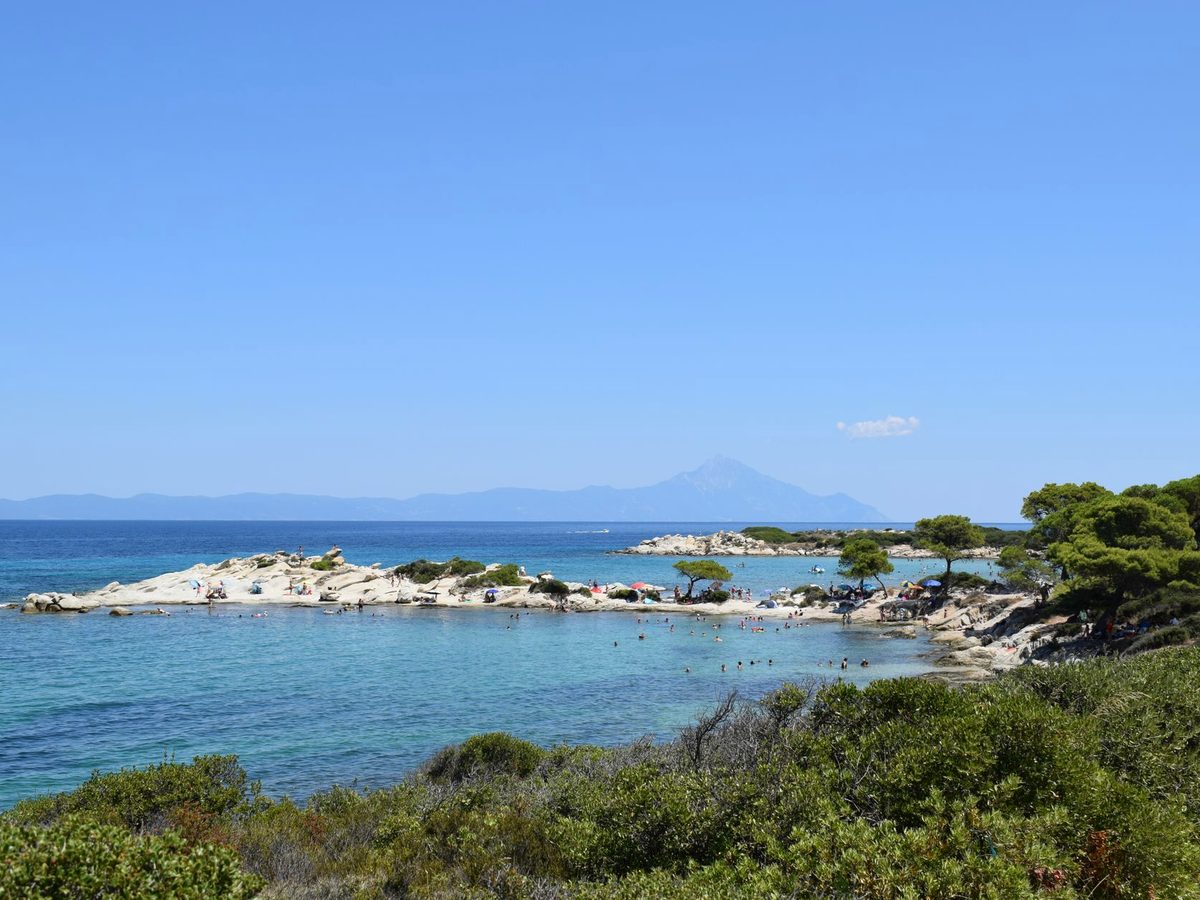
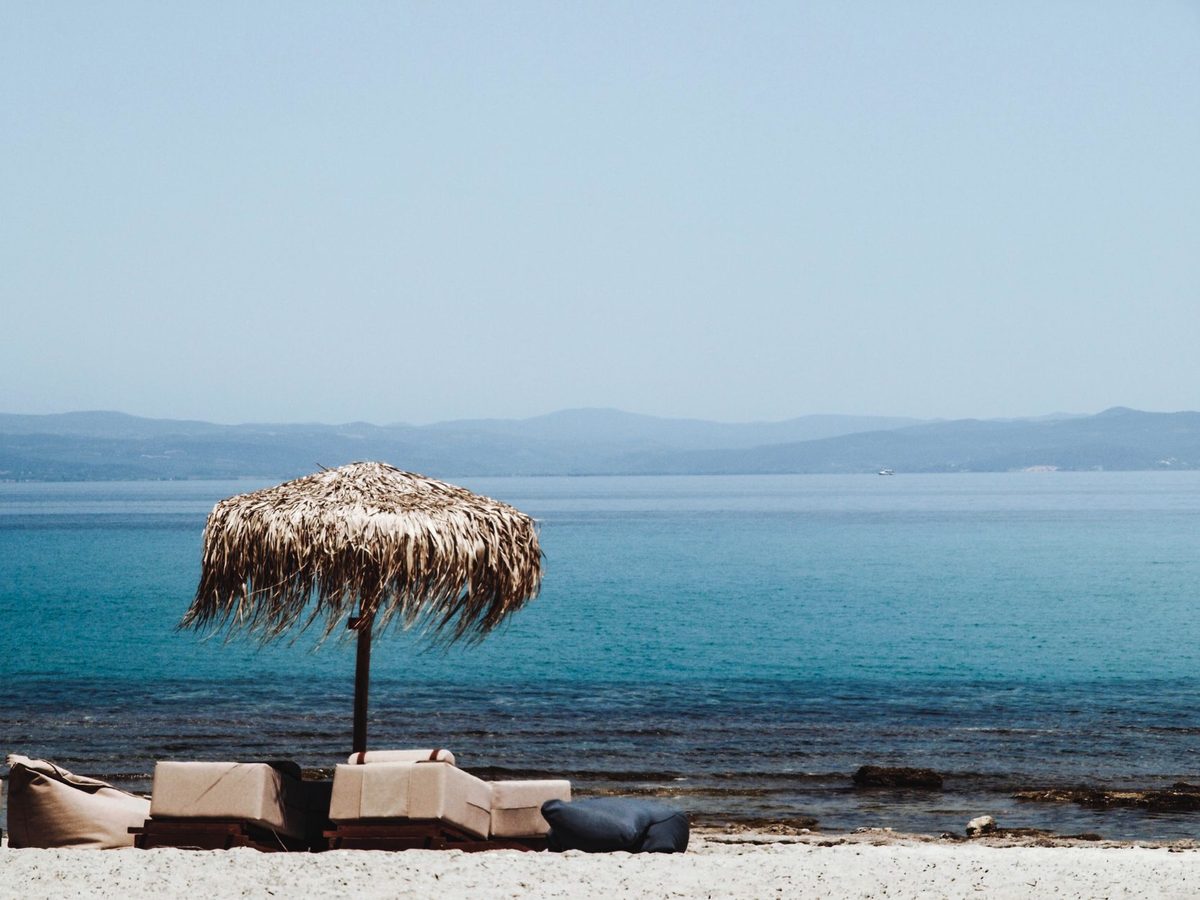
The sheltered gulfs warm the coast and keep it calm, so long, shallow, sandy entries are the default rather than the find. On Kassandra the resort beaches at Hanioti, Polychrono and their neighbours all shelve gently with organised sunbeds and tavernas behind; on Sithonia the same gentle pattern runs through Nikiti and round to Toroni and Sarti, with the view across to Mount Athos thrown in on the east side. The best beach for young children is Karydi at Vourvourou, powdery sand and water that takes an age to reach a toddler's waist, with the lagoon beyond it calmer still.
No beach here is dangerous. The smaller things: August weekends fill the popular beaches, the smaller coves mix sand with pebble patches that justify beach shoes, and rocky points hold sea urchins. The usual Greek rules apply: follow the flags where lifeguards operate, the law keeps most of every beach free of paid sunbeds, and the purple jellyfish turns up in some years rather than every summer, flagged at organised beaches when it does.
Weather, days out and the daily shop
When to go through the season, the boat day and outings that suit small children, eating out and where to stock up.
Weather, May to October
The figures below are long-term averages for the coast. Halkidiki sits at 40 degrees north, the same latitude as northern Spain, so the season starts later and ends earlier than on Rhodes or Crete; in between, the sheltered gulfs stay warm and it's a standard Greek beach summer.
| Month | Daytime high | Overnight low | Rain | Wet days | Sea temp |
|---|---|---|---|---|---|
| January | 10° | 2° | 24 mm | 4 | 15° |
| February | 12.5° | 3.5° | 28 mm | 7 | 15° |
| March | 15° | 5.5° | 43 mm | 8 | 15° |
| April | 20° | 8.5° | 35 mm | 6 | 15° |
| May | 25° | 13.5° | 37 mm | 8 | 18° |
| June | 30° | 18.5° | 31 mm | 7 | 23° |
| July | 32.5° | 21° | 24 mm | 6 | 26° |
| August | 32.5° | 21° | 21 mm | 5 | 27° |
| September | 28° | 17° | 22 mm | 5 | 25° |
| October | 21.5° | 12° | 25 mm | 4 | 22° |
| November | 17° | 8.5° | 32 mm | 6 | 19° |
| December | 12° | 4° | 28 mm | 5 | 17° |
Typical monthly averages from weather-station records. Sea temperature is the open-water figure, so a sheltered bay can feel a degree or two warmer.
June and September are the best months, and September has the edge: the sea is still warm, the Balkan school crowds have gone and the lagoon is calm again. May is green and pleasant with a sea that's still for paddling only. The October verdict is in the questions below. Through high summer the day splits the standard Greek way, beach early, shade and air conditioning in the middle, beach again from five.
Filling the daysThings to do with little ones
The Vourvourou boat day is the one most families build the week around. The hire boats run engines small enough that no licence is needed, a 15-minute briefing covers the controls, and the crossing to Diaporos island is sheltered, short and shallow. The lagoon between the islets sits over pale sand that turns the water a swimming-pool turquoise, much of it standing depth for an adult, so you can do what you like all day, anchor, paddle, picnic, nap aboard. Operators also run skippered and kayak versions for families who'd rather not drive the boat themselves.
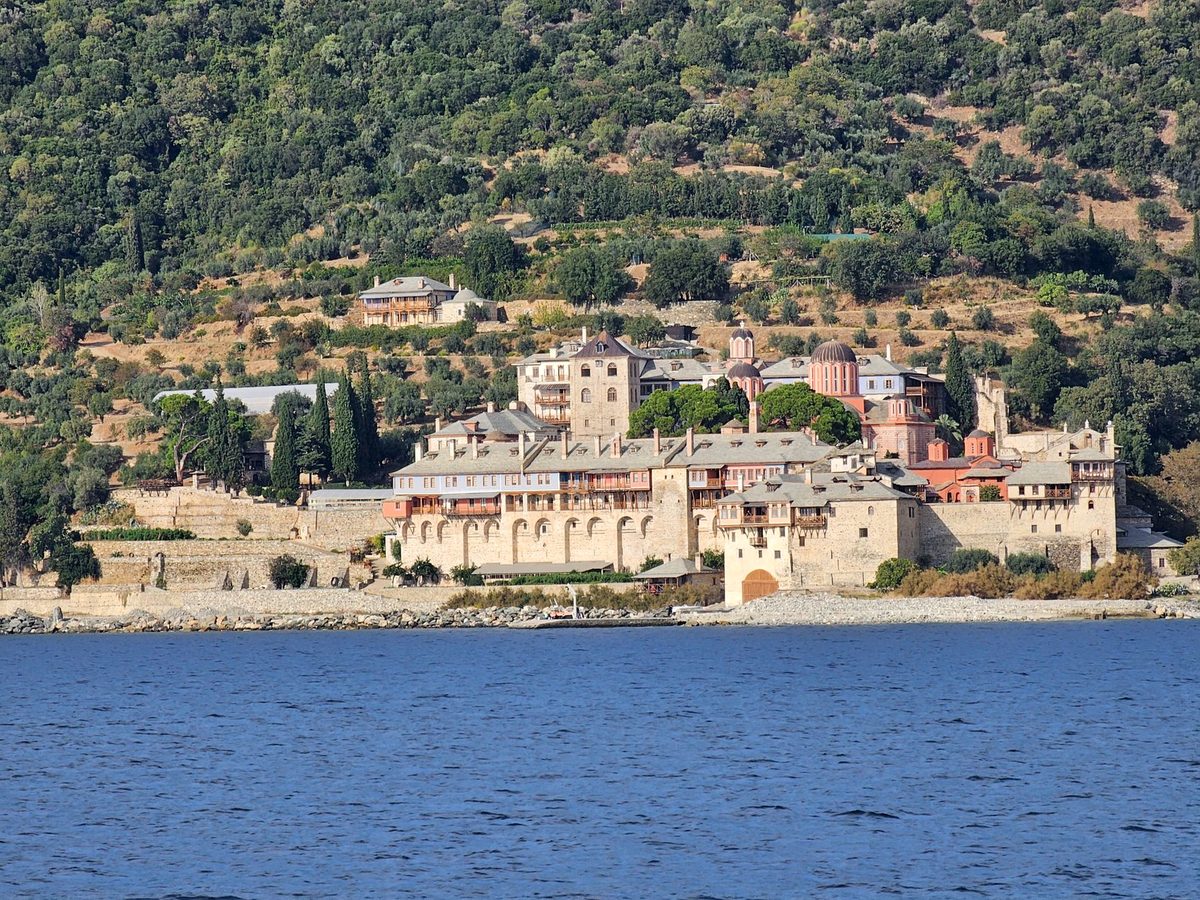
The Athos cruise is the standout outing. From the deck, fortress monasteries hang off the cliffs one after another below the 2,033-metre peak, and the short sightseeing cruise from Ouranoupoli suits small children far better than the full-day voyage from Sithonia's Ormos Panagias. Children under five sail free. Inland there are days out no island offers: Petralona Cave, where a famous prehistoric skull was found among cave-bear bones, runs cool guided tours reached by a little train and a carrier rather than a pram; Aristotle's park above Stagira scatters hands-on physics toys, whisper dishes, water turbines and telescopes aimed at Athos, across a hillside for small change; and Waterland, on the airport road, covers the hottest day with a pirate-ship toddler pool, free under three with swim nappies compulsory.
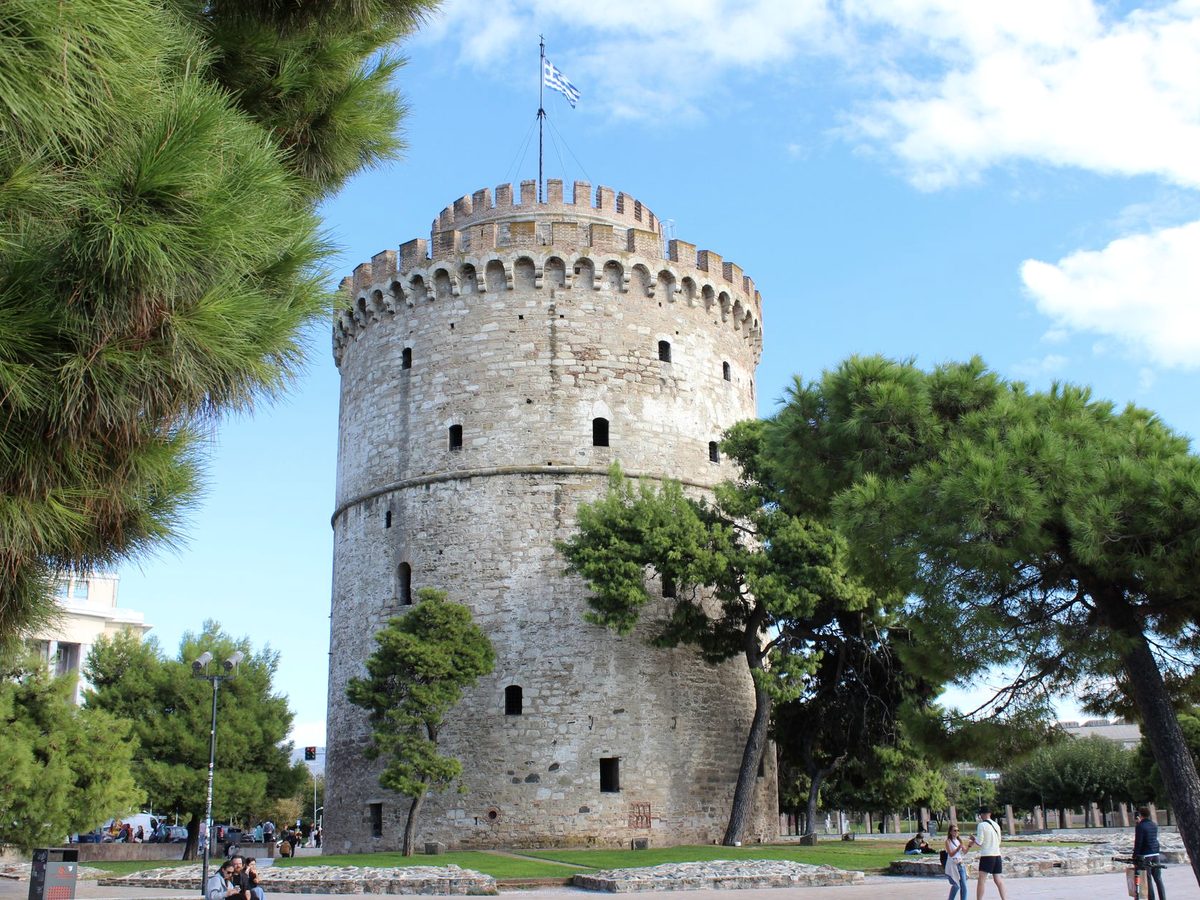
Thessaloniki rounds it out as a half-day from Kassandra: park once, walk the flat waterfront promenade past its run of playgrounds to the White Tower, add the half-hour pirate-boat ride from the quay and an ice cream, and leave before everyone wilts. The weekly village markets, Nea Moudania's Wednesday sprawl the biggest, do the holiday shopping with honey, olives and peaches by the kilo.
Eating out with children
The taverna culture is as child-tolerant as anywhere in Greece, and a UK bedtime falls at the local dinner hour rather than after it. High chairs come and go, so a clip-on travel seat is worth packing, and the reliable orders, souvlaki, chips, rice, yoghurt with honey, are everywhere. Resort kitchens in the family villages open early for the tourist trade.
The local produce is good: Halkidiki grows Greece's famous fat green olives and produces a serious share of its honey, the mussel farms on the gulf supply the saganaki pans, and whole bream comes off taverna charcoal in the fishing villages. The roadside fruit stalls in summer settle most toddler snack negotiations.
Milk, nappies and pharmaciesSupplies and the first-day shop
Supermarkets are plentiful: Masoutis, the northern chain, has branches across both legs from Hanioti to Nikiti, with AB Vassilopoulos and Lidl around Nea Moudania and the bigger towns, so a proper first-day shop never means a long drive. Nappies are Babylino, the main Greek brand, alongside Pampers; pack swim nappies from home.
Formula follows the Greek pattern: pharmacies rather than supermarkets, stage-1 tins from the pharmacist, Aptamil sold as Almiron and ready-made cartons scarce enough to bring from home. The green-cross pharmacy also stocks Depon, the children's paracetamol, and Nurofen for Kids, with the out-of-hours rota in the window. For bottles, buy low-mineral bottled water; tap quality varies enough by resort that bottled is the working default for everyone.
Getting around, a real week and the admin
Transfers and hire cars, what a week actually looks like, the health and document checks and a list to pack against.
Getting there and around
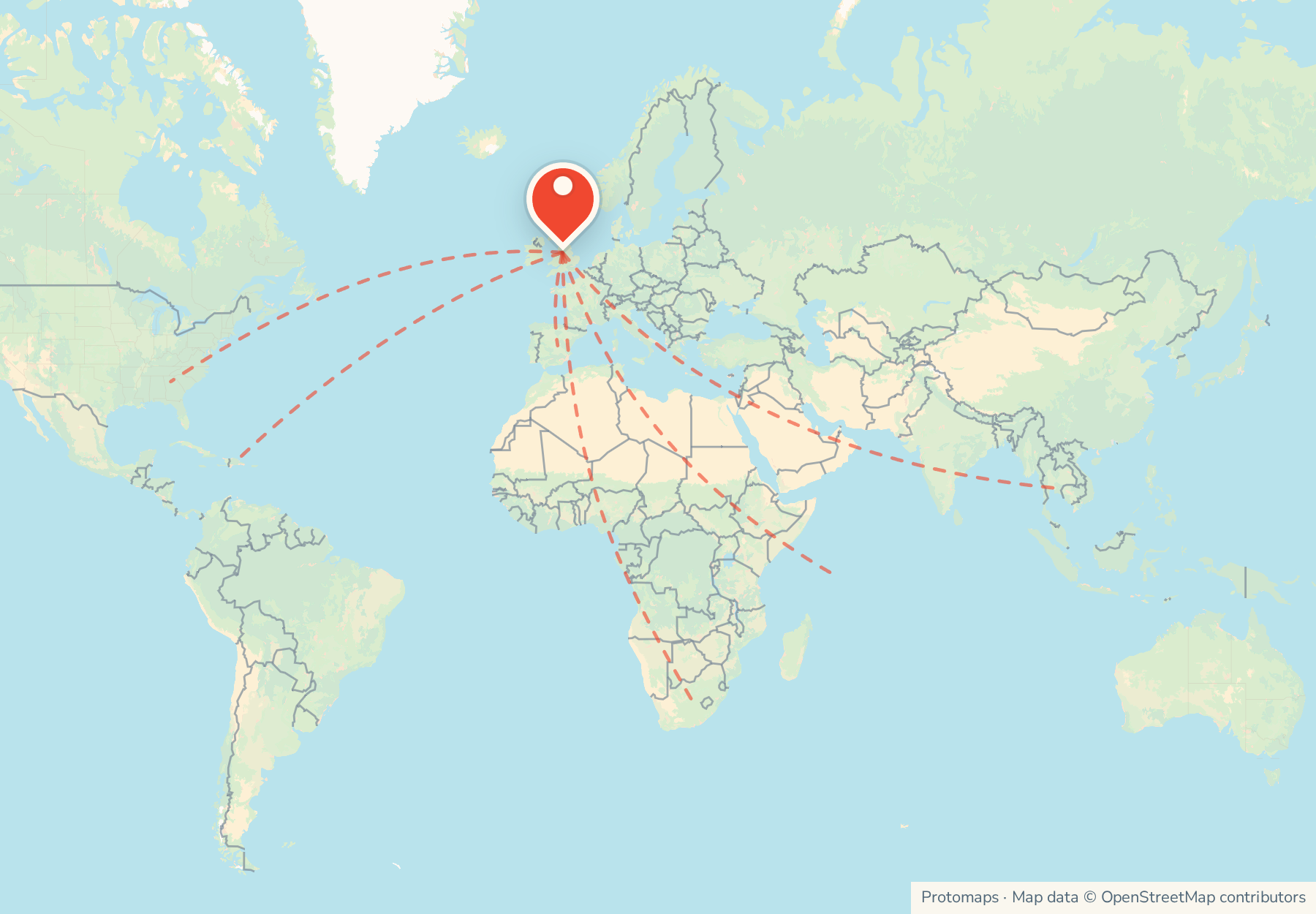
Thessaloniki's airport is the door, around three and a quarter hours from the UK with Jet2, easyJet, Ryanair and TUI in season, and the transfer deserves real budgeting: an hour to an hour and a half to Kassandra and up to two for Sithonia, on good roads via the Nea Moudania motorway. Pre-book the transfer with a child seat, since Greek law requires seats for under-12s or under-135-centimetre children in cars while exempting taxis, which is exactly why the taxi rank is the worse option with a baby.
On the ground, you'll use the car most days. KTEL buses connect the main towns a few times a day and serve commuters more than beach-hoppers, so plan to drive to the lagoon, the cruise, the cave and the city. There are fuel stops everywhere. Book the child seat with the car, and check the boot takes the buggy plus the beach kit.
What a real week looks likeA realistic week with little ones
The motorway south from Thessaloniki, a first swim in the gulf and dinner on the village promenade.
Shallow sand in the morning, lunch and a nap out of the heat, then back to the water until an early taverna dinner.
A no-licence boat from Vourvourou, the turquoise shallows off Diaporos, lunch back on shore and a flat-out afternoon nap.
The short Athos cruise past the monasteries, or the cave and the physics park in one inland loop.
A final morning swim, a honey and olive shop for the suitcase and the run back up the motorway.
With young children, the home beach, the pool, the lagoon boat day and one hinterland outing fill a Halkidiki week, with the city day banked for a second visit or a cooler spell.
The practical adminHealth, documents and the boring bits
Check the GOV.UK Greece advice before booking and travelling. Passports need to be issued within the last ten years and valid three months beyond departure, children's included. Carry a GHIC each plus travel insurance: the region's general hospital sits inland at Polygyros, health centres at Kassandria and Nea Moudania handle the everyday closer to the resorts, and for anything serious Thessaloniki's big hospitals are the backstop, with Papageorgiou on the ring road the quickest to reach from the Halkidiki road. The emergency numbers are 112 generally and 166 for an ambulance.
The hazard list is ordinary: strong summer UV managed by shade and cream, sea urchins on rocky points managed by beach shoes, the occasional jellyfish bloom year flagged at lifeguarded beaches and thunderstorms that pass through and clear. Supervision is the lifeguarding on the quieter coves.
Before you payBooking checklist
- Pick the leg first: Kassandra for walkable resort life, Sithonia for quiet and the lagoon.
- Book the hire car for the full stay with the child seat included.
- Budget the transfer properly; Sithonia can take two hours from the plane door.
- Reserve the Vourvourou boat for a June or September day if you can, and skip windy days.
- With young children, choose the short Ouranoupoli version of the Athos cruise over the full-day one.
- Pack a carrier for the cave and beach shoes for the pebblier coves.
- Bring a couple of days of formula and nappies, plus ready-made cartons for the whole trip if you use them.
- Booking October half term? Compare Rhodes or Kos first; this coast has gone quiet by then.
- Confirm the cot, the high chair situation and the cancellation terms with the accommodation.
- Recheck the GOV.UK Greece advice and every passport before you go.
Resort guides in Halkidiki
We've researched these places to stay in Halkidiki for families with young children. Each guide covers what it's like, who it suits and what to check before you book.
Questions, links and the last word
The things families ask most, the official pages worth a bookmark and when this guide was last refreshed.
Common parent questions
Which leg should we stay on?
Kassandra if you want everything walkable: resort villages like Hanioti put the beach, the tavernas and the mini-market within buggy range, and the transfer is shorter. Sithonia if you'd trade that for quiet: fewer resorts, emptier sand and the Vourvourou lagoon, at the cost of more driving. A first trip with a toddler usually lands on Kassandra; returners head for Sithonia.
What's the story with the third leg?
Athos is a closed monastic territory: no casual visitors, no women at all under a Greek law of 1953, and boats kept 500 metres offshore. For families that means a cruise, and the practical question is which one. The short sightseeing run from Ouranoupoli suits small children; the full-day voyage from Ormos Panagias runs seven to ten hours afloat, which is a lot at this age. Children under five sail free.
Can we really drive our own boat?
Yes. At Vourvourou the small boats run on engines below the licence threshold, so a 15-minute briefing replaces any paperwork, and the channel across to Diaporos island is sheltered and shallow. Anchor over the pale-sand lagoon and you have a calm, pool-shallow stretch, ankle to chest deep across much of it. A strong northeasterly is the one day to leave the boat and stay on the beach.
Is it right for October half term?
Not really. By late October the air is around 20 degrees and the sea has slipped to about 21, while Rhodes and Kos are still several degrees warmer in both. Halkidiki is a June-to-September destination with September the best month of all; for autumn warmth, book the south-eastern islands instead.
Do we need a hire car?
Yes. Distances are mainland-sized, the buses run a few times a day along the main corridor and not much else, and you'll want to drive most days. Greek law requires a proper seat for children under 12 or under 135 centimetres, taxis are exempt (so pre-book transfers with seats instead), and the roads to both legs are good.
Can we buy our usual formula and nappies?
Yes, with one wrinkle: formula is a pharmacy buy here, not a supermarket one, and ready-made cartons are scarce enough to bring if you rely on them. Nappies are easy in any supermarket. Pack a couple of days of both so the first morning isn't a shopping trip.
What do we do on a too-hot day?
This is where the mainland helps. Petralona Cave holds a steady 17 degrees whatever the sky is doing, and Waterland on the airport road swaps the beach for a pirate-ship toddler pool. The physics park up at Stagira and the shaded Thessaloniki waterfront are the other ways out of the midday heat.
Are there jellyfish?
Now and then. The purple stinger shows up some summers and not others, with 2021 a bad year on Kassandra and most seasons clear. Check the flags rather than plan around it; lifeguarded beaches post a warning when anything's about.
See more Halkidiki photos
Open the photo gallery →Useful links
- GOV.UK Greece travel advice: passport rules, entry requirements and health updates before you travel.
- Visit Greece: the official national tourism site.
- Waterland: the waterpark on the Thessaloniki road; check current tickets and season dates.
- Athos Sea Cruises: timetables for the Mount Athos coastal cruises.
Last updated 12 June 2026.