Sicily with little ones
Sicily is the Mediterranean's largest island, and for families it splits into two distinct holidays sharing a name. Fly to Catania and the week is Etna, Taormina, Syracuse and a waterpark with life-size dinosaurs; fly to Palermo and it's Cefalù's town beach, Mondello's white shallows and the soft pale sand of San Vito Lo Capo. The beaches are a bigger draw than Sicily's reputation suggests: soft, pale and shallow-shelving, many with a paediatrician-judged award. Around them sit a live volcano with lower slopes a toddler can walk, temples, puppet theatres and food small children eat happily, starting with iced granita and a warm brioche for breakfast.
On this page
A family verdict at a glance
The quick read before the detail: who Sicily suits, the season to aim for and what to nail down before you book.
Best for
Proper sandy beaches with shallow entries, a volcano and temples within pushchair reach, and food a small child eats with both hands: granita, arancini, half-portions of pasta on request.
Maybe not for
You if you want one compact resort with everything walkable, or you won't drive on holiday.
Best ages
Strong from babyhood at the beach bases; Etna, Etnaland and the puppet theatres are worth it from about two or three.
Best areas
Cefalù as the all-rounder, Giardini Naxos for the Taormina east, San Vito Lo Capo for the standout sand.
Why families pick it
A three-hour flight to white sand, warm October half terms and an island with plenty to do beyond the beach.
Check before you book
Which airport your half of the island needs, and whether your hotel sits inside a ZTL camera zone.
One island, two holidays
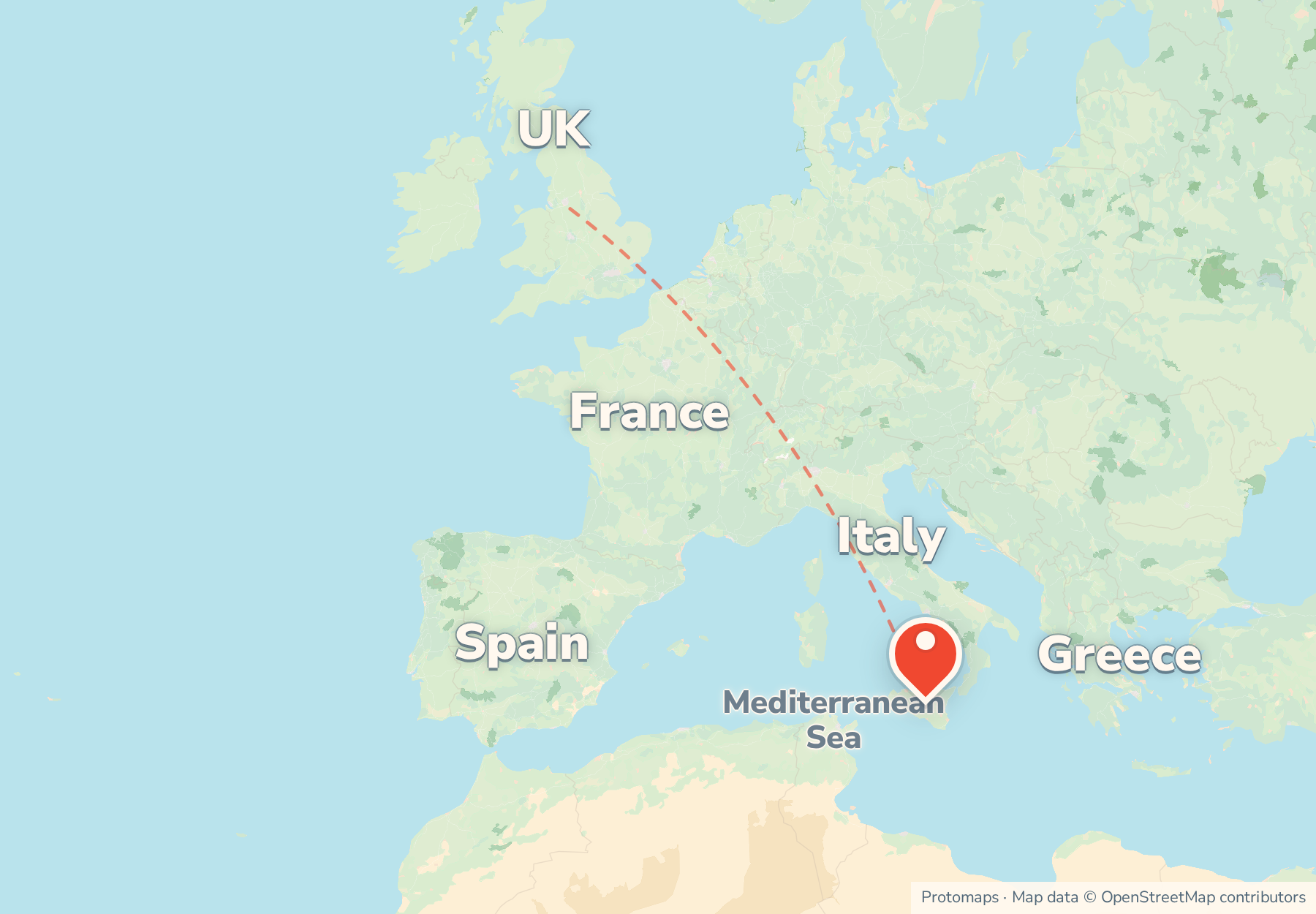
Sicily is a big island, and its two airports sit at opposite corners: Catania under Etna in the east, Palermo on the north-west coast, more than two hours apart by road. The east covers the volcano, Taormina and Syracuse; the west covers Cefalù, Mondello and San Vito Lo Capo. Choose your half before you look at hotels. One base and day trips covers that half comfortably in a week, while chasing both means a long transfer day, and that's hard going with young children.
Sicily's family beaches are soft pale sand with slow, shallow entries, not the shingle common on Greek islands. Italy grades them with the Bandiera Verde, a flag judged by paediatricians on shallow seabeds, sand quality and lifeguards, and Cefalù, Mondello, San Vito Lo Capo, Giardini Naxos and Marsala's Signorino all hold it. If you expected water shoes and pebble mats, you can leave both at home.
A quick gut checkIs Sicily right for your family?
Worth comparing if
You want real sandy beaches plus things to point the buggy at: a volcano, temples, theatres and a serious waterpark.
Weigh it up if
Holiday driving is a dealbreaker, or you need everything within a flat ten-minute walk of the room.
To sort out before booking
East or west, the hire car and its child seats, and the hotel's answer to the ZTL question.
The numbers, the basics and the ages
Everything you'd want to skim first: the quick facts, the everyday practicalities and how Sicily changes as children grow.
Quick facts for UK families
Money, plugs, language and the basics
- Sicily is an autonomous region of Italy, in the EU and Schengen, so the entry rules and the GHIC work as they do for Rome or Lake Garda.
- The currency is the euro. Cards are widely taken; small cash helps at markets, beach lidos and granita bars.
- Sockets are the European two-pin type, with Italy's own three-pin variant alongside; one set of adapters covers both.
- The language is Italian, with English comfortable in the tourist towns and patchier inland.
- The clocks run one hour ahead of the UK, so a 7pm UK bedtime lands at 8pm Sicilian time.
- Tap water passes the official tests in the main tourist areas, but local habit is firmly bottled; follow the locals, especially for formula.
- 112 is the all-services emergency number, 118 calls an ambulance directly and 116117 reaches the out-of-hours doctor service.
- Each comune charges its own small tourist tax per person per night, collected at the accommodation; the cities cap it after a few nights, several towns exempt young children and rates change yearly, so check your comune's current figures.
Sicily by age and stage
Babies
Short flight, gentle time difference and good pharmacy coverage to help; the driving distances and bottled-water habit are the admin to plan around.
Toddlers
Shallow sandy beaches that suit this stage exactly, lido infrastructure everywhere and arancini as the perfect hand-held lunch.
Preschoolers
Life-size dinosaurs at Etnaland, knights battling at the puppet theatre and a crater walk on a real volcano.
Young children
More of the island is in reach: the cable car up Etna, snorkelling coves, Greek theatres and temples that hold attention once stories stick.
Where to base yourselves
The bases on each half of the island, an orientation map and which sand suits small swimmers.
Where to stay with young children
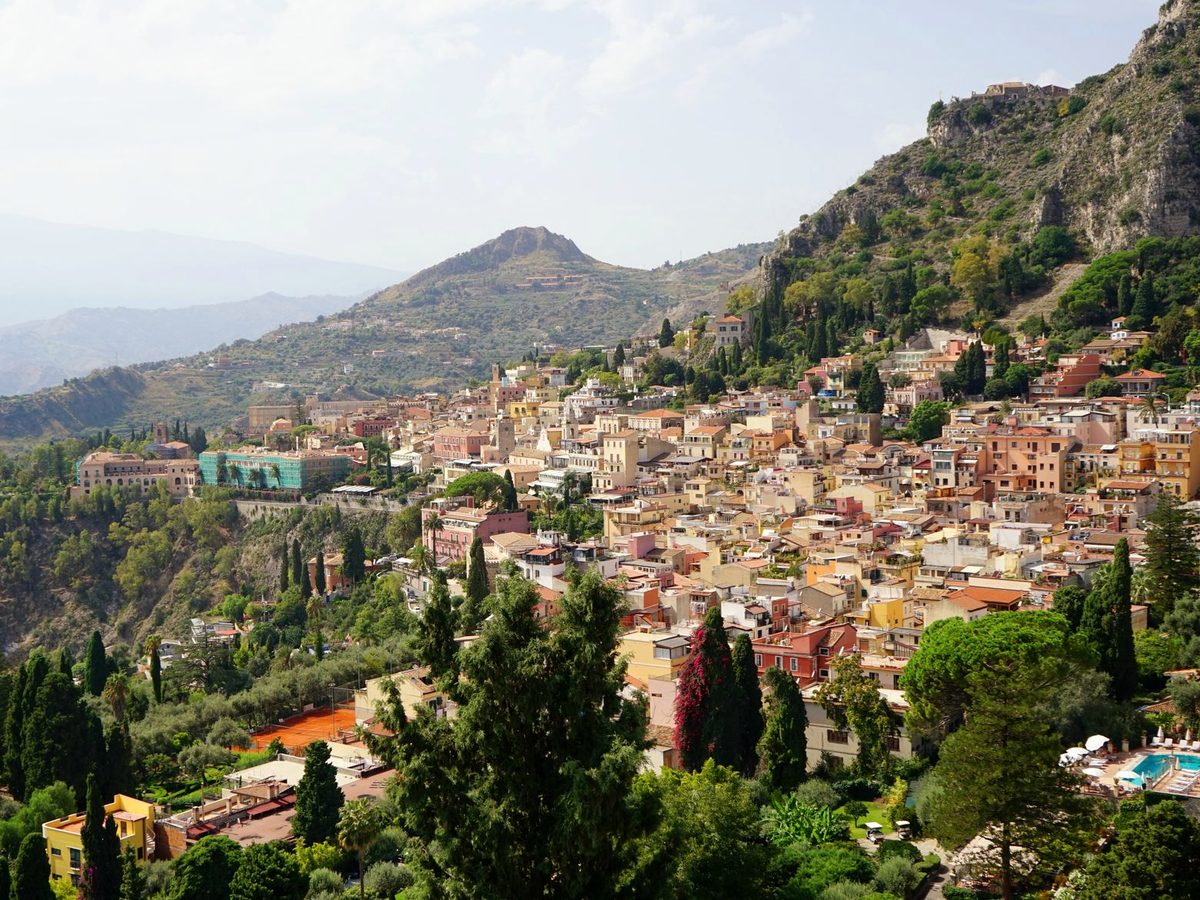
On the east, the Taormina coast is the classic. Giardini Naxos puts the family at beach level on a long organised bay, sandiest and shallowest at the Schisò end, with Taormina itself a cable car ride above for the evening stroll; Letojanni next door is quieter, sandy and a Blue Flag beach. An hour south, Syracuse suits families who want a town with their beach: Ortigia's flat baroque lanes for the slow evenings and Fontane Bianche's white shallows fifteen minutes away for the days. Both bases keep Etna and Etnaland inside day-trip range.
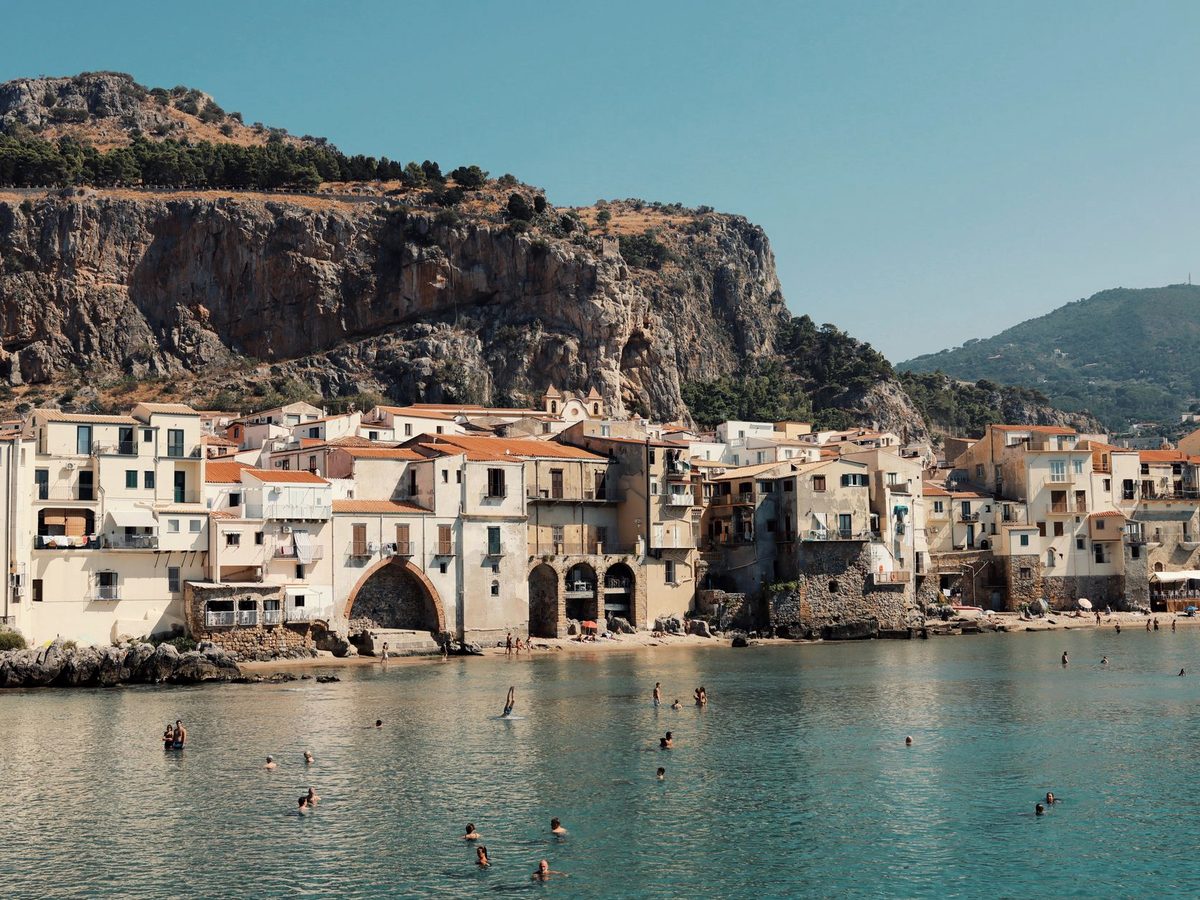
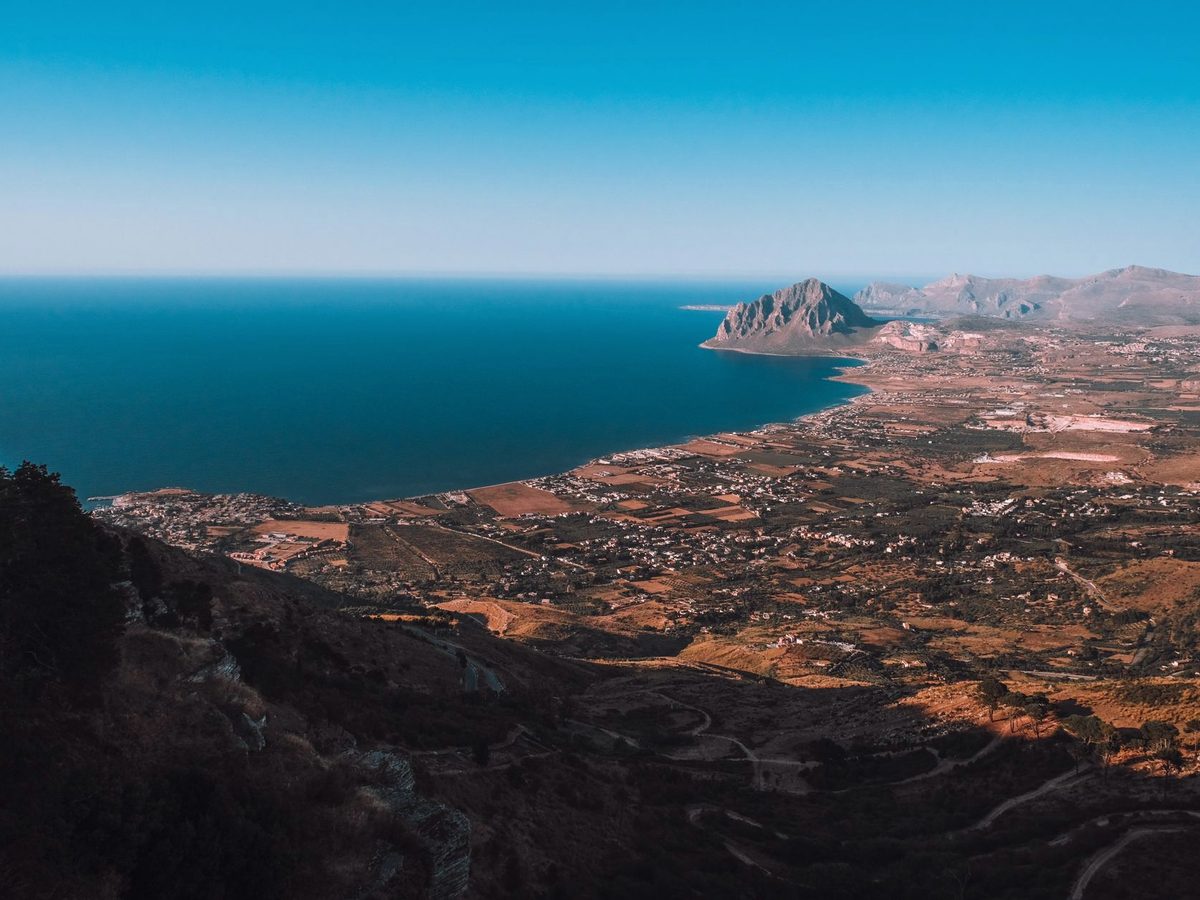
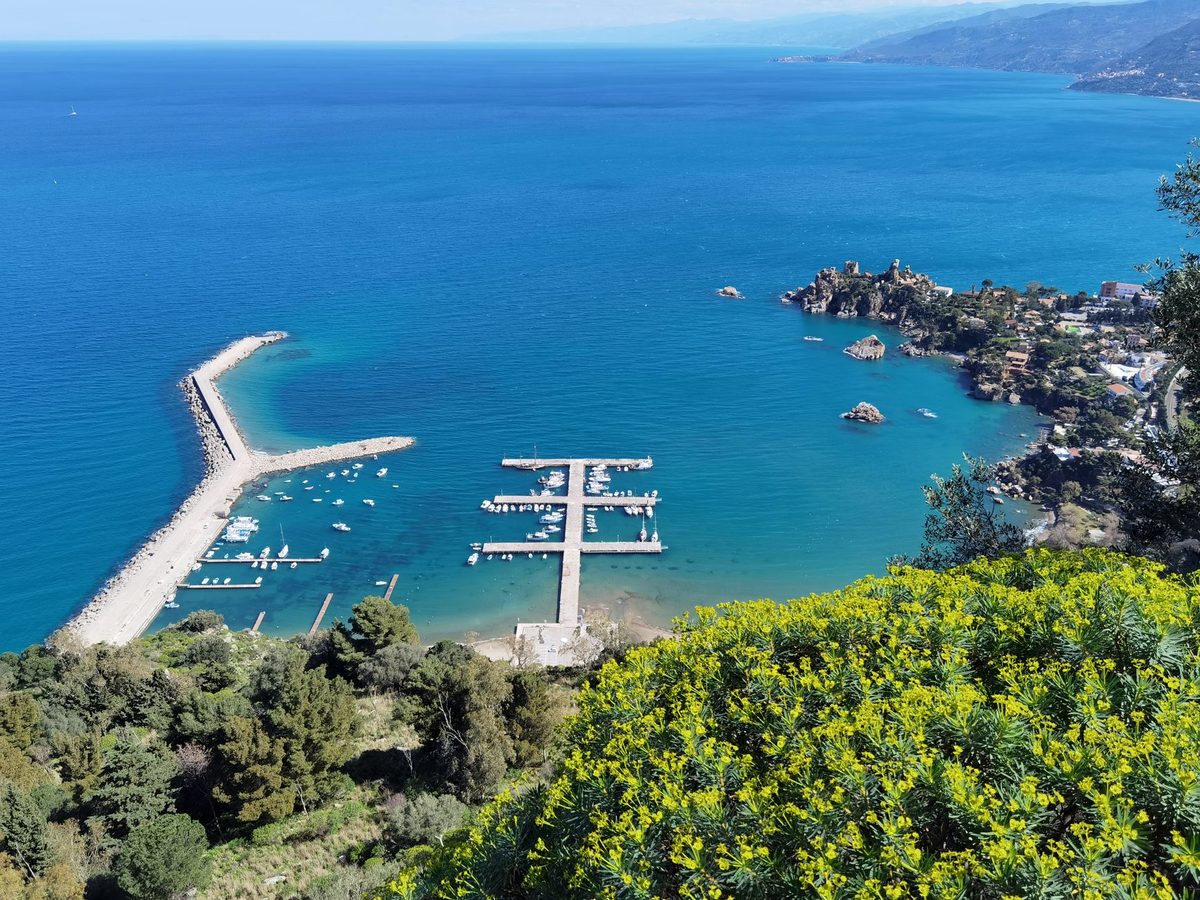
On the west, Cefalù is the strongest single base on the island and the one that works without a car: a fine sandy crescent with lifeguards, a proper medieval town directly behind it and a frequent 40 to 50 minute train into Palermo. Mondello does the same white-sand job for families staying around Palermo, at its best outside August. The far north-west has the best sand but the longest drive: San Vito Lo Capo is a 1h15 to 1h30 drive from the airport with a full resort town behind the beach, while Castellammare del Golfo nearby is a cheaper, more local harbour town along the same road.
The east has more days out within reach; the west has the better beaches and easier pace. Whichever side wins, two booking habits matter here more than star ratings: confirm how the named hotel's stretch of beach actually enters the water, and ask whether the building sits inside a ZTL camera zone and where arriving cars should go, before the deposit leaves your account.
| Area | Transfer | The swimming | The feel |
|---|---|---|---|
| Giardini Naxos and Letojanni | 45 to 60 min from Catania | Golden sand and a gentle slope at the Schisò end and at Letojanni; pebbles creep in elsewhere | The Taormina pairing: organised beach below, the hilltop town reached by cable car above. |
| Syracuse and Fontane Bianche | 50 to 55 min from Catania | White sand at Fontane Bianche that stays shallow a long way out; Arenella gentler and quieter still | Baroque Ortigia for the evening stroll, the east's best toddler sand fifteen minutes south. |
| Cefalù | 1h to 1h15 from Palermo | A crescent of fine pale sand with a gradual entry and lifeguards in season | A medieval town with its beach attached, walkable and easy with small children. |
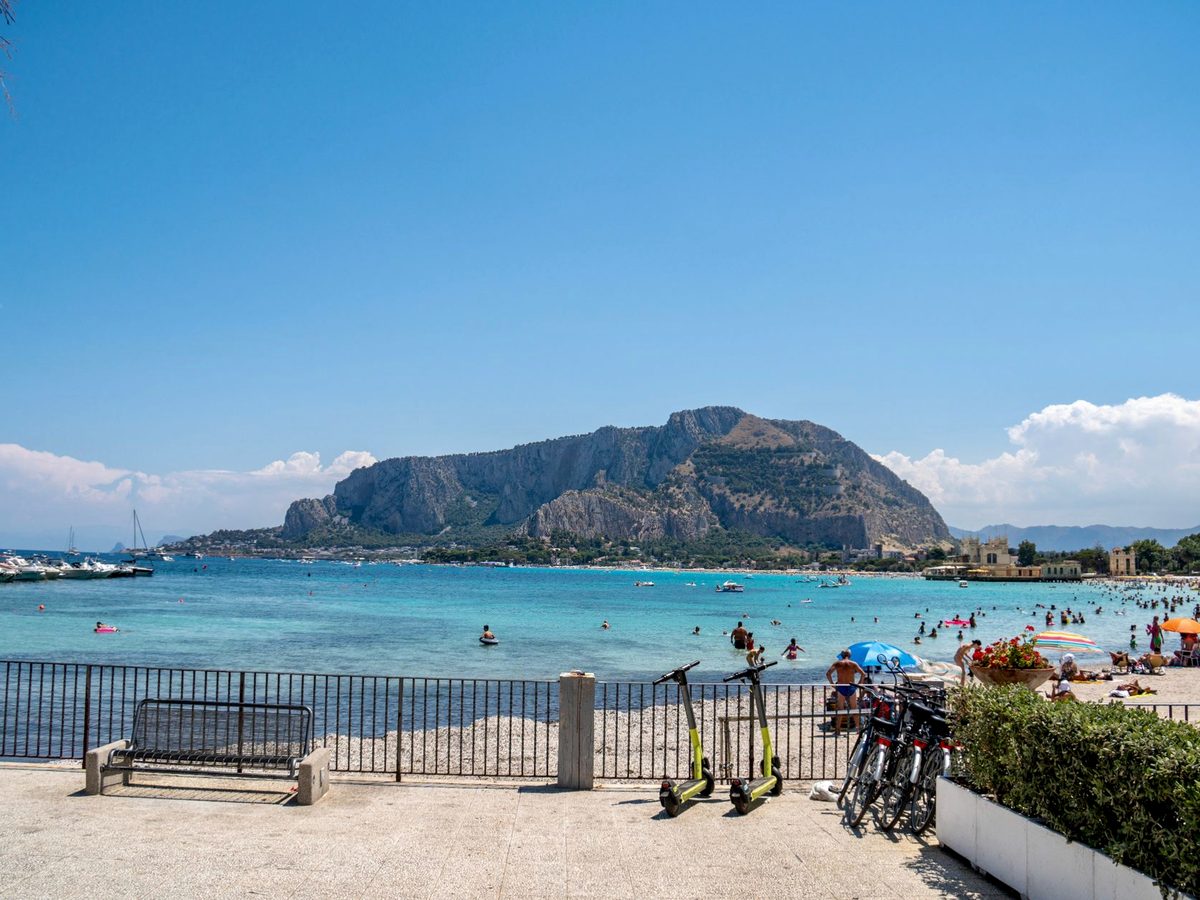
| Mondello | Much like Palermo's 30 to 40 min | Noticeably white sand, ankle-deep for a long first stretch, calm in its sheltered bay | Palermo's local beach: packed in August, easy and bright in June or September. |
| San Vito Lo Capo | 1h15 to 1h30 from Palermo | Powder-white sand and flat turquoise shallows under Monte Monaco | The island's far corner; a full resort town and a hire car part of the deal. |
| Castellammare del Golfo | On San Vito's road, short of its 1h15 | A sandy town beach with ramped access and a steady, no-surprises entry | A working harbour town between Palermo and San Vito, a practical base rather than a destination. |
Map of the main family areas
An orientation map of the areas above, both airports and the big days out. The numbers match the key beneath.
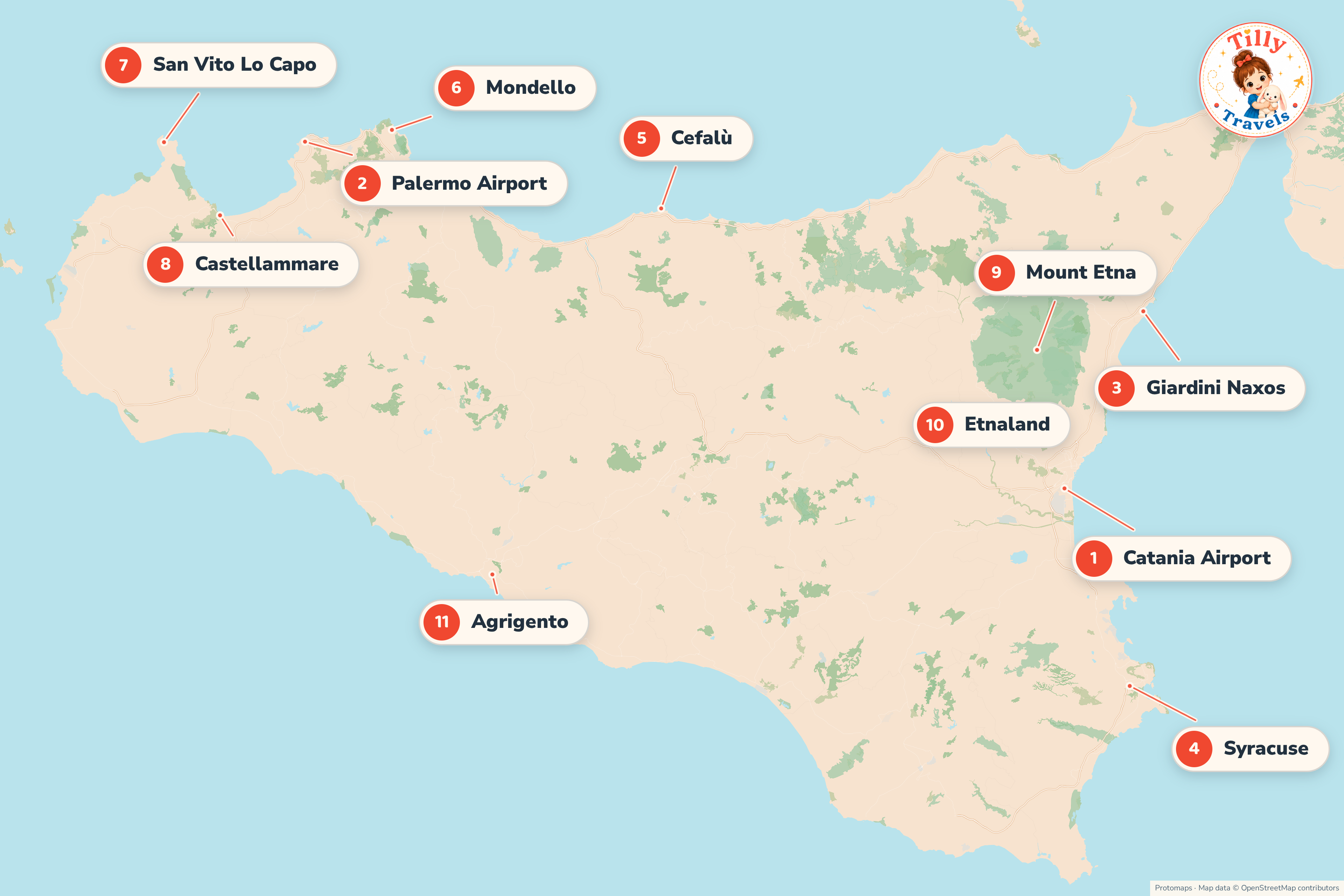
- 1Catania Airport Gateway to the east
- 2Palermo Airport Gateway to the west
- 3Giardini Naxos The Taormina base
- 4Syracuse Ortigia and Fontane Bianche
- 5Cefalù Beach, town and train, no car needed
- 6Mondello Palermo's beach
- 7San Vito Lo Capo Far north-west, full resort town
- 8Castellammare The local harbour town
- 9Mount Etna Crater walks at 1,900m
- 10Etnaland Waterpark and dinosaurs
- 11Agrigento Valley of the Temples
The beaches, sorted for small swimmers
The toddler shortlist starts at San Vito Lo Capo, where powder-white sand runs into water so flat and shallow that small children wade a long way out, sheltered from wind by the mountain behind. Mondello near Palermo is the other standout for tiny children: its sheltered bay stays ankle-deep for the first 50 metres or so. Fontane Bianche near Syracuse is the east's best, white sand shelving slowly with lidos behind it, Cefalù pairs fine pale sand with a gradual entry, and Giardini Naxos at the Schisò end and Letojanni cover the Taormina coast. Around Catania the sand turns volcanic black at La Playa, soft and novel but hot underfoot at midday; its lidos have more playgrounds than anywhere else on the island, which offsets the port view.
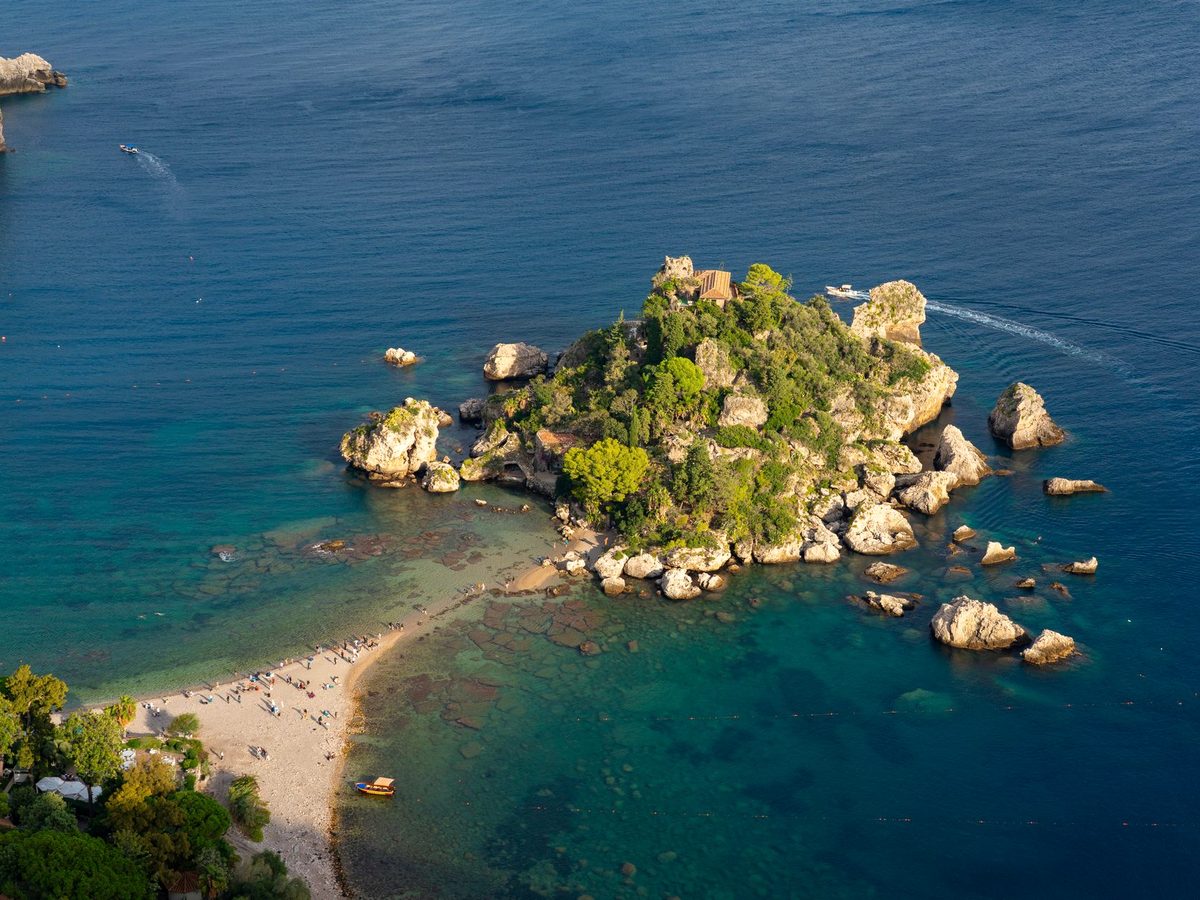
Two beaches need a warning. Isola Bella, the small islet below Taormina, is pebble underfoot and in the water; ride the cable car down for the view and a photo, then swim elsewhere. Calamosche in the Vendicari reserve is a sheltered natural cove, but reaching it is a shadeless 20-minute walk from the car park with no facilities, so it suits carrier-age babies or confident walkers only. If that rules it out, the same reserve's Tonnara di Vendicari main beach sits much closer to its own car park and holds a Green Flag. Lidos rent sunbeds and umbrellas almost everywhere else, free stretches sit alongside, and lifeguards work the certified beaches in season.
Weather, days out and the daily shop
When to go through the season, Etna and the days out that suit small children, eating out and where to stock up.
Weather across the season
The figures below are for Catania on the east coast; Palermo runs a degree or two gentler by day, slightly warmer at night and a little less wet in October. Sicily has the warmest sea of Italy's islands and a longer season than the mainland by weeks at both ends.
| Month | Daytime high | Overnight low | Rain | Wet days | Sea temp |
|---|---|---|---|---|---|
| January | 15° | 10° | 98 mm | 10 | 15° |
| February | 15° | 9.5° | 110 mm | 10 | 15° |
| March | 16.5° | 11° | 78 mm | 9 | 15° |
| April | 19° | 13° | 65 mm | 9 | 16° |
| May | 21.5° | 16° | 36 mm | 4 | 19° |
| June | 26° | 20° | 18 mm | 2 | 23° |
| July | 29° | 23° | 7 mm | 1 | 27° |
| August | 29.5° | 23.5° | 32 mm | 2 | 28° |
| September | 27° | 21.5° | 65 mm | 5 | 26° |
| October | 24° | 18° | 106 mm | 8 | 23° |
| November | 20° | 15° | 118 mm | 10 | 20° |
| December | 16.5° | 11.5° | 124 mm | 12 | 17° |
Typical monthly averages from weather-station records. Sea temperature is the open-water figure, so a sheltered bay can feel a degree or two warmer.
The best months are June and September: full warmth, a swimmable sea and space on the sand. July and August deliver the warmest water in exchange for serious heat management, and the inland sights are too hot for toddlers at midday; visit Agrigento in the evening opening or in another month entirely. The wildcard all season is the scirocco, a Saharan wind that can spike temperatures into the forties for a day or two; weather apps flag it ahead, and the answer is a pool-and-air-conditioning day, since the sea stays usable. October showers tend to pass rather than settle.
Filling the daysThings to do with little ones
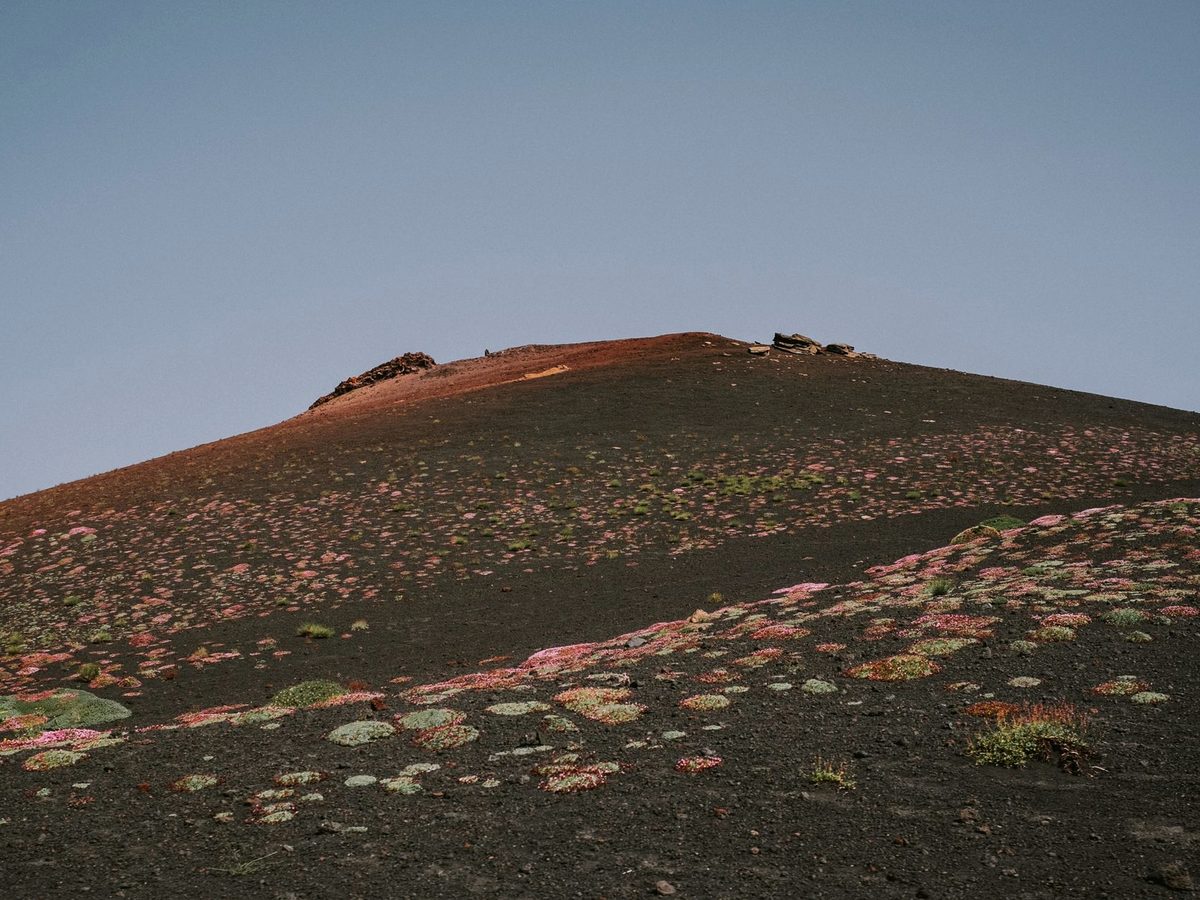
Etna is the main draw, and the lower slopes suit families better than the summit. From the Rifugio Sapienza car park at 1,900 metres, the Silvestri craters offer a toddler-paced walk around two extinct cones on flattish volcanic paths, free of charge, with lava crunching underfoot, which small children enjoy; the cable car to 2,500 metres suits children happy in a carrier through wind and sudden cold. Down on the plain, Etnaland near Belpasso, 30 to 40 minutes from the Catania airport area, is the island's big structured day out: a full waterpark with a dedicated children's water-play area, gentler slides from 90 centimetres, free entry under 90, and a Dinopark of life-size models that two-to-five-year-olds treat as the highlight.
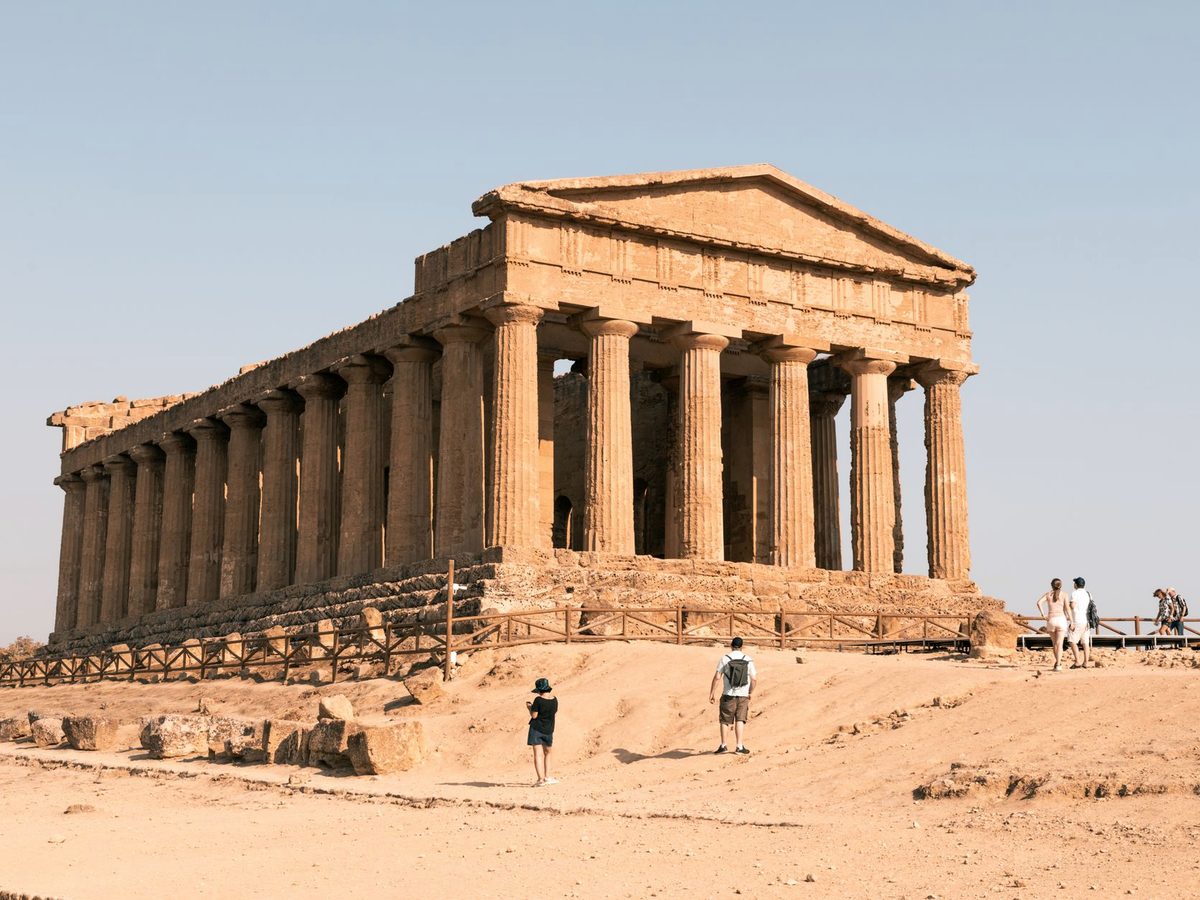
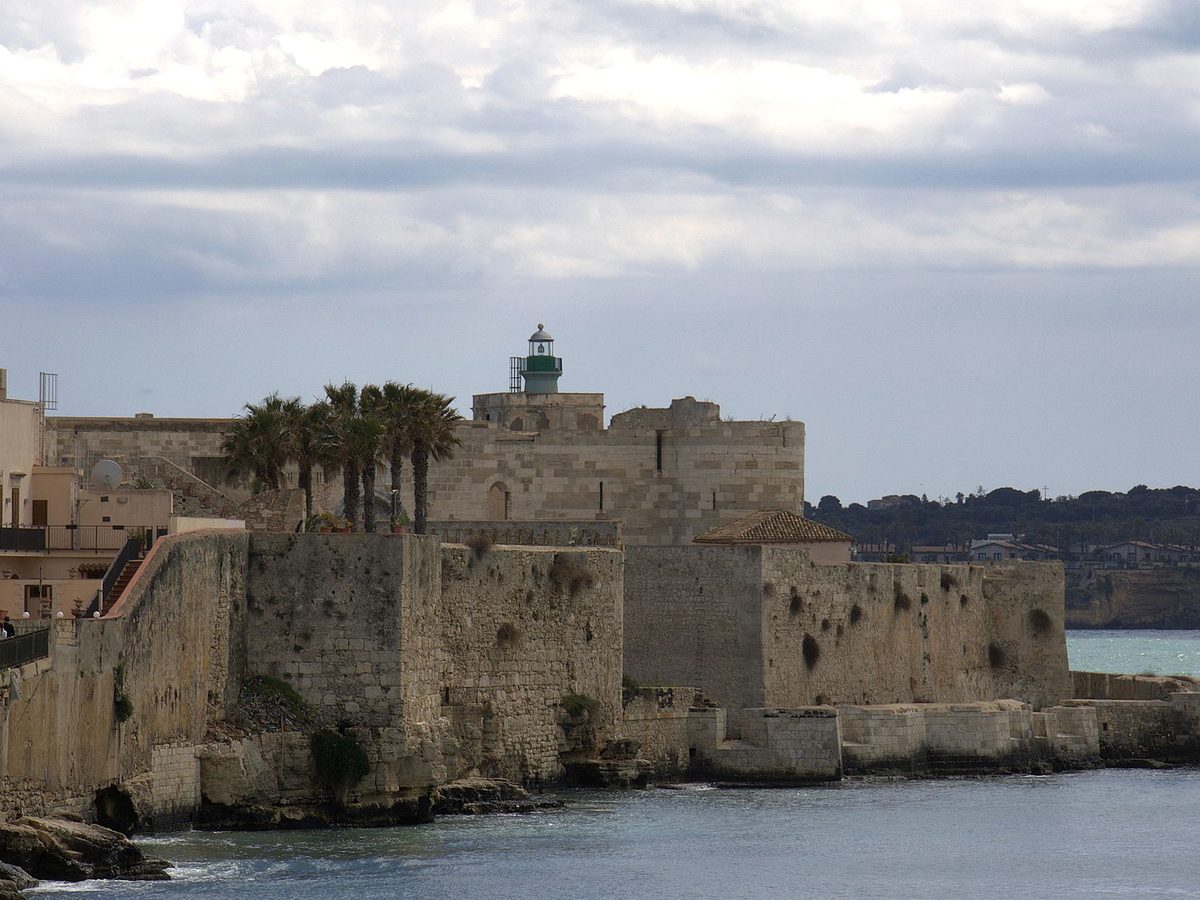
The towns are worth an afternoon. Taormina's Greek theatre frames Etna through its broken stage wall and is worth about 20 minutes with a small child, with the cable car ride down to the coast a draw in itself; Ortigia in Syracuse is flat, compact and made for a slow evening, and its puppet theatre stages the Opera dei Pupi, a UNESCO-listed tradition of armoured marionettes in theatrical battle that delights from about age three. Agrigento's Valley of the Temples is the cultural heavyweight, best taken in shoulder season or on a summer evening opening, when floodlit temples and cooler air turn it into a family outing rather than an endurance test.
Aci Trezza's sea stacks and gelato-front make an easy half-day from the east coast with a seafood lunch attached; over west, the Marsala salt pans put windmills, salt mountains and, in spring and autumn, flamingos in front of the buggy, with the Stagnone lagoon's calf-deep water alongside as a giant natural paddling pool. Cefalù's Norman cathedral is worth 20 minutes of any beach day, gold mosaics and all.
Eating out with children
Breakfast is granita and brioche. A glass of finely shaved almond, lemon or strawberry ice with a warm domed brioche beside it is the standard summer breakfast, children included, and the ones that make their own are worth seeking out. Arancini are the midday staple, fried rice balls the size of an orange, round in Palermo and Etna-coned in Catania, with the ham-and-béchamel version the safe bet for small children; rosticcerie and market stalls sell them from mid-afternoon, which neatly solves the early-hungry toddler problem. Cannoli for pudding.
Southern kitchens open late, often not before 7.30 or 8pm, with locals arriving later still. Tourist-town restaurants in Taormina, Cefalù and Giardini Naxos often open earlier for northern Europeans, so ask; otherwise street food bridges the gap and a 7.30 sitting makes you the first, warmly welcomed table. Trattorie treat children as family, mezza porzione (half portion) is a standard request for any pasta, and pasta alla Norma, Catania's aubergine-and-ricotta dish, goes down better with toddlers than its menu description suggests. High chairs exist in tourist areas without being guaranteed; a clip-on seat travels well here.
Milk, nappies and pharmaciesSupplies and the first-day shop
Supermarkets sit on the outskirts: Conad, Lidl, Carrefour and the discounters cluster in retail parks outside the historic towns, so fold the big shop into day one while the car is already moving, with Conad's hypermarket near Catania airport the natural east-coast first stop. Small alimentari handle top-ups in the old centres at a markup. Mind the rhythms: most shops close for a long lunch and Sunday afternoons go quiet.
Formula is pharmacy territory for the first-stage milks, with Mellin the Italian market leader, Aptamil itself on the shelves and Plasmon dominant in the weaning aisle; pack 48 hours of supply and find the farmacia, marked by its green cross, on the first day. Tachipirina is the Calpol equivalent, sold over the counter as syrup with a dosing syringe, and the farmacia di turno notice on any closed door points to the duty pharmacy out of hours. For bottle-making, buy a low-mineral bottled water and check the sodium line on the label; under 20 milligrams a litre is the rule of thumb.
Getting around, a real week and the admin
Transfers and hire cars, what a week actually looks like, the health and document checks and a list to pack against.
Getting there and around
The flight runs around three hours to either airport, with easyJet, Jet2, Ryanair and BA covering a wide spread of UK departures and Jet2 the dominant package operator. From Catania, the Taormina coast is 45 to 60 minutes and Syracuse under the hour; from Palermo, the city is 30 to 40 minutes, Cefalù about an hour and San Vito up to 1h30. Pre-booked transfers work for single-base weeks, but most families collect a car at the airport, and the right car is the smallest one that fits: hilltop towns predate motoring, parking is tight and a big car is more trouble than it's worth at the first medieval gateway.
The driving itself is easier than its reputation, with motorway and rural miles straightforward and almost all of them toll-free; the adjustment is local style, assertive overtaking and drivers who rarely indicate, which most UK drivers absorb within a couple of days. The traps are administrative. ZTL camera zones guard every historic centre, Catania's around the clock, so plan parking in advance: Lumbi with its free shuttle for Taormina, the Marina and Talete car parks for Ortigia, park-and-taxi for Palermo. Book child seats with the car, and note Italian law requires an anti-abandonment alarm for under-fours, which hire companies increasingly supply if asked when booking. The one base that opts out of all this is Cefalù, where the train does Palermo in 40 to 50 minutes, 18-plus times a day, for a few euros.
What a real week looks likeA realistic week with little ones
Land, pick up the smallest car that fits the family and do the big shop at an out-of-town supermarket on the way to the base.
Granita and brioche for breakfast, sand through the morning, a long shaded lunch and nap, then back to the water until early evening.
Up to the cable car base at 1,900 metres with layers packed, the toddler-paced walk around the Silvestri craters, lunch at the rifugio and an afternoon nap in the car down.
A cable car up to Taormina or a wander through Ortigia as the heat fades, a puppet show if one's on and dinner at a kitchen that opens early.
A slow morning swim and an unhurried run to the airport, with slack in the plan in case ash disruption affects flights.
One half of the island, one Etna or Etnaland day, one town evening and a run of unhurried beach mornings fill a Sicilian week with young children, and without a single long drive.
The practical adminHealth, documents and the boring bits
Italy plays by familiar rules: the GHIC covers state healthcare for every family member alongside proper travel insurance, 112 is the emergency number, 118 the direct ambulance line and 116117 the out-of-hours doctor. Hospital cover at the bases is good: Taormina has a full 24-hour A&E with intensive care at the Ospedale San Vincenzo, Catania's Garibaldi Nesima runs a dedicated paediatric emergency unit and Palermo's children's hospital sits in the Civico complex. Pharmacies cover everyday needs, and travel insurance should name volcanic-ash disruption, the one Sicilian extra: Catania airport closed four times in the 18 months to December 2025 when ash reached the runway, usually reopening within hours, with Palermo as the standard diversion. Keep the last day loose rather than booking tight onward connections.
Day to day, plan around the sun: July UV reaches 11, so the hat-cream-shade routine is non-negotiable and the beach works best in mornings and late afternoons in high summer. Jellyfish drift through in patches in late summer, worth a daily word with the lifeguard, and the meduseo.com citizen-science map tracks Italian sightings. Passports follow the standard Schengen sums: issued within ten years, three months left after the return date.
Before you payBooking checklist
- Pick east or west first; each airport puts a different week in reach.
- Book the smallest hire car the family fits, with child seats and the under-four anti-abandonment device requested.
- Add independent excess insurance for the car; scratches are common.
- Ask the hotel whether it sits inside a ZTL zone and where arriving cars should actually go.
- Confirm how your hotel's beach enters the water; sand quality varies sharply within single bays.
- Check the travel insurance names volcanic-ash disruption, and leave slack around the flight home.
- Pack layers for Etna whatever the month, and a carrier rather than the buggy for anything above the cable car base.
- Take 48 hours of formula and locate the farmacia and an out-of-town supermarket on day one.
- Choose June or September if the dates flex; plan mornings-and-evenings if they don't.
- Recheck GOV.UK Italy for entry rules and every passport's Schengen dates before you fly.
Resort guides in Sicily
We've researched these places to stay in Sicily for families with young children. Each guide covers what it's like, who it suits and what to check before you book.
Questions, links and the last word
The things families ask most, the official pages worth a bookmark and when this guide was last refreshed.
Common parent questions
Should we fly to Catania or Palermo?
If Etna and Taormina top your list, fly Catania; if the best beaches do, fly Palermo. The two airports sit more than two hours apart, so a week with young children works around one of them, not both. Pick the half your shortlist points to and save the other side for another year.
Can we take a toddler up Etna?
Up, yes; to the top, no. Aim for the Silvestri craters beside the Rifugio Sapienza car park: free to wander, manageable on a small child's own legs and impressive enough that nobody misses the summit. Treat everything above as carrier territory for children who'll tolerate wind, scree and sudden cold, and leave the buggy in the car. Whatever the coast is doing, the mountain runs 10 to 15 degrees colder, so warm layers ride along even in August, and a glance at the INGV activity bulletins before the drive up saves a wasted morning.
What happens if the volcano disrupts our flight?
Occasionally it does: ash on the runway closed Catania airport four times in the 18 months to December 2025, usually for hours, once for sixteen. When it happens, flights divert to Palermo and airlines must reroute you and cover meals and accommodation under EU261, though ash counts as extraordinary, so no cash compensation. The preparation costs nothing: pick travel insurance that names volcanic disruption, avoid tight same-day connections on the way home and check the airport status page if Etna is lively in the days before you fly.
Do we really need a hire car?
It comes down to one choice: Cefalù, or anywhere else. Cefalù is the single base you can do car-free, with its beach and town on foot and a frequent train into Palermo. Pick any other base and the beaches, Etna and the reserves sit beyond useful public transport, so you hire from day one. There is no useful middle option, no part-week car that saves much, so decide car or no car when you decide where to stay.
What's the deal with the ZTL fines?
Italian historic centres run camera-enforced limited traffic zones, and Sicily's tourist towns all have them. Drive past a camera and the fine reaches you by post months later, plus the hire company's admin fee. To avoid it, ask your hotel before arrival whether it sits inside a zone and can register your plate, and otherwise leave the car in a named car park outside, like Taormina's Lumbi with its free shuttle.
How does October compare with Rhodes?
For guaranteed swimming, Rhodes has the edge: a warmer sea and fewer rain days late in the month. Sicily has more to do when showers pass through, with Etna, the temples and the puppet theatres alongside the beach, and its October air is among the warmest of any European destination at around 25 degrees. Pick Rhodes if the holiday is mainly the sea, Sicily if you want days out to fall back on. Some seasonal hotels begin closing late in October, so confirm yours before booking.
Can we make up bottles with tap water?
Treat it as a bottled-water island for anything a baby drinks. The tap supply in the main tourist areas passes the official tests, yet locals drink bottled almost universally, partly because rooftop tanks and Etna minerals affect the taste, and holiday rentals often run on the same tanks. Bottled water is cheap and everywhere, so choose a low-mineral brand with sodium under 20 milligrams a litre for formula and ask your accommodation about their supply. Cooking, washing and teeth are fine from the tap.
Where's the best sand for a two-year-old?
San Vito Lo Capo has the finest, but it needs a car and a base in the far north-west. If you would rather not drive far, Cefalù pairs good sand with a walkable town, and Mondello near Palermo stays ankle-deep a long way out. On the east, Fontane Bianche near Syracuse is the one to head for. Whichever you choose, look for the Bandiera Verde flag, the Italian paediatricians' award for shallow seabeds, good sand and lifeguards.
See more Sicily photos
Open the photo gallery →Useful links
- GOV.UK Italy travel advice: entry requirements and health notes before you travel.
- Visit Sicily: the official tourism site for beaches, towns and events.
- Catania airport: live status, worth a glance if Etna is active in the days before flying.
- Etnaland: current prices, opening dates and height rules for the big day out.
Last updated 12 June 2026.