Madeira with little ones
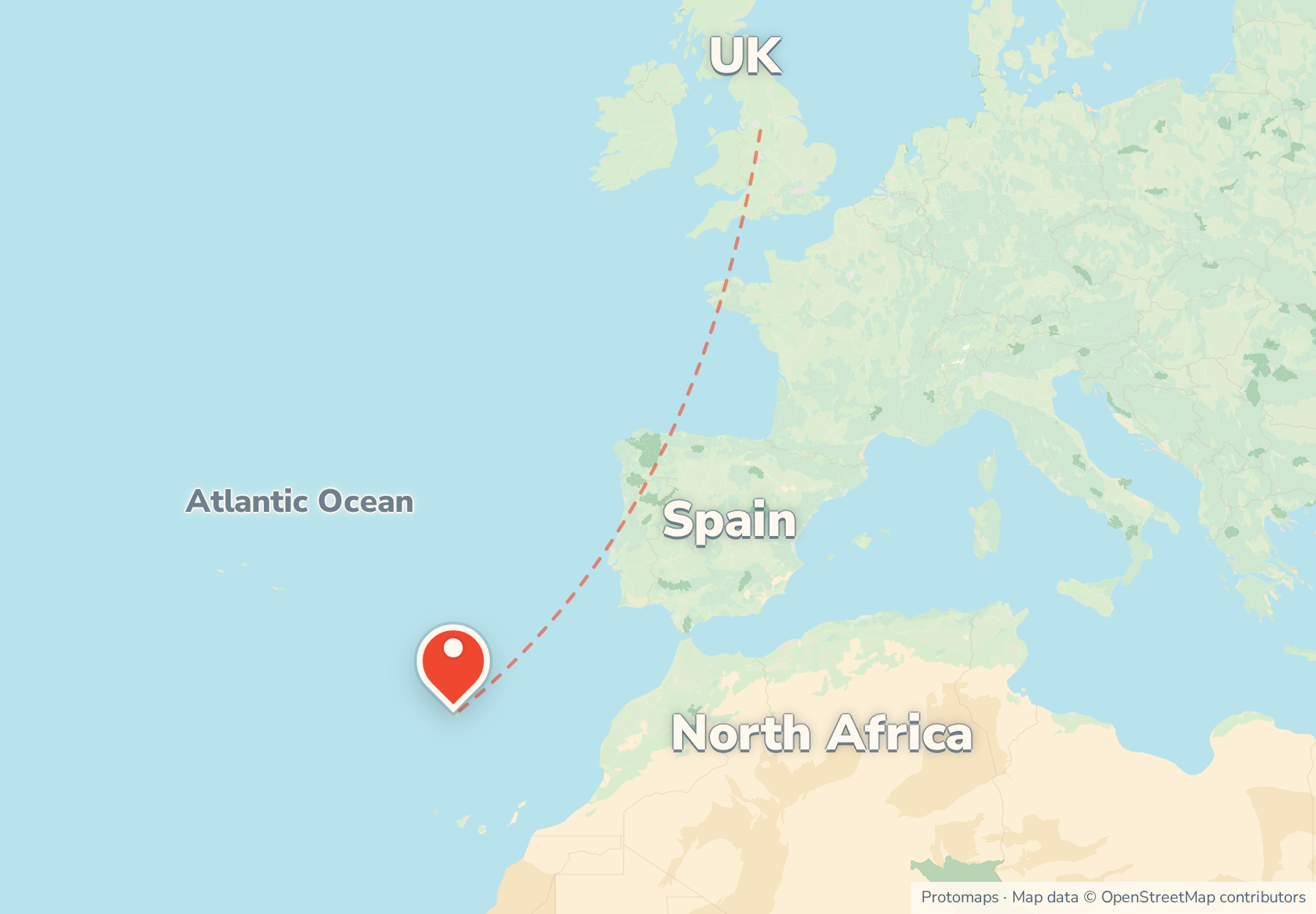
Madeira is a volcanic island that rises steeply from the Atlantic, on the same clocks as London, green all year and never too hot for a baby, with December days around 21 degrees and flights through the winter. It isn't a beach island: the natural shore is pebble and rock, and the swimming happens in municipal lidos, behind the breakwaters of two imported-sand beaches and in volcanic rock pools. Around that sit cable cars, whale catamarans, drive-up summits and exactly two levada walks that work at this age.
On this page
A family verdict at a glance
The quick read before the detail: who Madeira suits, the season to aim for and what to nail down before you book.
Best for
Year-round mildness, cheap lido swimming, gardens, cable cars and whale boats.
Maybe not for
Bucket-and-spade weeks, or wanting to push a buggy everywhere, since almost everything climbs.
Best ages
Babies do unusually well here; threes and up get more from the toboggans, boats and viewpoints.
Best areas
The Funchal Lido zone as the default, Machico for flat streets and real sand, Calheta for sun and the marina.
Why families pick it
A week that mixes pools, mountains and dolphins rather than just sand, in any month of the year.
Check before you book
That the hotel sits on flat ground rather than above it, plus the cot, the cancellation terms and the levada slots if a walk is on the list.
Not a beach island, mild all year
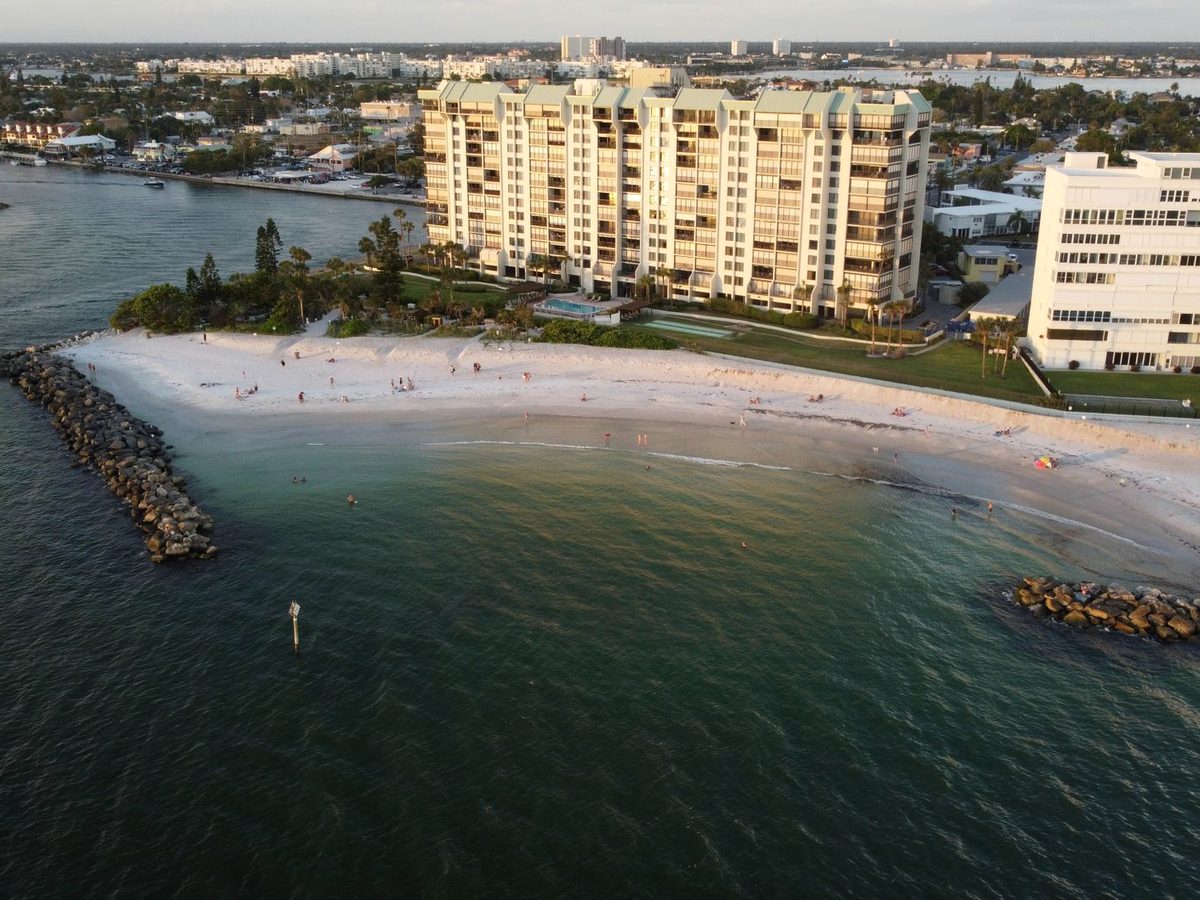
Madeira has no natural golden sand. The shore is pebbles, black volcanic sand and rock, so the swimming is mostly built: four municipal lido complexes in Funchal with dedicated children's pools, €6 an adult and under-sevens free (last checked June 2026), two breakwater-calmed beaches at Calheta and Machico, their sand imported from North Africa, managed lava pools at Porto Moniz and the sandy sister island of Porto Santo a ferry ride away.
Funchal's temperature barely moves through the year, around 20 degrees in February and 27 in August. Winter is showery rather than wet through, the lidos stay open and the flights keep running, which makes Madeira the one island in this part of the Atlantic besides the Canaries where February half term is a realistic option. The island is the top of a volcano, so away from the seafronts almost every street climbs.
A quick gut checkIs Madeira right for your family?
Worth comparing if
You want mild weather in any month, varied days out and swimming that doesn't depend on a beach.
Weigh it up if
Your toddler's idea of a holiday is sandcastles, or you'd struggle with a buggy on a hilly base.
To sort out before booking
A hotel on the flat, the cot and a hire car decision made early, since summer automatics sell out.
The numbers, the basics and the ages
Everything you'd want to skim first: the quick facts, the everyday practicalities and how Madeira changes as children grow.
Quick facts for UK families
Money, plugs, language and the basics
- Madeira is an autonomous region of Portugal, an island of around 260,000 people about 620 miles (1,000 km) south-west of Lisbon, closer to Africa than Europe.
- The currency is the euro and cards are accepted almost everywhere; buses want their GIRO card or cash.
- Sockets are the round two-pin European type, so UK plugs need an adapter. The voltage matches the UK.
- The language is Portuguese, with English widely spoken; the island has 200 years of British connections behind that.
- Tap water comes off the mountains and is safe island-wide; boil it for formula as you would at home.
- Your GHIC card covers the state system here, run regionally as SESARAM; 112 is the emergency number and the island has its own health advice line.
- Most municipalities charge a tourist tax of €2 a person a night, capped at seven nights; children are exempt, with the cut-off age varying by municipality, so check your hotel's wording.
Madeira by age and stage
Babies
No extreme heat in any month and catamarans that carry them free. A carrier matters more here than on most islands we cover, because of the hills.
Toddlers
Lido children's pools, the cable car, tame finches landing on hands at Balcões and squares with pigeons to chase. The hills are the adult's problem, not theirs.
Preschoolers
The toboggan run, dolphins off the bow, the glass platform at Cabo Girão and black sand that washes off.
Young children
You can do longer levadas, the boat days lengthen and the mountain days stop depending on naps.
Where to base yourselves
The bases side by side, an orientation map of the island and where the swimming actually happens.
Where to stay with young children
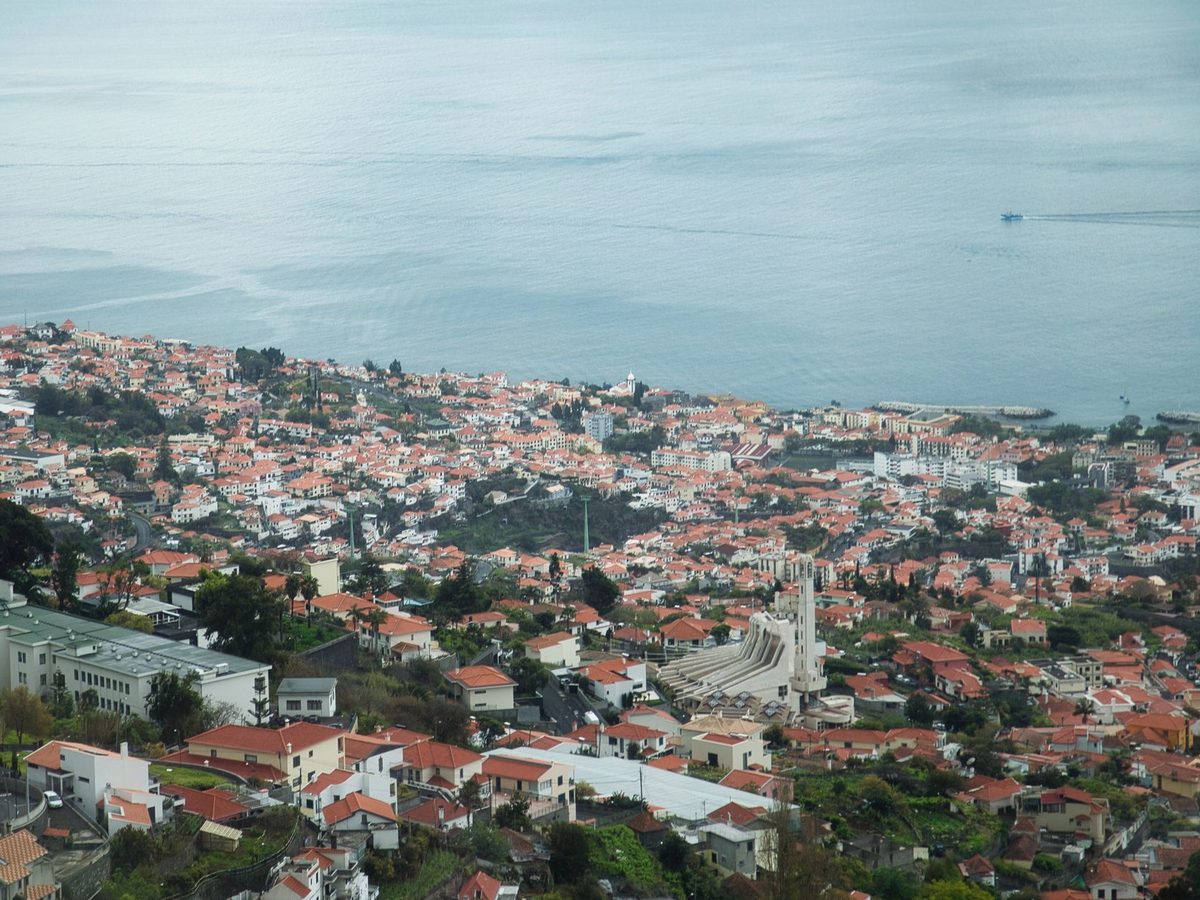
The Funchal Lido zone is the default for good reasons. The Estrada Monumental spine is relatively flat, the big family hotels and all-inclusives cluster along it, two lido complexes sit on the doorstep and the Lido promenade is the best buggy walk on the island, flat and traffic-free past cafés, playgrounds and pools to the pebble coves of Praia Formosa. Of the two complexes, Ponta Gorda is the better full-day base with small children, with a playground, a kids' club and a 690-square-metre solarium to spread out on; the Lido is the more central if you want to walk to it. The crucial booking check is altitude: a hotel on the spine or the seafront works, one a few streets uphill means ending every outing with a climb. Praia Formosa itself is the city's big public beach, pebbles and black sand with lifeguards and a playground, better for a toddle and a paddle than a swim on rough days.
East of the capital the practical picks line up. Machico, ten minutes from the airport, is the rarest thing on Madeira, a flat town, with calm lifeguarded sand behind two piers and a playground on the promenade; the price is intermittent aircraft noise and quieter evenings. Santa Cruz next door is low-key and local with a palm-lined promenade lido and the island's summer waterpark, with planes passing low overhead. Caniço de Baixo is where the big operator all-inclusives perch on the cliffs: comfortable hotels, sea access by lift and steps, fine with a carrier and a kids' club, hard work with a buggy.
West, the road runs long and scenic. Calheta has the island's other sandy beach in two breakwater-calmed coves, a marina with whale boats, the sunniest weather on the island and a steep little town behind the front, 50 to 60 minutes from the plane. Ponta do Sol is a compact sunny village, steep behind the front, with a small calmed pebble beach. Porto Moniz, in the far north-west, is a day trip rather than a base for most families, and Porto Santo, the sandy sister island, is covered in the swimming section below. Wherever you stay, the west and north want a car; Funchal doesn't. If you'd rather push a pram than carry a baby on a levada, only one walk allows it, "Um Caminho Para Todos" near Queimadas, covered in the questions below.
| Area | Transfer | The swimming | The feel |
|---|---|---|---|
| Funchal Lido zone | 20 to 25 min | No sand: the lido complexes with children's pools, and the flat seafront promenade | The default base. Pick a hotel on the Estrada Monumental spine or the seafront; the side streets climb hard. |
| Machico | About 10 min | Imported golden sand behind two piers, calm and lifeguarded in season | A flat town centre, rare here, with a promenade playground. Some aircraft noise; cheaper than Funchal. |
| Calheta | 50 to 60 min | Two coves of imported golden sand behind breakwaters, calm and shallow | The sunniest end, with a marina for the whale boats. The town climbs steeply behind the front. |
| Caniço de Baixo | About 15 min | Cliff-foot lidos and a pebble cove reached by lifts and steps | The all-inclusive cliff, where the big operator hotels cluster. Fine with a carrier, awkward with a buggy. |
| Santa Cruz | About 10 min | A palm-lined promenade lido with a children's pool, plus the summer waterpark | Low-key and local, next to the airport, so planes pass low overhead all day. |
| Ponta do Sol | About 40 min | A small breakwater-calmed pebble beach with a bar and changing rooms | A compact sunny village, steep behind the front. Water shoes for the pebbles. |
Map of the main family areas
An orientation map of the areas above, the airport, the big days out and Porto Santo. The numbers match the key beneath.
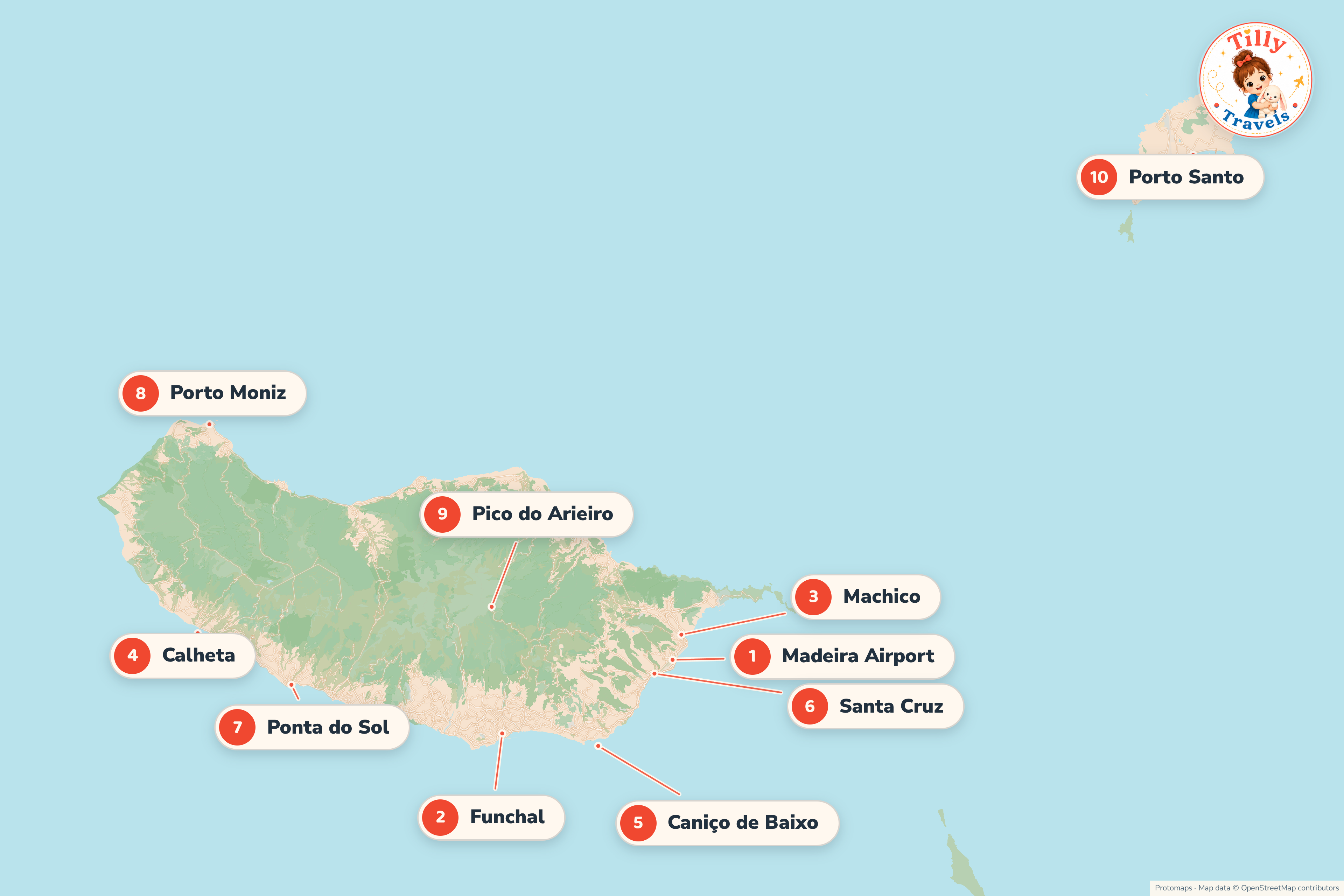
- 1Madeira Airport East coast, by Santa Cruz
- 2Funchal The Lido zone default
- 3Machico The flat town with sand
- 4Calheta Sand and the sunny west
- 5Caniço de Baixo The all-inclusive cliff
- 6Santa Cruz The quiet airport town
- 7Ponta do Sol The sunny village
- 8Porto Moniz The lava pools day
- 9Pico do Arieiro The drive-up summit
- 10Porto Santo The sandy sister island
Where the swimming actually happens
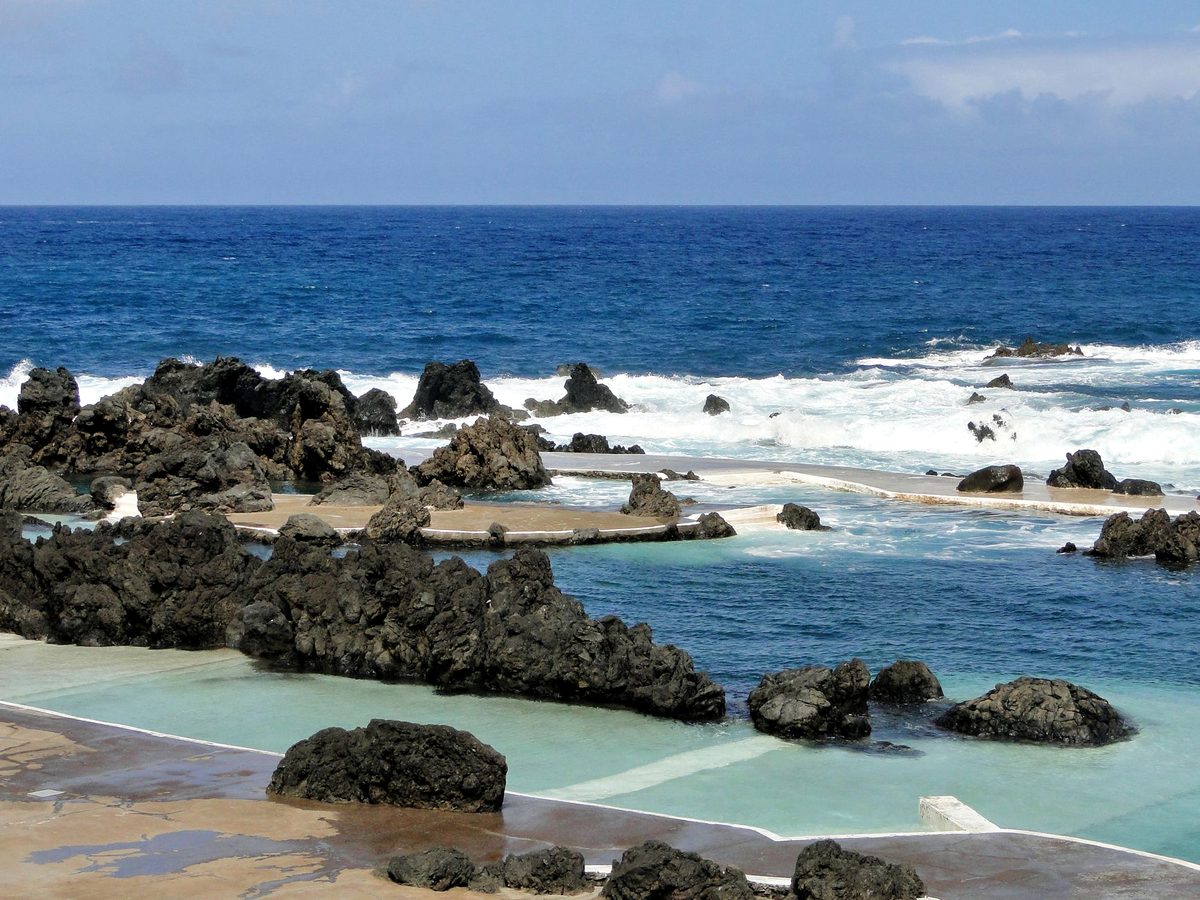
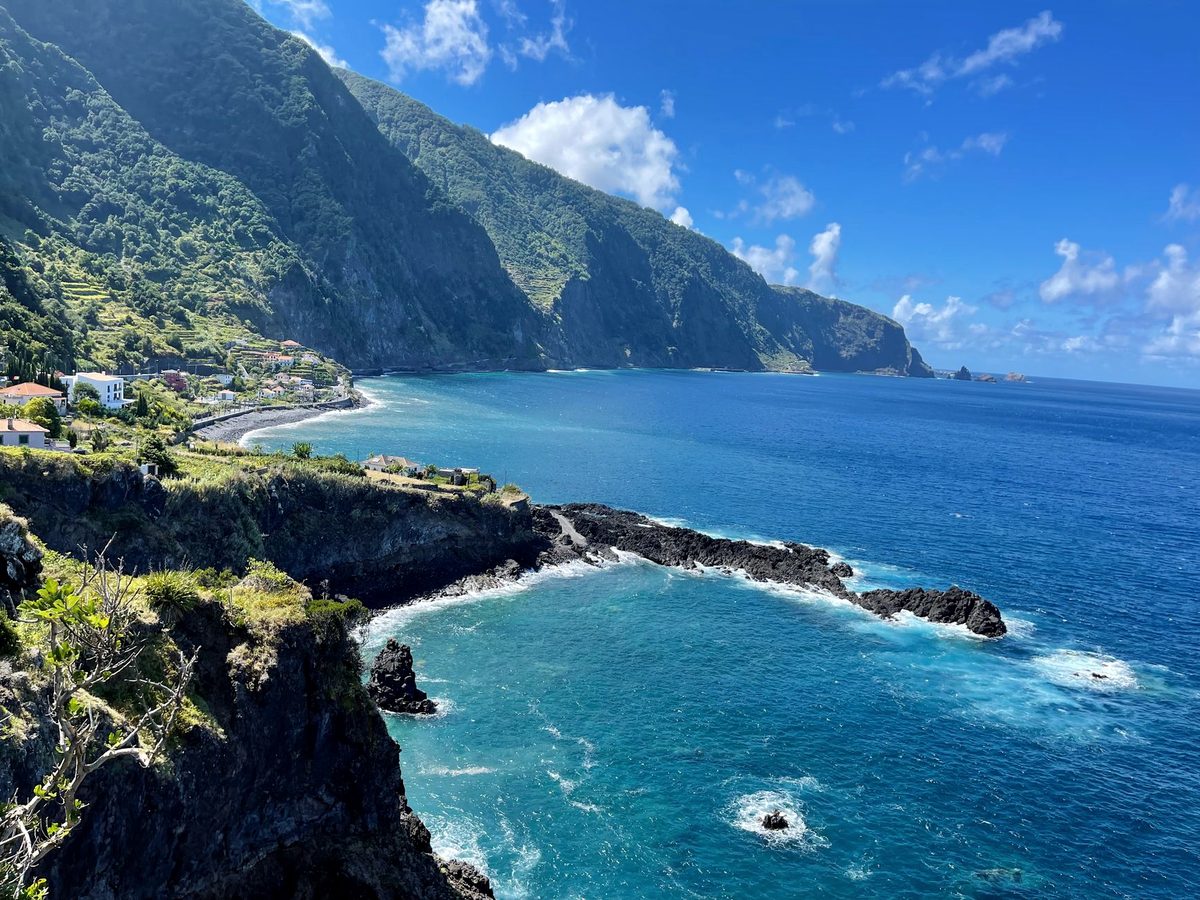
The lidos are the daily answer. One municipal tariff covers Funchal's four complexes, with the central Lido and the bigger Ponta Gorda the family picks: saltwater pools with dedicated children's pools, lifeguards, cafés and playgrounds, open year-round, €6 an adult and free under seven. The main pools run adult-deep and sea access is ladders off rock, so the shallow, lifeguarded children's pools are the toddler's domain. For sand, Calheta and Machico do calm, shallow, lifeguarded swimming behind their breakwaters; Porto Moniz's managed lava-pool complex, €3 with under-threes free (last checked June 2026), has a children's pool and shallow concreted edges, with the raw free pools next door best left to photographs. Seixal's black-sand cove is the one natural-shore swim worth the trip, calm behind its breakwater on a good day, with a steep path down and no buggy access.
The open sea here is rougher than the Med: swell and currents are stronger, so the rule is lifeguarded spots only, and one flag UK parents won't know, the black-and-white chequer, means the lifeguard is temporarily off station. The sea runs 18 degrees in late winter to about 24 in September, so comfortable toddler swimming in the open sea is realistically July to November, with the lidos and their gentler corners covering the rest of the year. Water shoes help the whole family: pebbles, lido rock and the odd urchin on rocky shores.
Porto Santo is the part most guides skip. The sister island has 6 miles (9 km) of continuous golden sand, calm and shallow, the real beach the main island lacks. The ro-ro ferry takes about two and a quarter hours each way, with a children's play room aboard and a deserved seasickness reputation; buggies and hire cars travel fine on the car deck, and under-fours travelled free on the fares we found, worth checking with Porto Santo Line. There's also a 25-minute propeller flight. With young children, a night or three beats the thirteen-hour day trip, and a two-island week of Funchal plus Porto Santo gives a family both halves.
Weather, days out and the daily shop
When to go through the year, the days out that suit small children, eating out and where to stock up.
Weather, month by month
The figures below are official Portuguese met-service averages for Funchal. Barely seven degrees separate February from August, no month is too hot for a baby and none is hopeless, with the rain concentrated from October to April in showers rather than washouts. Funchal is drier across a year than London; it rains in fewer, heavier bursts.
| Month | Daytime high | Overnight low | Rain | Wet days | Sea temp |
|---|---|---|---|---|---|
| January | 20° | 14.5° | 99 mm | 9 | 19° |
| February | 20° | 14° | 95 mm | 8 | 19° |
| March | 20.5° | 14.5° | 83 mm | 10 | 19° |
| April | 21° | 15° | 62 mm | 7 | 19° |
| May | 22° | 16.5° | 44 mm | 5 | 20° |
| June | 24° | 18.5° | 17 mm | 2 | 21° |
| July | 25.5° | 20° | 4 mm | 1 | 23° |
| August | 27° | 21° | 4 mm | 1 | 24° |
| September | 26.5° | 20.5° | 45 mm | 5 | 24° |
| October | 25° | 19.5° | 118 mm | 10 | 24° |
| November | 22.5° | 17° | 112 mm | 10 | 22° |
| December | 21° | 15.5° | 135 mm | 12 | 21° |
Typical monthly averages from weather-station records. Sea temperature is the open-water figure, so a sheltered bay can feel a degree or two warmer.
Rain is local: the south coast is the dry side, and driving twenty minutes often changes the weather entirely, which is why a shower in Funchal rarely costs a day. The mountains run about ten degrees colder than the coast, with cloud and wind, so pack layers in the summit bag even in August. UV runs very high from May to August and you won't feel it under the mild air: factor 50, suits and shade for babies even when it doesn't feel hot.
Filling the daysThings to do with little ones
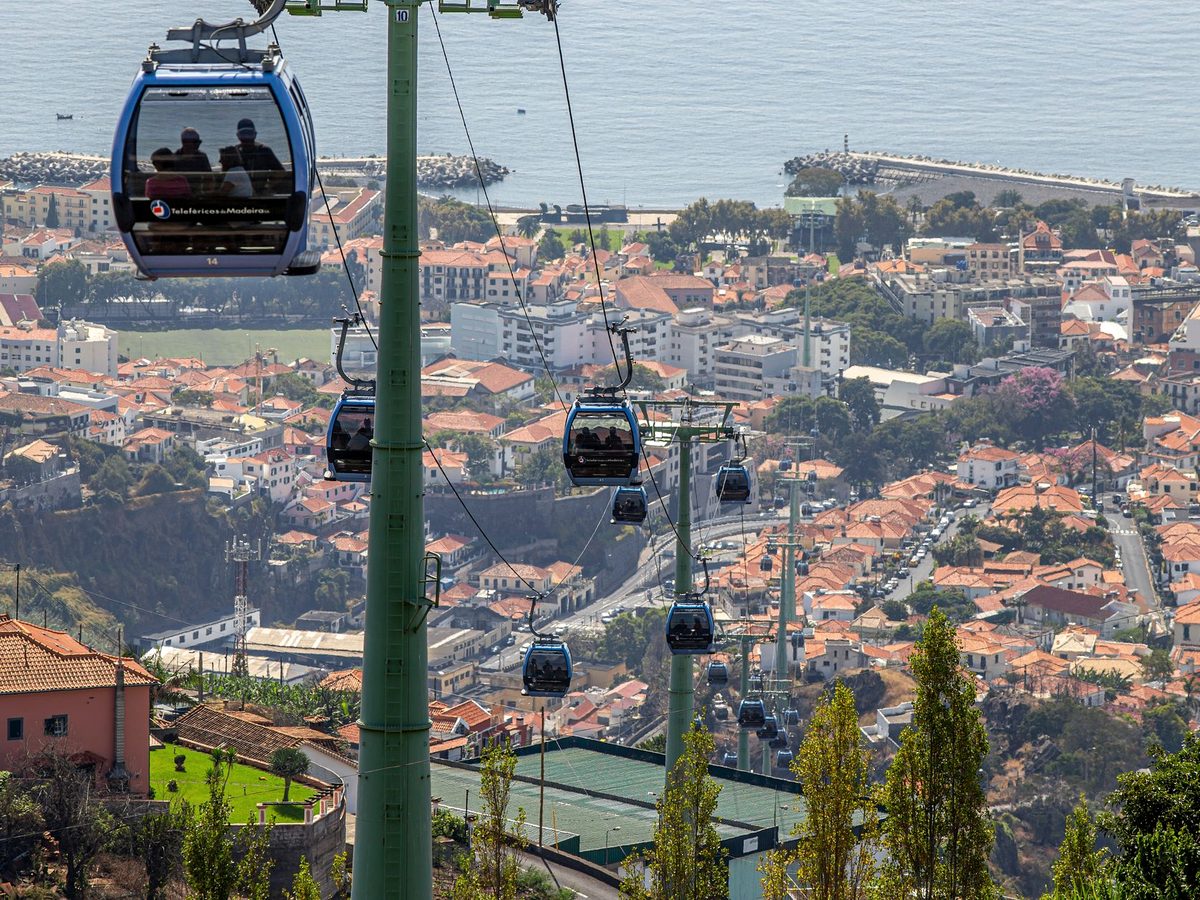
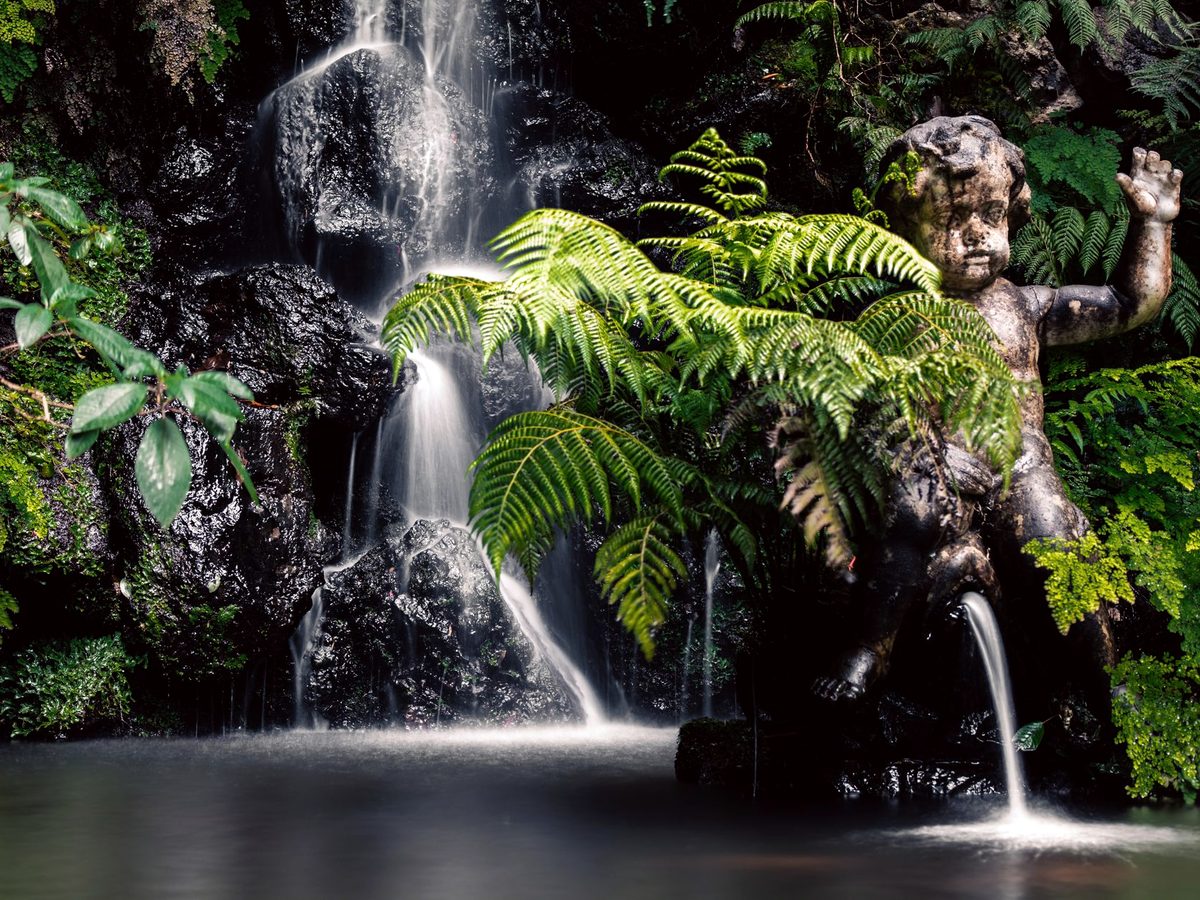
Monte is the standout day out. The cable car reopened in April after its biggest renovation, €22 return for adults and free under seven (last checked June 2026), climbing 560 metres over the rooftops in fifteen minutes; go at opening or after three on cruise-ship days, which spike every queue in town. At the top, Monte Palace Tropical Garden is koi lakes, peacocks and painted tiles down a steep hillside, free for under-15s and a carrier job rather than a buggy one. The wicker toboggans run back down 1.2 miles (2 km) of tarmac, Monday to Saturday; whether they suit your child is answered in the questions below. A second cable car drops from Monte to the Botanical Garden, under-sevens free again, and a Bolt or Uber rescues tired legs from anywhere in the system for a few euros.
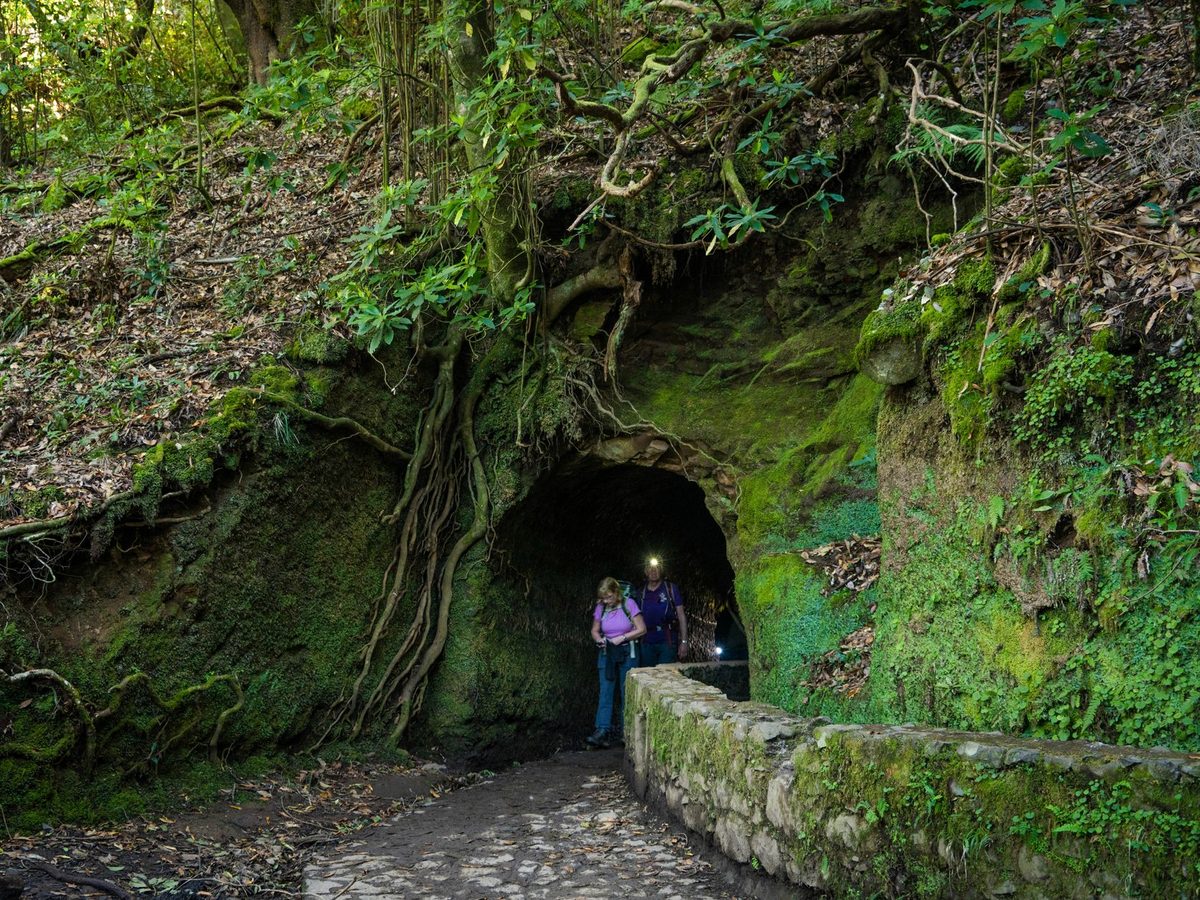
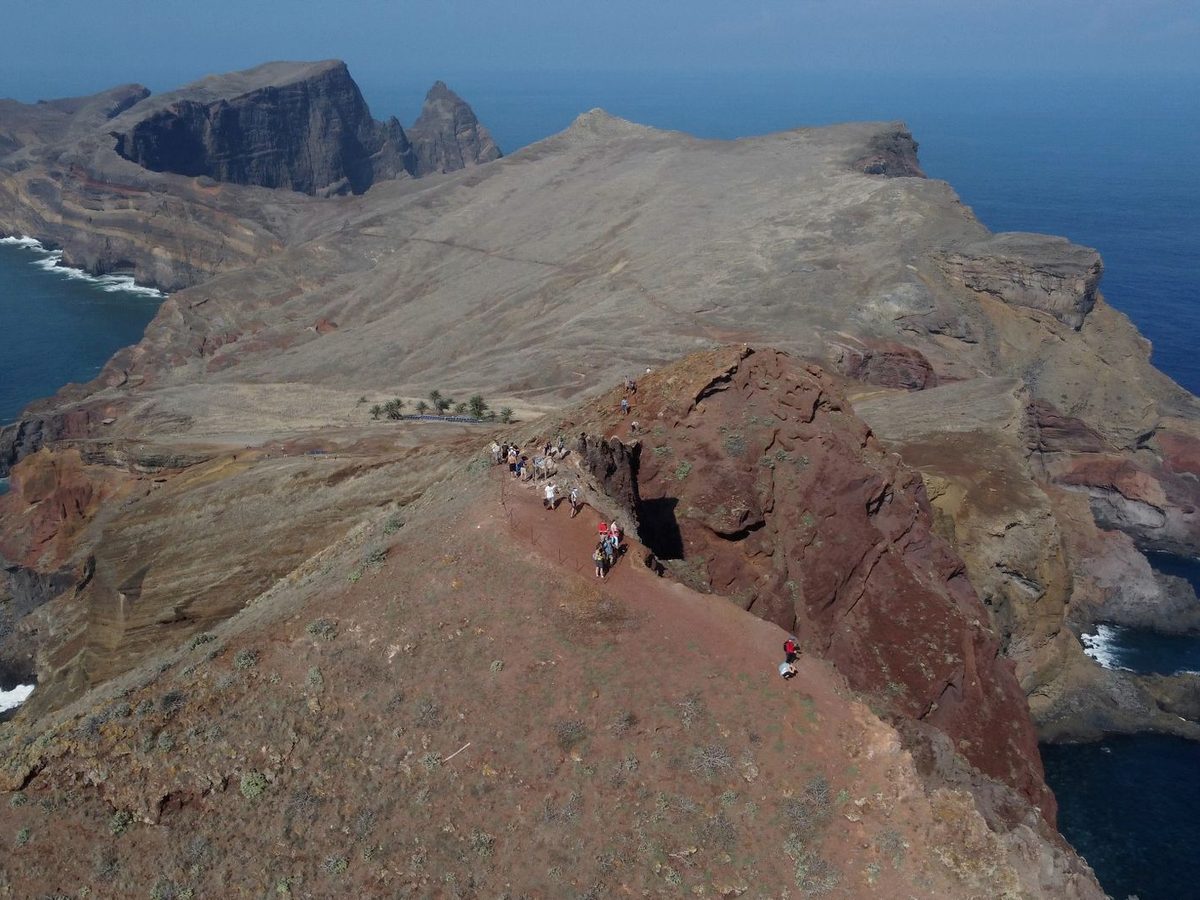
The levada question has a short answer at this age, two walks, and both are covered in the questions below along with the booking system every trail now requires. The drive-up days fill the rest: Pico do Arieiro puts the car park at 1,818 metres for a one-minute walk to the view, ten degrees colder than the coast, with paid parking and a café and absolutely no continuing along the ridge trail with small children; Cabo Girão's glass-floored skywalk hangs 580 metres over the sea, a fiver a parent with under-13s free; Eira do Serrado's balcony over the Nun's Valley is a five-minute paved walk with chestnut cake in the village below; and Fanal's fog-twisted ancient trees stand in flat grassy bowls a toddler can wander, mud and cows permitting. Santana's A-frame houses make a free photo stop with a gentle theme park of miniatures and playgrounds next door, and the lava pools at Porto Moniz are the centre of the north-coast day with Seixal on the way.
Boat trips divide by boat type. Catamarans from Funchal and Calheta run two-to-three-hour whale and dolphin trips year-round, with resident pilot whales and bottlenose dolphins and babies aboard free; the RIB operators set minimum ages of five or six, so with a baby it's the catamaran. The glass-bottom boat to the Garajau reserve is the gentler hour, and the pirate-ship replica looks the part and is a long three hours for a two-year-old. In town, Santa Catarina park has the best playground in central Funchal, free, with a duck lake and harbour views, the flat seafront does boats and ice cream, and the Mercado dos Lavradores is worth the building and the fish hall, with one warning: don't touch the upstairs fruit samples, which turn into some of the most expensive fruit in Europe. Rainy days are covered better here than on most islands, with real soft-play centres in Funchal, the story museum in the old town and the lidos open regardless. The waterpark at Santa Cruz runs high summer only, with a proper toddler zone and under-fours free.
Eating out with children
Portugal welcomes children culturally rather than commercially, babies included and evenings too, and Madeira adds bolo do caco, the warm garlic-butter flatbread that solves most toddler dinners on the island. Half portions, the meia dose, are a real menu convention at roughly two-thirds of the price, portions run generous anyway, and dinner from seven is normal, kinder than Spain's nine. Watch the couvert: the bread and olives that arrive unasked are charged per item touched, so wave them away or treat them as a cheap starter for a hungry toddler.
Easy toddler food is everywhere: milho frito, fried polenta cubes that pass for chips, mild scabbard fish, grilled chicken, the tiny sweet local bananas and custard apples in winter. The espetada arrives on a metre-long skewer hung over the table, a talking point for small children, and the poncha is the parents' drink to go slow on, since it tastes far gentler than it is.
Milk, nappies and pharmaciesSupplies and the first-day shop
Continente and Pingo Doce cover the island, including central Funchal stores open daily into the evening, Sundays included, so the first-day shop is easy from any base; there's no Lidl or Aldi here, whatever Portuguese mainland habits suggest. Nappies are sold as Dodot, the Iberian Pampers, with supermarket own brands the budget option, and the baby-food aisles run deep on pouches and the Portuguese papa cereals. The one shelf surprise is milk: overwhelmingly UHT, with fresh pasteurised only in bigger stores' chillers.
Formula is friendlier than much of Europe: Aptamil is sold as Aptamil, in pharmacies and bigger supermarkets, with stages close to but not identical to the UK tins, so bring enough to bridge and check with your HV or GP before swapping. Pharmacies are everywhere under the green cross, the children's paracetamol is Ben-u-ron syrup over the counter, and the out-of-hours rota hangs on every closed door.
Getting around, a real week and the admin
Transfers and hire cars, what a week actually looks like, the health and document checks and a list to pack against.
Getting there and around
Day to day the airport is a modern, small one ten minutes from Machico and twenty-five from Funchal along the motorway, with a cheap Aerobus into town whose racks take a folded buggy. Portuguese law requires child seats for under-12s below 135 centimetres, taxis are legally exempt but the advice doesn't change, pre-book the seat or bring your own, and the local firm AGU hires car seats, cots and even hiking carriers with delivery to the airport.
You don't need a car for a Funchal week; anything wider, you do. The motorway and the island's 150-plus tunnels make the coast quick, Machico in twenty minutes and Calheta in thirty-five, while the old roads above run to 20 to 25 per cent gradients, hairpins and hill starts that make an automatic worth its premium; automatics sell out months ahead for summer. Fuel runs cheaper than mainland Portugal, a UK photocard licence is all you need, and the buses are united under the SIGA network, fine for Funchal and the east, one service a day to the far north-west. Car sickness is the real risk: wind, tunnels and bends hit the two-to-twelve age hardest, so ventilation, snacks and a pharmacist's advice on children's travel tablets belong in the plan.
What a real week looks likeA realistic week with little ones
A short transfer if you're east, a scenic one if you're west: pool or lido, supermarket and an early dinner with bolo do caco.
Lido or beach in the morning, lunch and a nap, gardens or the seafront promenade after.
Cable car up, the garden with a carrier, the toboggan down if you judge yours ready and a Bolt back from the bottom.
Pico do Arieiro and a levada with layers in the bag, or a catamaran morning among the dolphins.
A final lido swim and a slow pack.
With young children, the lidos, the Monte day, one mountain-or-whale day and the seafront fill a Madeira week.
The practical adminHealth, documents and the boring bits
Check the GOV.UK Portugal advice before booking and travelling. Passports need to be issued within the last ten years and valid three months beyond departure, children's included. Carry a GHIC each plus travel insurance: the GHIC covers Madeira's regional health service, including the main hospital in Funchal with 24-hour paediatric emergency, while the island's private hospital offers a round-the-clock paediatric route your insurer pays for. The emergency number is 112, and Madeira runs its own health advice line rather than the mainland's SNS24 number.
Most hazards here come from the terrain. Unfenced viewpoints, levada edges and cliff drops are the main one, so the standing rule is fenced platforms only with walking toddlers, the carrier elsewhere. The open-sea rules from the swimming section apply, the summit cold is real in any month, and UV runs very high even under mild air. Madeira's mosquitoes bite by day, and after a couple of isolated dengue cases in early 2025 the standing advice is simple daytime repellent in Funchal in the warm months, nothing more dramatic.
Before you payBooking checklist
- Check the hotel sits on the flat: the Estrada Monumental spine, the seafront or Machico, not the hillside above.
- Book an automatic hire car months ahead for summer, with the child seat on the booking.
- Pack a day of nappies, formula and medicines in hand luggage in case the wind diverts the flight.
- Reserve levada slots on SIMplifica before you fly, and check the walkers' notice on the day.
- Confirm the cot, and a heated pool if you're going between November and April.
- Pack layers for the mountains, rain covers in winter and factor 50 all year.
- Choose catamaran over RIB for any boat trip with a baby.
- Budget the €2-a-night tourist tax, paid at the hotel.
- Confirm the cancellation terms and your travel insurance.
- Recheck the GOV.UK Portugal advice and every passport before you go.
Resort guides in Madeira
We've researched these places to stay in Madeira for families with young children. Each guide covers what it's like, who it suits and what to check before you book.
Questions, links and the last word
The things families ask most, the official pages worth a bookmark and when this guide was last refreshed.
Common parent questions
Is Madeira actually a beach holiday?
Not in the bucket-and-spade sense, so plan the days around water rather than a beach. Base near Ponta Gorda for a full day with toddlers, or the central Lido if you want to walk to it, and budget almost nothing: a lido day is a few euros for the adults and free for small children. If you want actual sand, build in a Calheta or Machico beach day, or a couple of nights on Porto Santo.
Can we do a levada walk with a toddler?
Two of them, and the rest are not for this age. Vereda dos Balcões is a flat 1 mile (1.5 km) to a railed viewpoint where tame finches land on outstretched hands, and "Um Caminho Para Todos" near Queimadas is 1.3 miles (2.1 km) of laurel forest built wide and flat for wheels, the one trail you can push a pram or wheelchair along. Every classified trail now needs a pre-booked slot on the SIMplifica site, €4.50 for adults (last checked June 2026) and free for under-12s, who still need their own slot, and closures change weekly, so check the official walkers' notice on the day. Of the popular longer ones, 25 Fontes is only feasible with a carried baby, early, at best, and Caldeirão Verde, with its tunnels and cliff ledges, is a flat no at this age.
What about the scary airport?
The reputation is real but episodic. The runway sits on columns over the sea, pilots need special certification and crosswind limits are strict, so on a handful of days a year, mostly autumn and winter, flights hold, divert or cancel; about 3 per cent of flights were cancelled across 2024, a year that included the August wildfires. So pack for the small chance of a diversion: keep a spare day's nappies, formula and medicines in the hand luggage, and know the airline must look after you if you divert.
Does winter half term really work?
Yes, and the Canaries are the only other short-haul option that can. February runs around 20 degrees with the lidos open and direct flights from a dozen UK airports, on the same clocks so there's no jet-lagged toddler at either end. Go in expecting it as a pool-and-garden week, not a beach one: the downsides are real showers, a jumper in the evening and a sea that's a paddle at best, so book a hotel with a heated pool. The Canaries hold up better for guaranteed pool weather; Madeira gives you the greenness, the gardens and a more varied week.
Can we take a baby on a whale boat?
On the right boat, yes, so for a baby book a catamaran rather than a RIB. The catamarans take babies, often free under five, with shade, toilets and room to move; the RIBs and speedboats set minimum ages around five or six. Book a morning sailing, when the sea is calmer for small stomachs, and bring the car-sickness kit. Treat "guaranteed sightings" as marketing: the standard promise is a free second trip, not a refund, which only helps if you're staying long enough to use it.
Are the wicker toboggans safe for children?
They're a judgement call we can't make for you. Two runners steer the wicker basket down 1.2 miles (2 km) of ordinary tarmac at jogging-to-rolling speed; small children ride on a parent's lap, there are no restraints and no official minimum age is published. With a baby, ride the cable car both ways instead. With a three-or-four-year-old it's a memorable ten minutes: €40 for two (last checked June 2026), closed Sundays, queues worst on cruise mornings, and a Bolt back from the bottom costs a few euros.
Can we buy our usual formula and nappies?
Yes, with one caveat worth planning around. The Aptamil sold here has stages close to but not identical to the UK tins, so bring enough to bridge the trip and check with your health visitor or GP before swapping a baby over. The everyday brands and the where-to-shop detail are in the supplies section above.
Do we need a hire car?
It depends entirely on your base, so decide the base first. Stay in the Funchal Lido zone and you can skip it, using Bolt for the gaps; pick anywhere west, north or up in the hills and you'll want one. If you do hire, choose an automatic for the hill starts, typically €5 to €30 a day more than a manual, and book it well ahead for summer. A UK photocard licence is all you need.
See more Madeira photos
Open the photo gallery →Useful links
- GOV.UK Portugal travel advice: passport rules, entry requirements and health updates before you travel.
- Visit Madeira: the official tourism site, including the live notice to walkers with trail closures.
- SIMplifica: the official portal for booking the paid levada and trail slots.
- Funchal cable car: current prices and hours for the Monte ride.
Last updated 12 June 2026.