The Lake District with little ones
The Lake District is England's lakes-and-mountains national park, and with little ones you stay low: the lakeshores, the valley walks, the boats and the steam trains, not the fells. It also rains here more than almost anywhere in England, so a wet day is something you plan for. You get some of the gentlest family walking in England, lake cruises and steam railways a small child loves, and the landscape of the Beatrix Potter books.
On this page
A family verdict at a glance
The quick read before the detail: who the Lake District suits, the season to aim for and what to nail down before you book.
Best for
Lakeshore walks, boat trips and steam trains among the lakes and fells, with no flight and plenty of flat, buggy-friendly paths.
Maybe not for
Not for you if you want a beach or reliable sun, or expect to climb the fells with a toddler. You will get rained on, and the fells are for when they're older.
Best ages
Toddlers and preschoolers, especially any who know the Beatrix Potter books. Babies do well in a carrier on the flat walks.
Best areas
Windermere or Ambleside for facilities, Keswick for the northern lakes, Ullswater or Coniston for a quieter, scenic week.
Why families pick it
Boats and steam trains for small children, flat lakeshore paths a buggy can manage, and big scenery with no flight.
Check before you book
A solid wet-day plan, a carrier for the walks, parking that fills early at Bowness, Ambleside and Keswick, and a cot at the cottage.
Stay low, and pack for rain
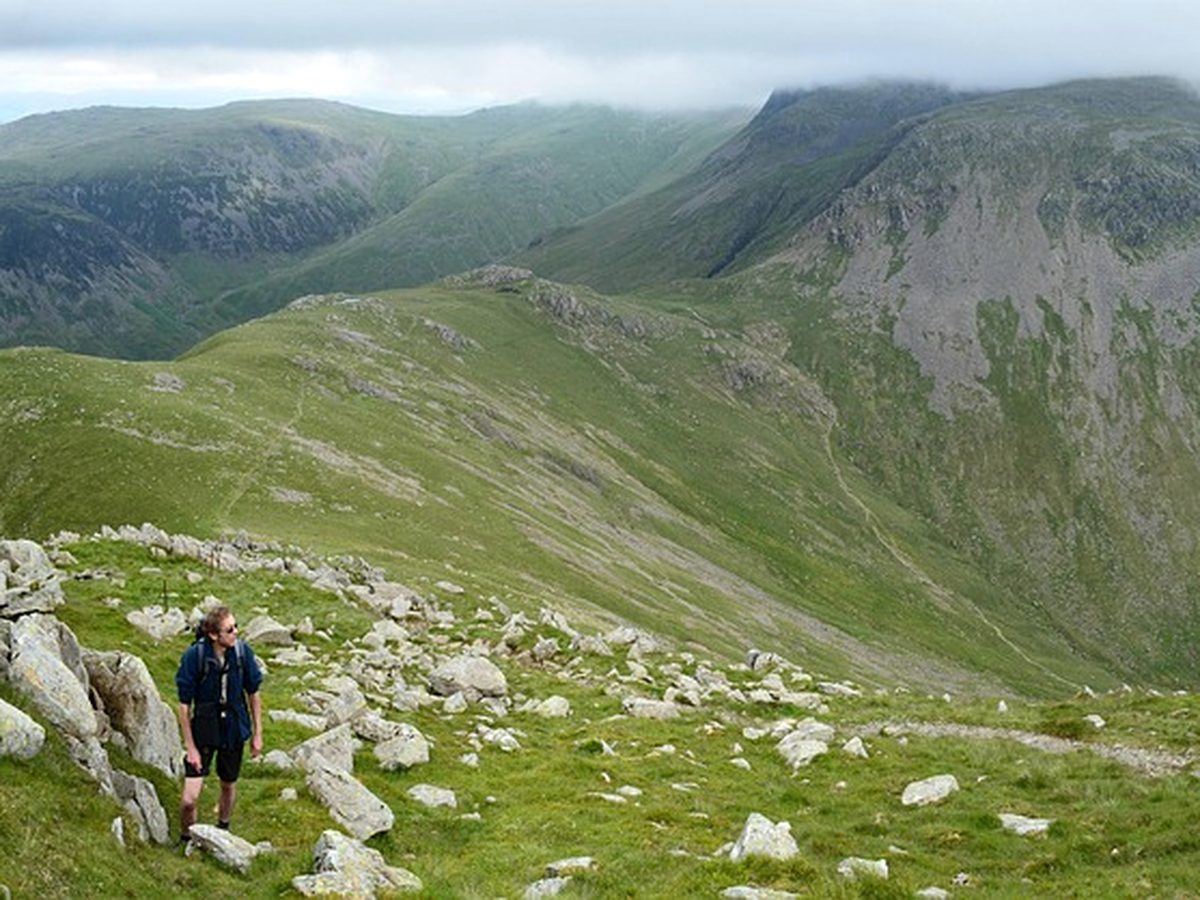
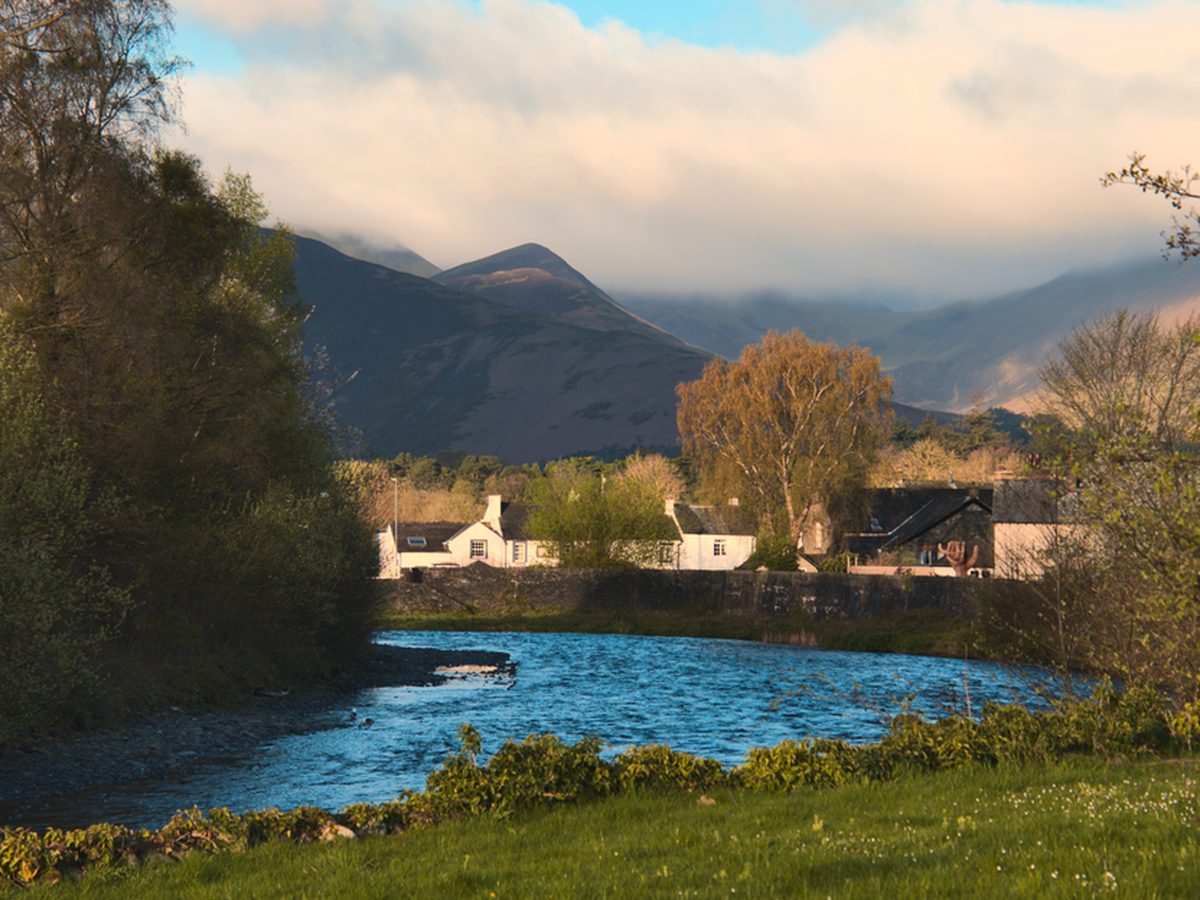
The Lake District is mountains, but with young children you stay at the bottom of them. The fells are steep, uneven and exposed near the tops, and not the place for a toddler, while the scenery is all there at lakeshore and valley level: the cruises, the flat circuit at Tarn Hows, the old railway paths, the forest trails and the parks by the water. A carrier handles anything that climbs.
The rain is the other thing to plan for. This is one of the wettest corners of England, with rain on roughly 200 days a year and double the national amount in the valleys, so a week here without a wet day is unusual. Plan the indoor days in rather than hope they don't come: the lake boats and the enclosed steam carriages run in the wet, the aquarium is a good wet-day choice, and the towns have soft play, pools and indoor attractions. Pack full waterproofs for everyone, including the baby, and a buggy rain cover.
A quick gut checkIs the Lake District right for your family?
Worth comparing if
You want lakes, boats, steam trains and easy walks in big scenery, no flight, and you are happy to plan around the weather.
Weigh it up if
You need a beach or reliable sun, you can't face packing for rain, or you imagined carrying a baby up a mountain.
To sort out before booking
A wet-day plan, a good carrier, an early start for the busy car parks, a cot at the cottage and enough of any medicine your child takes.
The numbers, the basics and the ages
Everything you'd want to skim first: the quick facts, the everyday practicalities and how the Lakes change as children grow.
Quick facts for UK families
The basics for a Lakes trip
- The Lake District is England's largest national park, in Cumbria in the north-west, and a UNESCO World Heritage Site.
- The family-friendly scenery is down by the lakes and in the valleys; the fells are for when they're older.
- It rains a lot, more than almost anywhere in England, with rain on roughly 200 days a year in the valleys.
- The towns have supermarkets (Booths, Windermere and Kendal especially); the remote western valleys have almost nothing, so stock up first.
- The honeypot towns get very congested in summer, and roads inside the park are narrow and single-track in places.
- Many attractions run year-round, but western-valley facilities and some smaller places are thin in winter.
The Lake District by age and stage
Babies
A carrier for the flat walks, a cottage checked for stairs and a cot, and full rain gear. The boats and the aquarium work whatever the weather.
Toddlers
Lake cruises, steam trains, paddling at Fell Foot and the Beatrix Potter world. Short days, with the nap and the wet-day plan built in.
Preschoolers
The right age for the Gruffalo trails, Hill Top farm, the Tarn Hows circuit on their own legs and the otters at the aquarium.
Young children
First gentle fells like Orrest Head, the mine tour at Honister, longer lakeshore rides and the adventure playgrounds are all doable now.
Where to base yourselves
The bases side by side, an orientation map and the lakes and gentle walks with little ones.
Where to stay with young children
Windermere and Bowness are the obvious first base, with the most to do within walking distance and the only railway station in the park. Bowness is the pier and tourist hub, Windermere the town up the hill with the trains, and between them sit the Beatrix Potter attraction, the lake cruise piers and the waterfront, with the aquarium a short cruise south. It's also the busiest spot in the Lakes, and the central streets get thronged in peak season. Ambleside, at the head of the lake, is a calmer version: a small town with shops, cafes and a cinema, and good walking from the door.
Keswick, in the north by Derwentwater, is a working market town with an outdoors slant rather than a package-holiday feel, with a heated family pool for wet days and the lake launch from the edge of town. Ullswater, off the M6 at the Penrith end, is the quiet, scenic choice, with the steamers, the Aira Force waterfall and the adventure playground at Lowther Castle close by. Coniston is smaller and calmer again, with the Victorian steam gondola and Tarn Hows nearby.
The western valleys, around Eskdale and Wasdale, are the quietest part of the park: remote and almost without facilities, with the narrow-gauge steam railway running up Eskdale from the coast. Worth it if you want space over amenities and you're happy to be self-sufficient. The roads are demanding and the nearest A&E is a long way off. For most first trips with young children, a self-catering cottage near Windermere, Ambleside or Keswick is the easiest choice.
| Area | On the water | The feel | Good for |
|---|---|---|---|
| Windermere and Bowness | On Windermere, cruises from the pier | The biggest, busiest hub, with the most to do on foot: Beatrix Potter, the lake boats and the aquarium nearby. The train reaches it. Congested in peak season. | Most on foot, and train access |
| Ambleside | At the head of Windermere | A proper small town with shops and a cinema, good walking from the door and a touch less bustle than Bowness. | A base-town feel with amenities |
| Keswick and Derwentwater | On Derwentwater | The northern hub, more walking-and-outdoors than package tourism, with a heated family pool and the lake launch from town. | The northern lakes and a wet-day pool |
| Ullswater and Pooley Bridge | On Ullswater | Quieter and scenic, easy off the M6, with the steamers, Aira Force and Lowther Castle nearby. | A quieter, scenic base |
| Coniston | On Coniston Water | Smaller and calmer than Windermere, with the Victorian steam gondola and Tarn Hows close by. | A quiet, self-contained base |
| The quiet west | Off the big lakes, in the valleys | Eskdale and Wasdale: few facilities, remote and quiet, with the narrow-gauge steam railway. Furthest from a hospital. | Space over amenities, if you are happy to be self-sufficient |
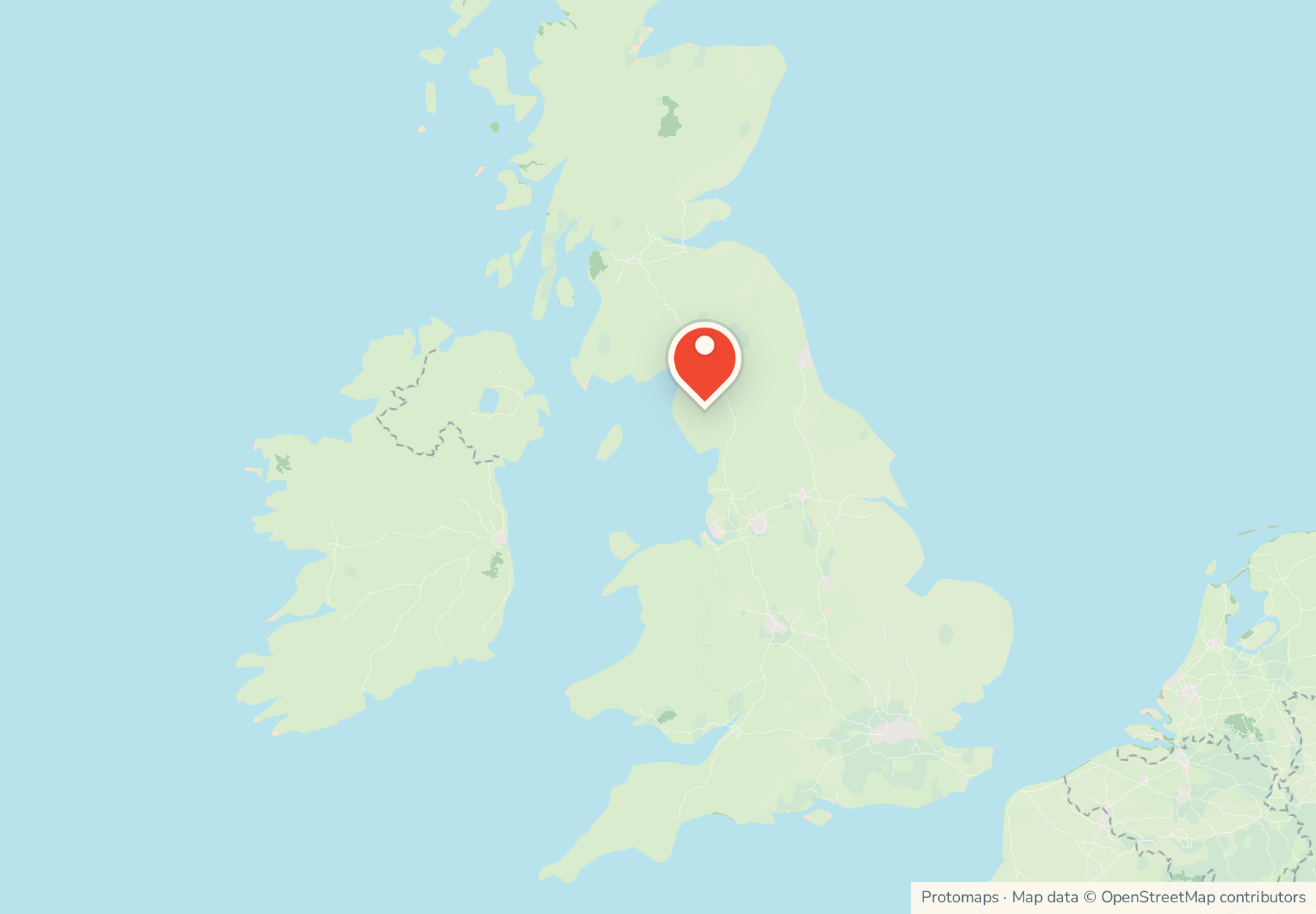
Map of the main family areas
An orientation map of the bases above, the lakes and the bigger days out. The numbers match the key beneath.
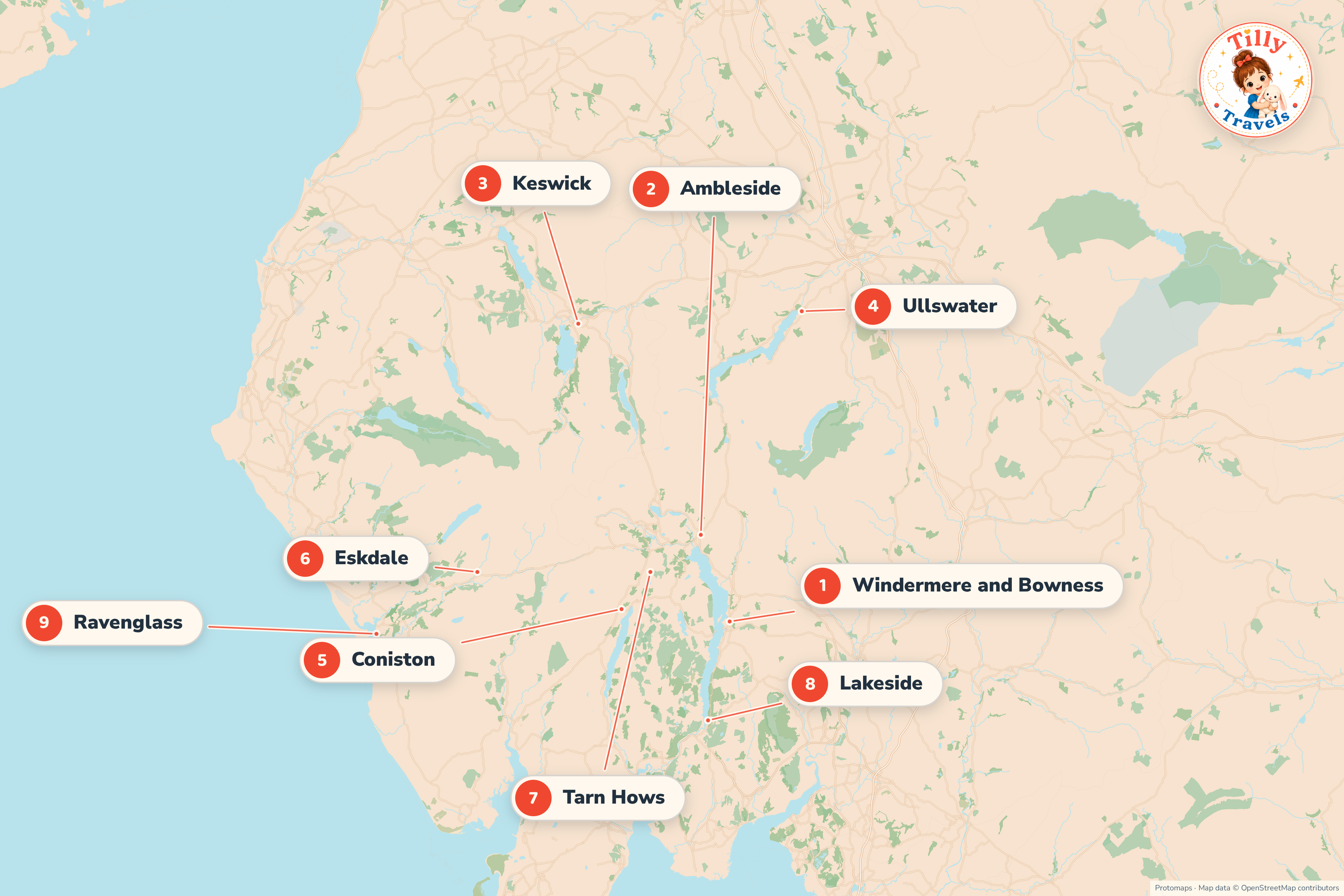
- 1Windermere and Bowness The main hub
- 2Ambleside Small-town base
- 3Keswick Derwentwater and the north
- 4Ullswater Steamers and Aira Force
- 5Coniston Gondola and the Old Man
- 6Eskdale The quiet west
- 7Tarn Hows The flat buggy circuit
- 8Lakeside Aquarium and steam train
- 9Ravenglass The narrow-gauge railway
Lakes and water with little ones
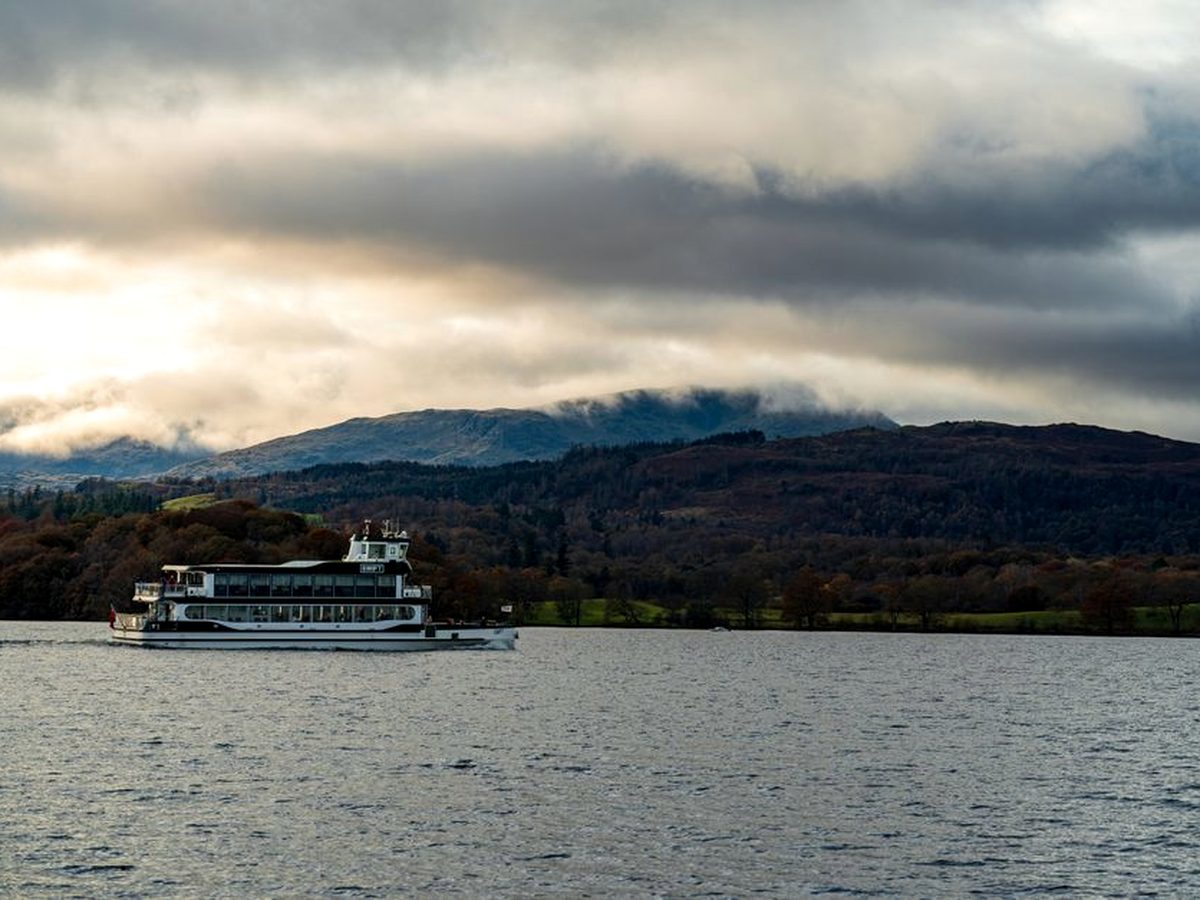
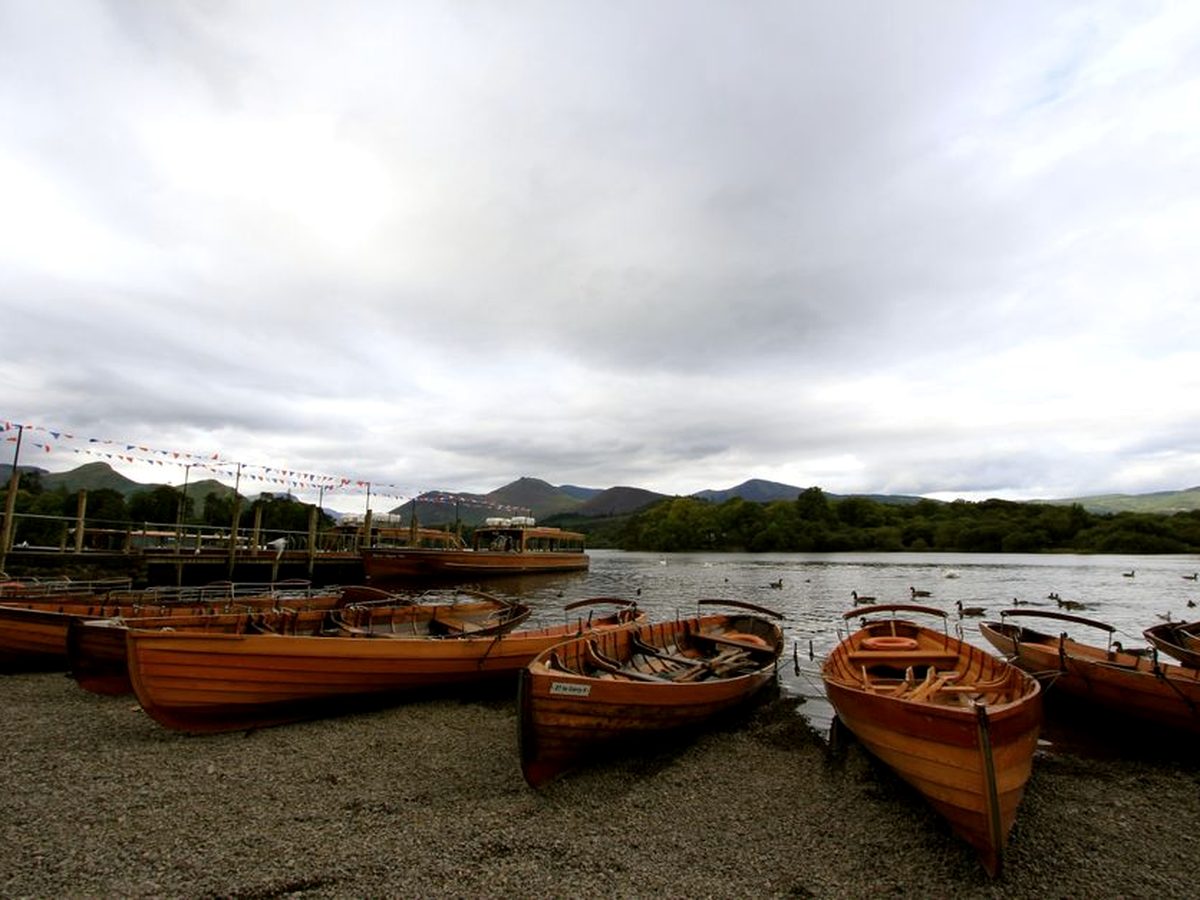
The lakes are the centre of a family trip, and the easiest way onto them is a cruise. Windermere Lake Cruises run from Bowness, Ambleside and Lakeside, with a 45-minute round trip that is the right length for a toddler and covered decks for the rain. Ullswater has its steamers, Derwentwater its launch from Keswick, and Coniston the restored Victorian steam gondola, all of them a sit-down boat ride with no walking.
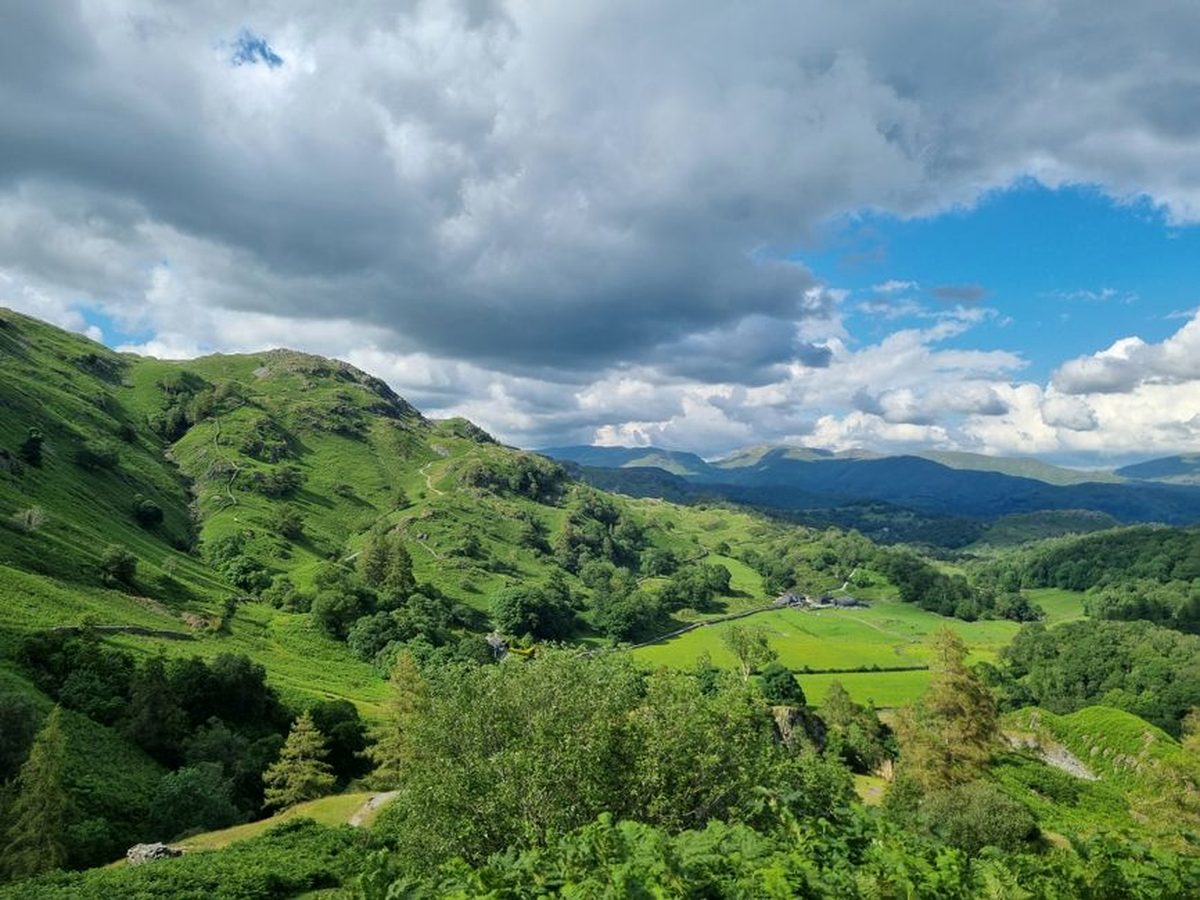
On foot, the low-level walking is some of the best in England. Tarn Hows near Coniston is the standout, a flat gravel circuit of under 2 miles (3 km) around a mountain tarn that the National Trust flags as suitable for prams. The old railway path from Keswick to Threlkeld is tarmac and flat, Fell Foot park at the foot of Windermere has lakeshore paths, a playground, free balance bikes and supervised paddling, and the National Park's Miles Without Stiles routes list dozens more that avoid steps and steep ground. The water is cold all year, so paddling means shallow edges and close watching, not a swim.
Weather, wet days and days out
When to go, the rainy-day plan, the days out that suit small children, eating out and where to stock up.
Weather, April to October
The figures below are long-term regional averages rather than a forecast. It rains a lot: the valleys get around double the English average and the fell tops far more. Showers blow through between brighter spells, a full week of unbroken rain is unusual, and the temperature rarely climbs out of the teens even in summer, so pack layers and waterproofs, not shorts.
| Month | Daytime high | Overnight low | Rain | Wet days |
|---|---|---|---|---|
| January | 7° | 1° | 218 mm | 18 |
| February | 7.5° | 1° | 192 mm | 16 |
| March | 9° | 2° | 167 mm | 15 |
| April | 12° | 3° | 114 mm | 14 |
| May | 15.5° | 5.5° | 114 mm | 13 |
| June | 17.5° | 8.5° | 109 mm | 14 |
| July | 20° | 10.5° | 108 mm | 12 |
| August | 19.5° | 10° | 133 mm | 13 |
| September | 17° | 8° | 153 mm | 14 |
| October | 13.5° | 6° | 242 mm | 19 |
| November | 9.5° | 3° | 216 mm | 20 |
| December | 7° | 1° | 230 mm | 18 |
Typical monthly averages from weather-station records.
For a family with young children, mid-May and June are the driest and quietest weeks of the year, before the schools break. Mid-September into early October is quieter again, with autumn colour, though wetter and with shorter days.
The rainy-day planWhen it rains
A wet day here is close to a given, so it pays to plan the indoor days. For the youngest, the World of Beatrix Potter at Bowness walks through the storybook settings in about an hour, the Lakes Aquarium at the south end has otters and a tunnel, and the heated family pool at Keswick has a shallow beach-style entry and a toddler slide.
Beyond those, the Rheged centre near Penrith has soft play and a giant-screen cinema, and there are farm parks with indoor barns at Lakeland Maze near Kendal and Walby near Carlisle, plus soft play in the towns. Brockhole on Windermere has free lakeside grounds and a play area, with a new indoor play attraction opening in 2026. The steam railways with enclosed carriages, the lake cruises and Grizedale's sheltered forest trails all work in poor weather too. Plan a couple of these into any week.
Filling the daysThings to do with little ones
The boats and trains are the backbone. A Windermere lake cruise, the Ravenglass and Eskdale narrow-gauge railway up its valley with under-fives free, and the combined steam-train-and-cruise day from Lakeside are all sized right for a small child and need no walking. The Windermere car ferry, a short chain crossing, is a cheap novelty on foot.
For the Beatrix Potter age, the World of Beatrix Potter in Bowness and Hill Top, her farmhouse across the ferry, are the actual places in the books, and much of the surrounding landscape is the one she drew. Tarn Hows is the easy walk everyone can do, the Gruffalo trails at Grizedale and Whinlatter forests suit 2-to-4s who know the story, and Fell Foot and the Lowther Castle adventure playground near Ullswater have room for toddlers to run. Aira Force on Ullswater is a short waterfall walk, with the meadow and lakeshore buggy-friendly and the falls themselves a carrier job.
Eating out with children
Self-catering is the norm here and takes the pressure off, but the pub-and-cafe scene is welcoming to children, with high chairs common in the towns and plenty of walkers' pubs with open fires to dry out in after a damp morning. Booking ahead matters in the busy towns in peak season.
The towns are well stocked with cafes, and a few local treats are worth the detour: Grasmere gingerbread from the tiny shop in the village, sticky toffee pudding as a local speciality, and Kendal mint cake for the journey home. A fold-up seat that clamps onto the edge of a table is worth packing for the smaller places that have no high chair.
Nappies, milk and the big shopSupplies and pharmacies
Shopping is straightforward in the main towns. Windermere and Kendal have the biggest supermarkets, including a Booths, and there are shops and a Boots in Ambleside, Keswick and Penrith.
The gap is the remote west. Eskdale, Wasdale and the smaller valleys have little more than a village shop, and the nearest pharmacy can be a long drive, so the sensible move is to do the big shop in a town on the way in and carry enough of anything your child relies on.
Getting around, a real week and the admin
Getting around, what a week actually looks like, the health and admin and a list to pack against.
Getting there and around
Most families drive, up the M6 to Junction 36 for the south lakes or Junction 40 for the north, then onto narrow roads for the last stretch, which can take longer than the map suggests in summer. The train is a good alternative for a Windermere base, reaching Oxenholme on the main line from London in around two and a half hours and branching to Windermere town, and the 555 bus then links Windermere, Ambleside, Grasmere and Keswick along the spine.
On the ground a car opens up the quieter valleys and the western lakes, where buses are thin or absent and the roads are single-track with passing places. Parking is the daily headache: the car parks at Bowness, Ambleside and Keswick fill before mid-morning on summer days, so an early start, a midweek visit or a remoter car park makes a real difference.
Underfoot, the lakeshore promenades, the Keswick railway path, Tarn Hows and the Miles Without Stiles routes are flat and buggy-friendly, but the town centres can be tight and crowded and almost everything that climbs is a carrier job. Many of the flat paths are gravel rather than tarmac, so an all-terrain buggy with air tyres rolls over them far more easily after rain than a narrow city pushchair. A buggy rain cover and a carrier together cover most conditions.
For a flat stroll from the two busiest bases, Cockshott Point and the Glebe Road loop give a level waterfront walk from the Bowness piers, and Friar's Crag is a flat 20-minute lakeshore walk from the middle of Keswick.
What a real week looks likeA realistic week with little ones
Settle in and stock up; a short lakeshore walk near the base. Nothing ambitious on arrival day.
A lake cruise in the morning, lunch by the water, then paddling and balance bikes at Fell Foot. Back before the evening routine.
The Beatrix Potter attraction and the aquarium together, or the heated pool at Keswick. Planned, not improvised.
The flat circuit at Tarn Hows, or the Gruffalo trail at Grizedale, with a carrier for the bits a buggy can't manage.
A gentle morning, the Windermere car ferry for the novelty, and home down the M6.
Check the forecast each morning, save the boats and walks for the brighter days and the indoor places for the wet ones, and keep to two activities a day so the nap still fits.
The practical adminHealth and admin
The nearest hospital to the south lakes, Westmorland General in Kendal, has an urgent treatment centre but not a 24-hour A&E, so emergencies go to Lancaster or Carlisle, the latter with a children's A&E. The remote western valleys are 40 minutes or more from emergency care with patchy mobile signal, so carry enough of any regular medicine and a basic first-aid kit including a tick tool.
Day to day the real risks are the water, the weather and the wildlife. The lakes are cold all year, cold enough to cause a gasp on sudden immersion and deep close to shore in places, so keep paddling to the shallow supervised edges and off any water with a blue-green algae scum. Ticks live in the bracken and long grass and can carry Lyme disease, so cover legs on grassy walks and check children afterwards. The weather on the tops changes fast, which is another reason to keep little ones at lake and valley level.
Before you payBooking checklist
- Plan a base on the spine (Windermere, Ambleside or Keswick) for a first trip, or a quieter lake if you have a car.
- Build a wet-day plan in before you go: the aquarium, the Beatrix Potter world, the Keswick pool.
- Pack full waterproofs for everyone, including the baby, and a buggy rain cover.
- Bring a carrier for the walks and the waterfall paths; leave the pushchair for the flat circuits.
- Aim for mid-May or June for the driest, quietest weeks.
- Plan early starts for the car parks at the honeypot towns, or go midweek.
- Confirm a cot, and ask a cottage about stairs and an enclosed garden.
- Pack a tick tool and check children after grassy or bracken walks.
- Do the big shop in a town before heading to a remote valley.
- Bring enough of any medicine your child relies on for the whole trip.
Resort guides in Lake District
We've researched these places to stay in Lake District for families with young children. Each guide covers what it's like, who it suits and what to check before you book.
Questions, links and the last word
The things families ask most, the official pages worth a bookmark and when this guide was last refreshed.
Common parent questions
Can we do it with a baby or toddler, given the mountains?
Yes. You skip the fells and keep to lake and valley level, where there's plenty for a small child: cruises, Tarn Hows, the Keswick railway path, Fell Foot and the Miles Without Stiles routes. A carrier covers anything that climbs.
How bad is the rain?
Bad enough that you build a wet day into every week and don't treat it as a write-off. There's a fair bit to do under cover: the aquarium, soft play, the Keswick pool, the lake boats and the enclosed steam carriages. Everyone needs full waterproofs, the baby included, plus a buggy rain cover.
Do we need a car?
You can manage without one if you base yourself on the train line at Windermere and lean on the 555 bus along the central spine. Anywhere off that line, the quiet valleys, the western lakes and most of the smaller days out, you'll want a car.
Which base suits a first trip?
Windermere and Bowness, with the train and the most within walking distance, though it's also the busiest. Ambleside, just up the lake, is calmer with the same conveniences. Keswick to the north is a market town with an outdoors slant and a heated pool. Ullswater and Coniston are quieter and scenic with a car.
When is the best time to go with little ones?
Aim for mid-May and June: the driest and quietest weeks, with long daylight and the schools still in. Early autumn, mid-September into October, is quiet again and colourful, if wetter and darker by evening. The summer holidays bring the warmth but also the crowds, the highest prices and the wettest of the summer months.
Is the open water a danger?
Treat it like the sea. Keep paddling to shallow, supervised spots such as Fell Foot, keep little ones off jetties and rocks when you're not right beside them, and avoid any water with a blue-green algae scum on it. The cold and the steep drop close to shore are the things to respect.
What about ticks?
Ticks are a real risk here. They live in bracken and long grass and can carry Lyme disease, so tuck trousers into socks on grassy walks and check children over the same evening, especially the hairline, behind the ears and the backs of the knees. Pack a tick tool to remove any you find.
What if someone is ill or hurt?
For minor things, Westmorland General in Kendal has an urgent treatment centre, though no round-the-clock A&E, and there's a children's A&E at Carlisle. The catch is the west: from Eskdale or Wasdale you're a long way from help with patchy phone signal, so pack a first-aid kit and bring your own supply of any medicine.
See more Lake District photos
Open the photo gallery →Useful links
- Lake District National Park: planning, parking and the Miles Without Stiles accessible-walk routes.
- Visit Lake District: areas, attractions and what's open while you're there.
- Windermere Lake Cruises: routes, fares and the combined steam-train day.
- Miles Without Stiles: the flat, step-free walks for buggies.
- AdventureSmart Lake District: weather and safety before any higher walk.
Last updated 17 June 2026.