Lake Garda with little ones
Lake Garda is the first place we cover with no sea at all. Italy's biggest lake has its own Mediterranean-like climate, with olive groves and lemon terraces growing at the latitude of Montreal, and calm, waveless water at flat-entry lidos. Families here stay differently too, most of them in vast, pool-stacked campsite-resorts along the southern shore, with ferries for the day trips and Gardaland one field inland when you want it.
On this page
A family verdict at a glance
The quick read before the detail: who Lake Garda suits, the season to aim for and what to nail down before you book.
Best for
Calm, waveless swimming, campsite-resorts built for children, ferry days below the mountains and summer heat that stays liveable.
Maybe not for
If you want sand to build castles in, or you'll be driving in August: the shores are pebble and grass, and the lakeside roads jam solid at peak weekends.
Best ages
Babies through to young children from June to September; the lake is too cold for small swimmers before then.
Best areas
Lazise as the family hub, Peschiera for the trains and ferries, Riva del Garda for the Alpine version.
Why families pick it
A two-hour flight to pools, playground lidos and boat rides, with Verona and a theme park in day-trip range.
Check before you book
The campsite or hotel's pool for the cooler months and the car-hire extras Italy requires for small children.
A lake, not a coast
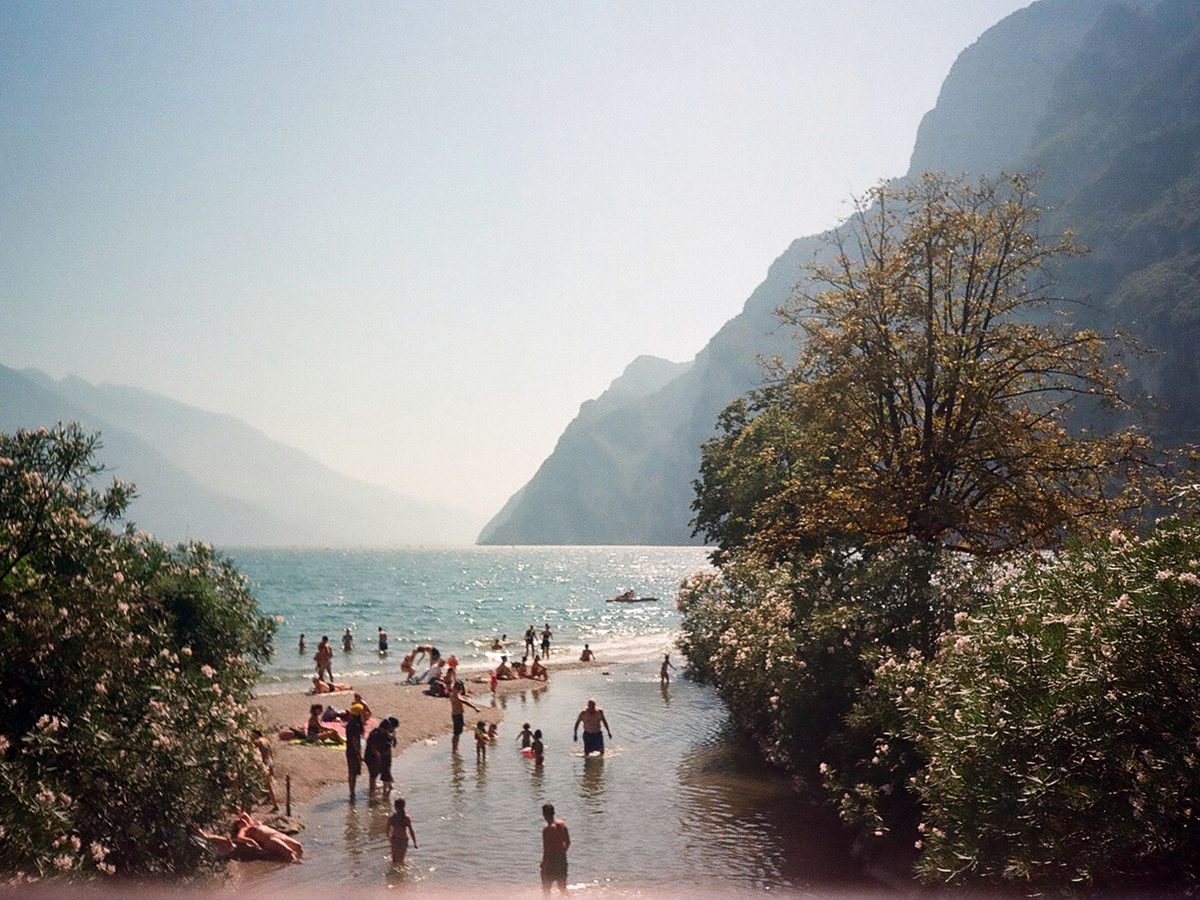
There's almost no sand here, and the water is fresh, calm and cold for half the year. The shores are pebble, gravel, mown grass or, at Sirmione's Jamaica Beach, flat shelves of smooth rock; the fine-sand lidos at Lazise, Spiaggia d'Oro and Spiaggia la Marra, are the exception. From June to September the south of the lake warms to comfortable, waveless swimming, and the lido culture supplies playgrounds, cafés and shade behind nearly every swimming spot.
The microclimate is the other half of it. The lake is a vast thermal store, so olives and lemons grow at 45 degrees north and July peaks around 30 degrees rather than Spain's low-to-mid-30s, which is easier with a baby. Expect afternoon thunderstorms that pass within the hour, mosquitoes in the southern summer and little open outside April to October.
A quick gut checkIs Lake Garda right for your family?
Worth comparing if
You want calm water, green scenery and a campsite-resort or aparthotel week where children outnumber adults.
Weigh it up if
The holiday must involve sand and a warm sea in May, or you plan to drive everywhere in August.
To sort out before booking
The base (south triangle or Riva), the pool situation for shoulder months and the train-versus-car arrival plan.
The numbers, the basics and the ages
Everything you'd want to skim first: the quick facts, the everyday practicalities and how Lake Garda changes as children grow.
Quick facts for UK families
Money, plugs, language and the basics
- Lake Garda is Italy's largest lake, 32 miles (52 km) long, with the Alps closing in at the narrow northern end and the flat family shores in the south.
- The currency is the euro and cards are accepted almost everywhere; small change helps at lido kiosks and parking machines.
- Sockets are the round two-pin European type, so UK plugs need an adapter. The voltage matches the UK.
- The language is Italian, with German often the second language of the lake's tourism; English works fine throughout the family areas.
- The clocks run one hour ahead of the UK, including the change dates.
- Tap water is alpine-fed and safe everywhere, including for making up formula once boiled, as at home.
- Your GHIC card covers Italy's state system; 112 is the general emergency number and 118 calls an ambulance directly.
- Each lakeside comune charges its own small tourist tax, typically a euro or two per adult night; children are exempt below an age that varies by town, so check at the hotel.
Lake Garda by age and stage
Babies
Mild heat, shade everywhere and pools at every family base; in July and August keep them in shade through the middle of the day. The mosquito kit isn't optional.
Toddlers
Flat-entry paddling, boats to watch from the quay and campsite splash parks built for exactly this age.
Preschoolers
Peppa Pig Land, the drawbridge castle at Sirmione, the trenino through the gardens at Sigurtà and a waterfall you walk inside.
Young children
The rotating cable car, bikes on the lakeside paths, the bigger slides and a first proper go at Verona.
Where to base yourselves
The towns and campsite belt side by side, an orientation map of the lake and how the swimming works.
Where to stay with young children
The first decision is the type of stay, because the lake does family accommodation differently. The southern and eastern shore between Peschiera and Bardolino holds some of Europe's largest campsite-resorts, and the word campsite is misleading: mobile homes and bungalows rather than tents, multiple pools with slides, kids' clubs, evening entertainment and direct lake access, run to Dutch and German standards. Piani di Clodia at Lazise runs to 29 hectares and seven pools. A campsite-resort or a family aparthotel is how most UK families with small children stay here, and it's why a car is worth more than it would be on a town-based trip.
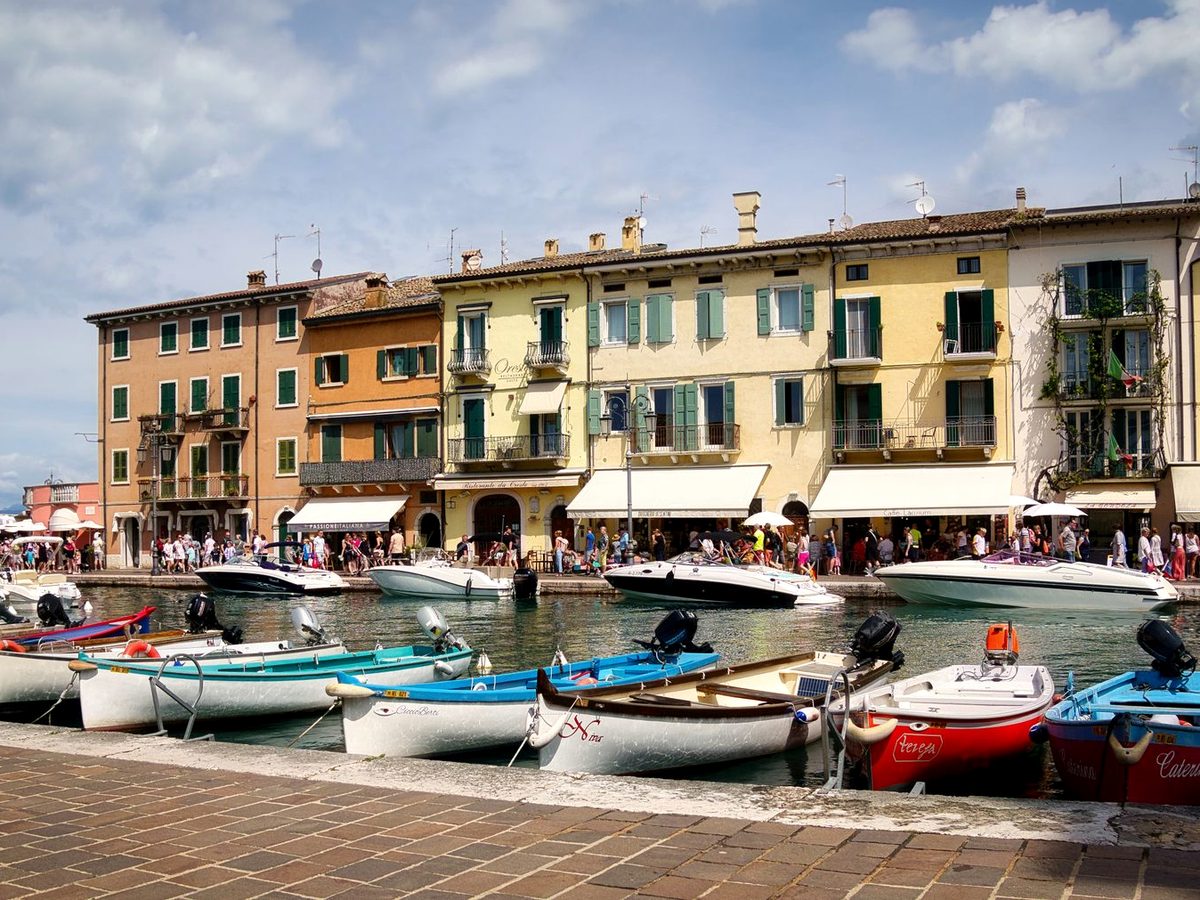
The towns differ in feel. Lazise is the family hub: a flat little walled town with a harbour, playgrounds and the lake's rare fine-sand lidos, surrounded by the campsite belt and closest to the theme parks. Peschiera del Garda is the transport answer, a walled Venetian town on the Milan-Venice railway with the ferry quay in the middle and Gardaland a mile (1.6 km) inland; its beaches are pebbly with a shallow entry along a flat lakeside path. Desenzano, the lake's biggest town, has the other mainline station, a more local feel and the ferry to Sirmione; Bardolino gives Lazise's lakefront life at a smaller, quieter scale, joined to it by a flat cycle path.
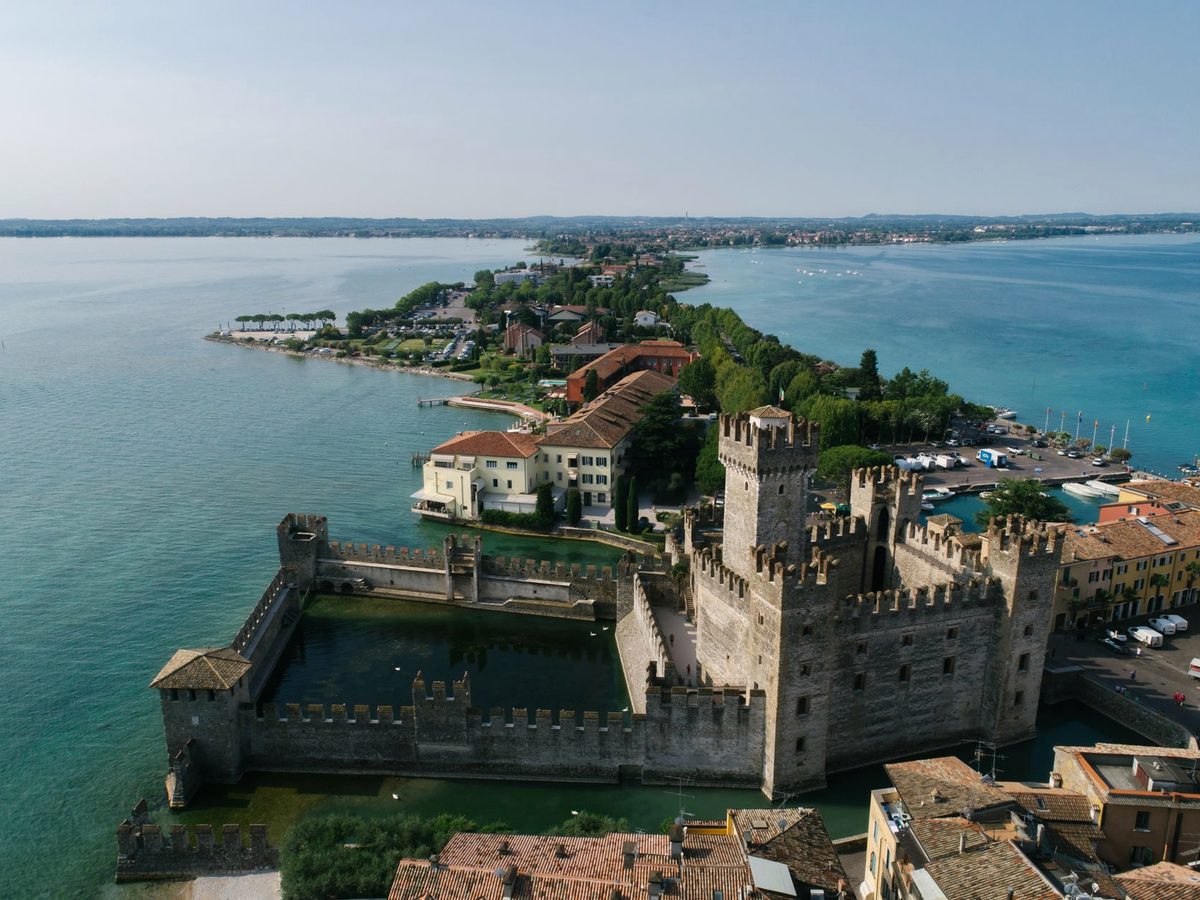
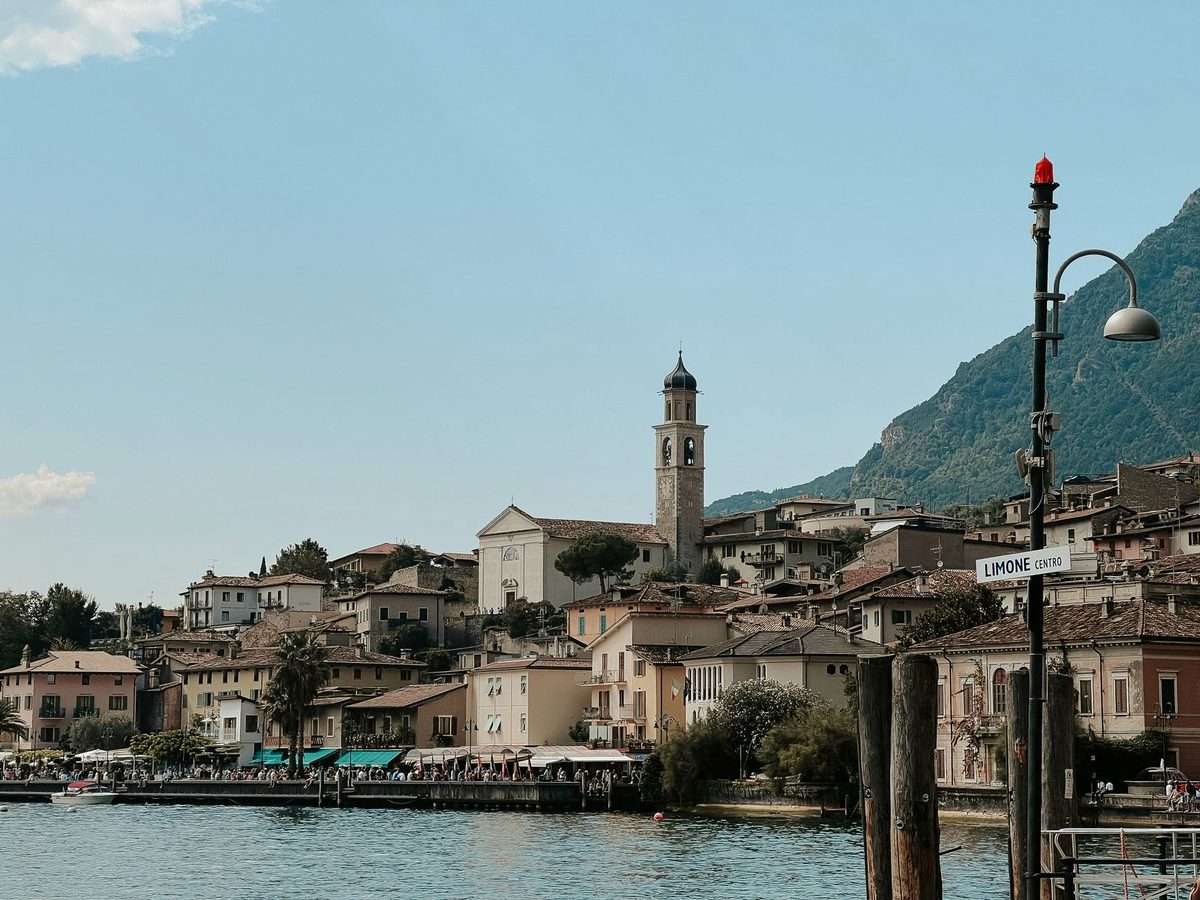
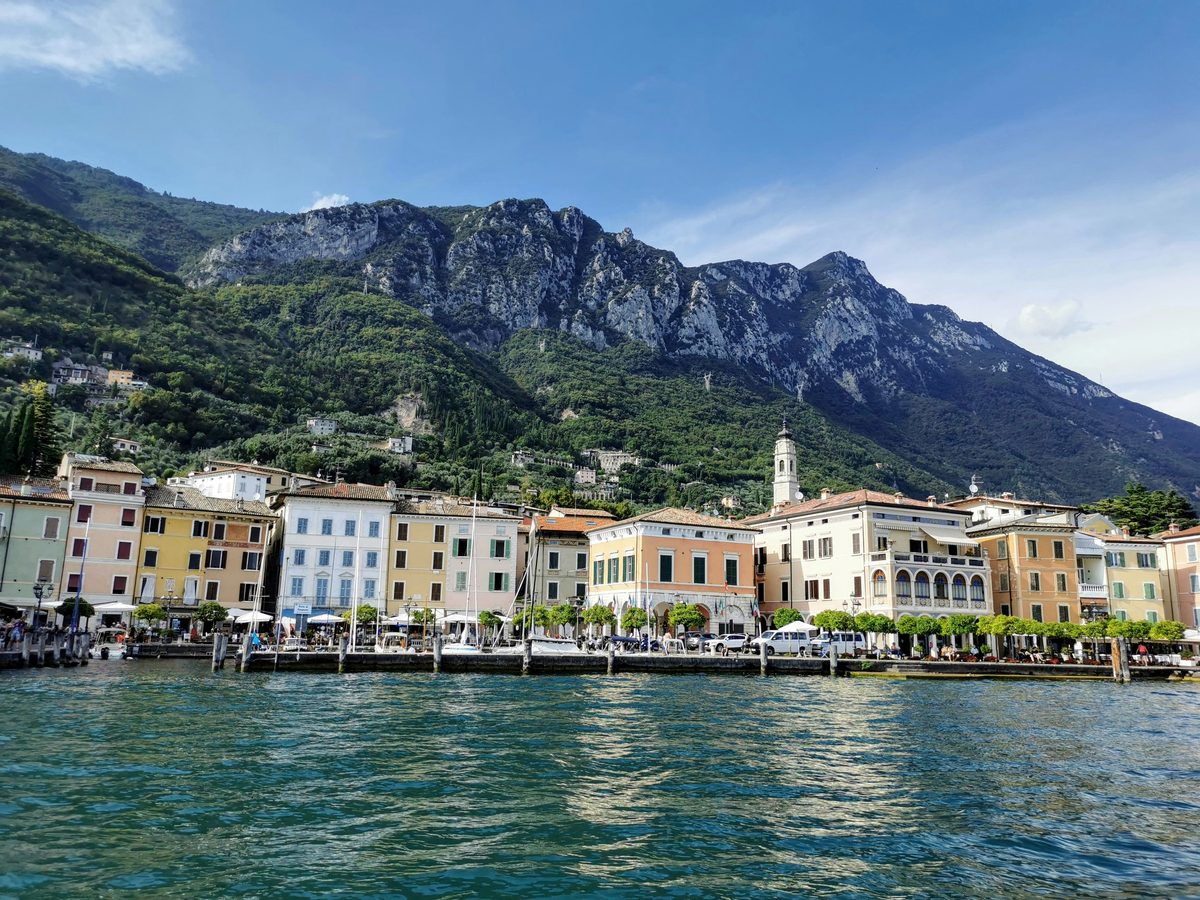
Sirmione is a 2.5-mile (4 km) spit ending in a moated castle and Roman ruins, with one narrow road in, camera-enforced traffic zones and serious summer crowds. Visit by ferry and it's easy; basing there with a car takes patience. At the far end of the lake, Riva del Garda is the one northern town that works as a family base, flat and pedestrianised under proper Alpine walls, with the free pebble-and-grass Spiaggia dei Sabbioni and its playground, cooler air and fewer mosquitoes; the water deepens faster up there, so it needs closer supervision than the shallow southern shore. Limone and Malcesine, steep and stacked up the cliffs, are day trips rather than bases with a buggy.
| Area | Transfer | The swimming | The feel |
|---|---|---|---|
| Peschiera del Garda | 25 to 35 min | Pebbly town beaches with shallow entries along a flat lakeside path | The walled rail-hub town: trains on the Milan-Venice line, the ferry quay and Gardaland a mile (1.6 km) away. |
| Sirmione | 35 to 45 min | The flat rock shelves of Jamaica Beach and pebbly Bionde on the spit | The narrow spit ending in a moated castle. One road in, serious summer crowds; arrive by ferry. |
| Desenzano | About 35 min | Pebble beaches and the bigger of the two railway stations | The largest town, more local than resort, with Sirmione 20 minutes away by ferry. |
| Lazise | About 40 min | The lake's rare fine-sand lidos, with playgrounds and gentle entries | The family hub: flat lanes, a harbour to dawdle round and some of Europe's biggest campsite-resorts either side. |
| Bardolino | About 45 min | Mixed gravel and lawn lidos along a long waterfront promenade | Smaller and quieter than Lazise, joined to it by a flat lakeside cycle path. |
| Riva del Garda | About 1¼ hours | A free pebble-and-grass beach with a playground; the water deepens quickly | The northern option: a flat, pedestrianised town where the Alps drop into the lake. |
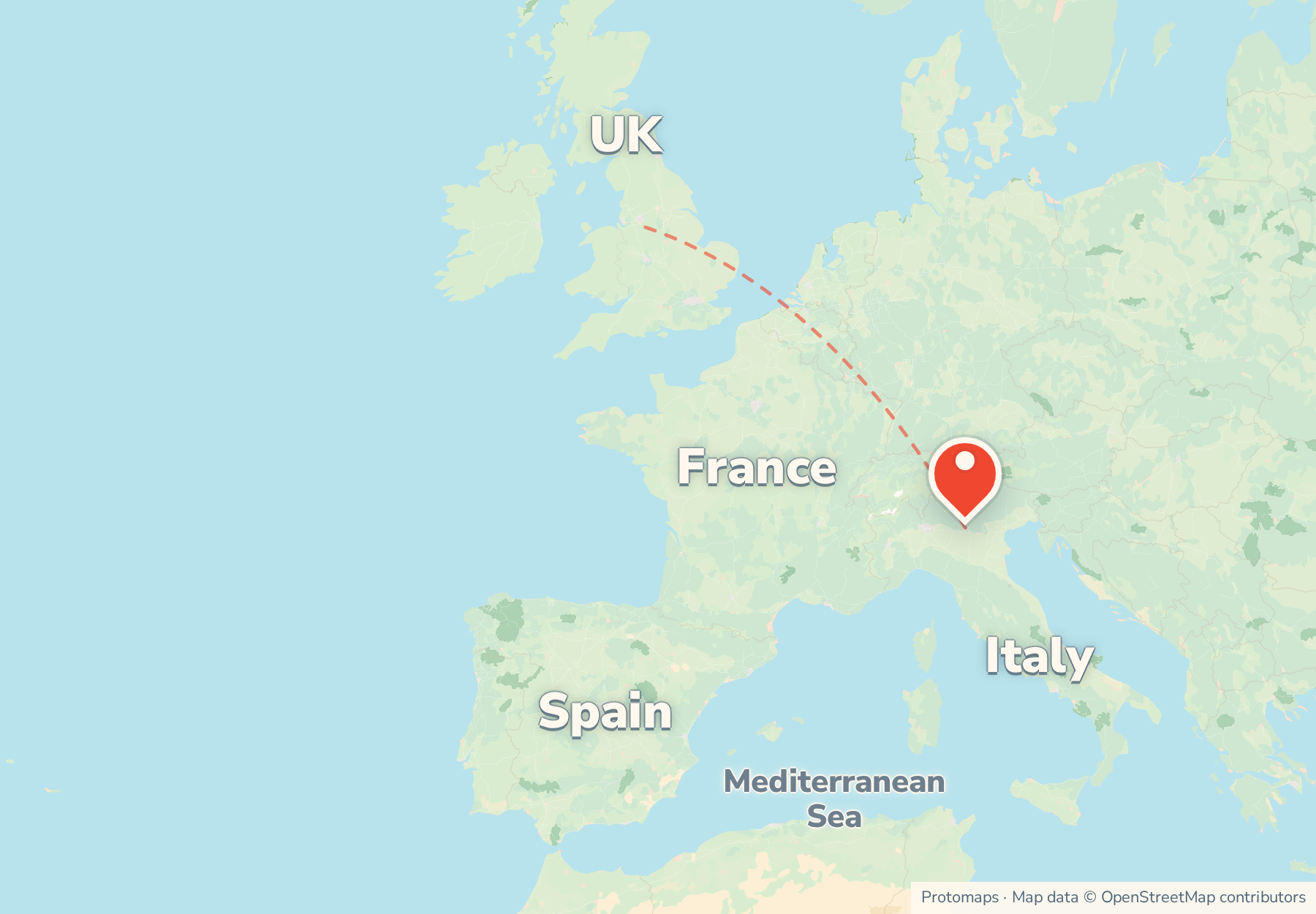
Map of the main family areas
An orientation map of the areas above, the airport and the big days out. The numbers match the key beneath.
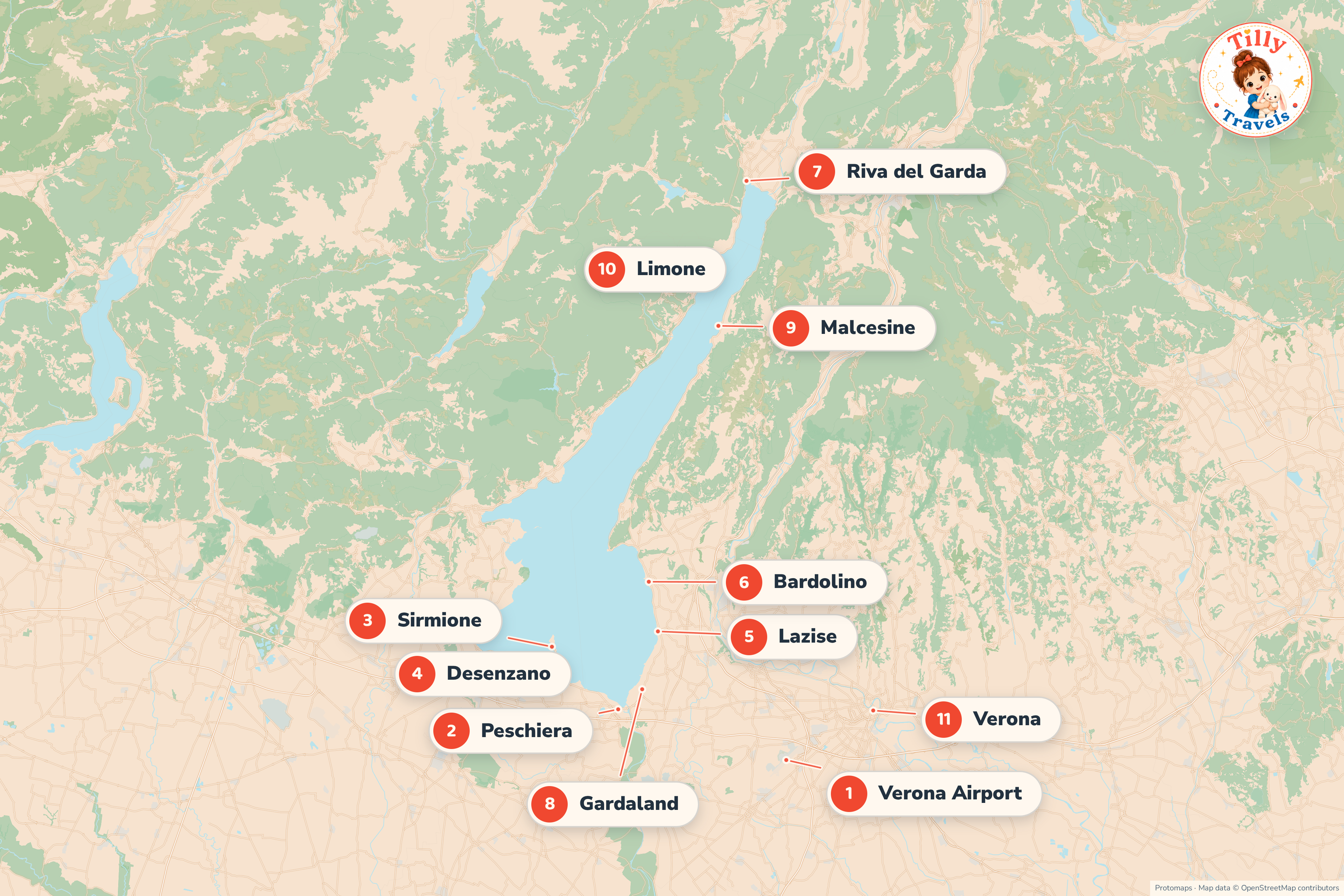
- 1Verona Airport 25 to 45 minutes out
- 2Peschiera Trains, ferries and the park
- 3Sirmione The castle peninsula
- 4Desenzano The biggest town
- 5Lazise The family hub
- 6Bardolino The quieter neighbour
- 7Riva del Garda The Alpine end
- 8Gardaland The theme park
- 9Malcesine The cable-car village
- 10Limone Lemons and the cliff path
- 11Verona The Roman day trip
Swimming in the lake
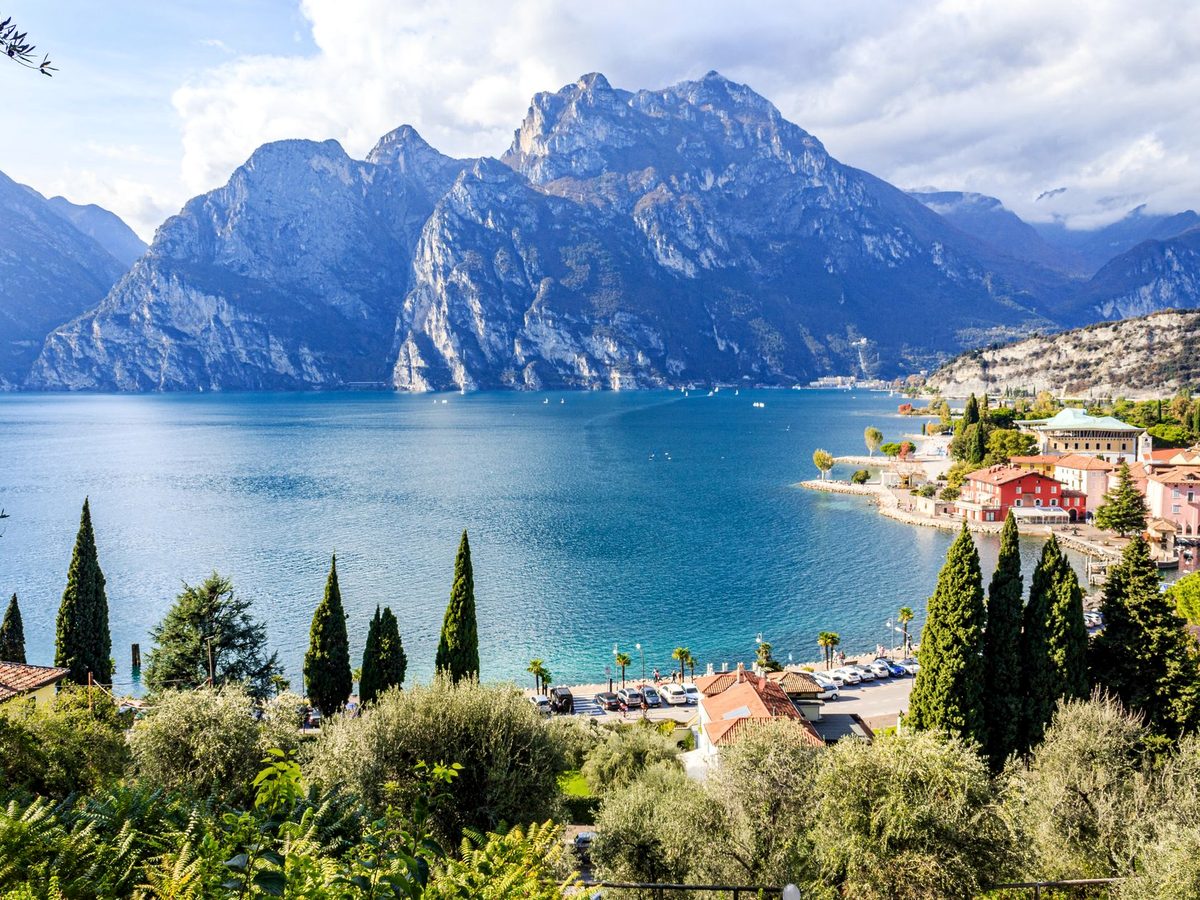
The south is shallow, warm and calm, which is why the family resorts cluster there: Lazise's sandy lidos and Peschiera's pebble stretches shelve gently, Sirmione has the flat rock terraces of Jamaica Beach at the peninsula's tip and the more conventional pebbles of Bionde on its sheltered side. The north is deeper, cooler and breezier, with morning and afternoon winds that make Torbole and Riva a windsurfing capital and the southern end correspondingly calmer for small children. Managed lidos charge a few euros for beds and shade and usually back onto a playground and a café; free stretches sit between them, and the campsite-resorts have their own.
Water temperature drives the timing here more than at the coastal places we cover: the lake stays cold late into spring, so May swimming is for the brave, June reaches 18 to 22 degrees and August peaks around 25 in the southern shallows. Lifeguard cover varies lido by lido, and hard stones underfoot are the rule at every entry.
Weather, days out and the daily shop
When to go through the season, the ferries and days out that suit small children, eating out and where to stock up.
Weather, April to October
The figures below are long-term averages for the southern shore. The pattern is alpine-Mediterranean: rain spread through the year rather than banked into winter, summer heat held down by the lake's bulk, and two daily winds, the morning Peler and afternoon Ora, that the northern sailing crowd live by.
| Month | Daytime high | Overnight low | Rain | Wet days |
|---|---|---|---|---|
| January | 7° | -0.5° | 44 mm | 6 |
| February | 10° | 0° | 38 mm | 5 |
| March | 15° | 3.5° | 42 mm | 5 |
| April | 19° | 7.5° | 67 mm | 8 |
| May | 24° | 13° | 70 mm | 8 |
| June | 28.5° | 17° | 62 mm | 7 |
| July | 30.5° | 19° | 67 mm | 5 |
| August | 30.5° | 18.5° | 75 mm | 6 |
| September | 25.5° | 14.5° | 75 mm | 6 |
| October | 19.5° | 10° | 65 mm | 7 |
| November | 13° | 4.5° | 87 mm | 8 |
| December | 8° | 0.5° | 64 mm | 8 |
Typical monthly averages from weather-station records.
July and August are the hottest and busiest months, the school holidays, so that's when most families come. June and September are quieter and still warm, and the lake is swimmable from June, so they suit families who can travel outside term time. There's the odd afternoon thunderstorm in summer, a few days a month, heavy for an hour then gone, so pack the buggy's rain cover and have an indoor option in mind for a wet afternoon.
Filling the daysThings to do with little ones
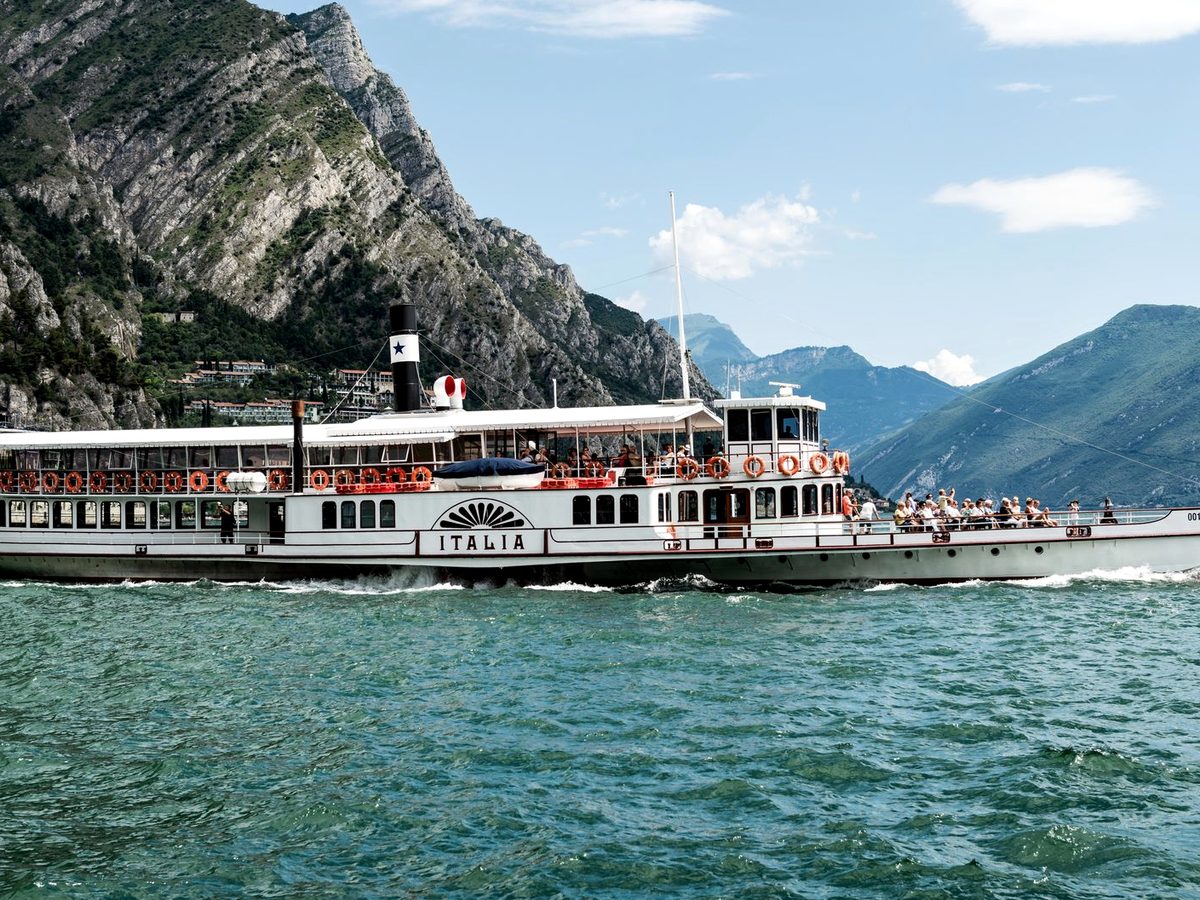
The cheapest good day out with a small child is the ferry. The slow boats stop everywhere, take buggies with a steadying hand from the crew, and carry under-fours free and four-to-elevens at half fare, with a family deal giving two free child tickets per two adults; Peschiera to Sirmione is about twenty minutes each way. The full-length cruise from Desenzano to Riva runs about four hours each way, a day in itself for boat-mad children. The fast hydrofoils charge the supplement for every passenger, free toddlers included, so the slow boat is the better-value ride. A car ferry also crosses mid-lake, a useful August shortcut when the shore roads clog.
Gardaland suits a toddler from about two, with Peppa Pig Land and Fantasy Kingdom the real itinerary at that age; there are plenty of gentle days out nearby too. Parco Giardino Sigurtà, twenty minutes south of Peschiera, is an excellent outing for little ones: 600,000 square metres of gardens with deer, donkeys and farm animals, flat paths and a panoramic trenino that loops the whole park in 35 minutes, free for under-fours with under-ones-metre children free on the train too. Parco Natura Viva at Bussolengo, about twenty minutes from the south-east shore, is a drive-through African safari you do from your own car plus a walk-through zoo of more than 1,500 animals through oak woodland, open from March to early January and a real hit with small children. Neighbouring Borghetto sul Mincio puts working waterwheels, a river bridge and tortellini restaurants in one flat little hamlet. Sirmione's castle has the working drawbridge and moat, with 146 steps to the battlements for whoever climbs, and the Roman villa ruins at the peninsula's tip are open ground for running, with a real Roman holiday villa to show older siblings; note that the free entry for under-18s at Italian state sites is an EU-citizen benefit, so UK families should check at the desk and treat free entry as a bonus. Verona is thirteen minutes by train from Peschiera, and the toddler version is the arena from outside, a piazza, a gelato and home by nap time.
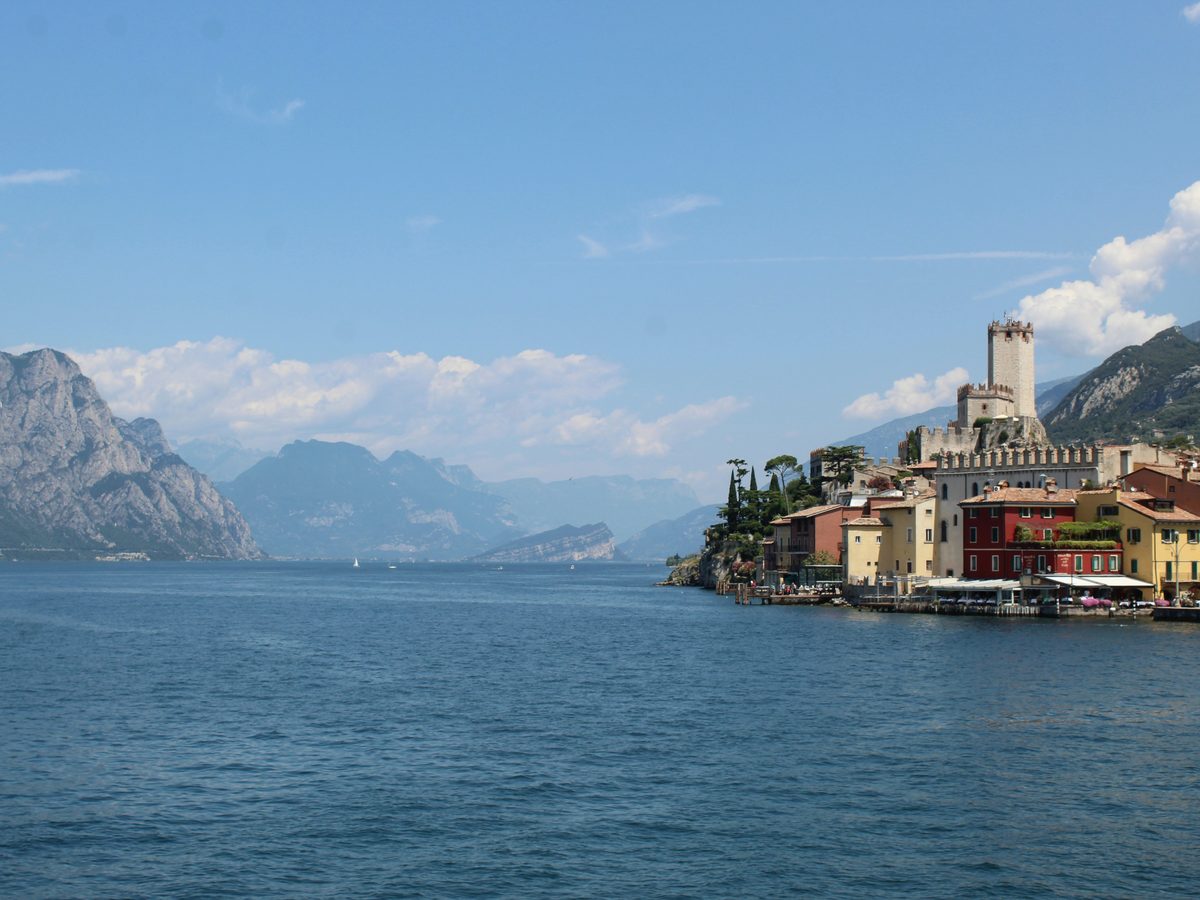
The northern outings climb into the Alps. The rotating cable car from Malcesine climbs to 1,760 metres on Monte Baldo in fifteen minutes, under-1.2-metre children free, open buggies carried for a €10 surcharge (last checked June 2026), with a layer packed because the summit runs ten degrees colder; it's fine for most toddlers and worth a GP chat first for young babies, given the fast climb. Riva's flat lakefront does bikes, playgrounds and ice cream below the cliffs, and the Cascata del Varone nearby is a waterfall you walk inside, a carrier job with about seventy steps; you will get wet, and disposable waterproofs are sold at the entrance. Limone's cantilevered cliff path, hanging fifty metres over the water, is flat and buggy-rated, with the medieval lemon houses in the village below. The water parks at Lazise, Caneva Aquapark and the Legoland water park inside Gardaland cover the hottest weeks, with the youngest entering free (under 90cm at Gardaland's LEGOLAND Water Park, under a metre at the Lazise parks). Movieland alongside Caneva has less for small children than Gardaland.
Eating out with children
Italy is one of the easiest countries in Europe to feed a small child, and the lake adds a northern-resort practicality: kitchens open earlier than the deep-Italian norm, high chairs are common in the family zones and a mezza porzione, the half portion, is a normal request. Pasta, pizza and gelato need no translation; the local cards are lake fish, the Garda DOP olive oil from Italy's northernmost groves and, at Borghetto, the tortellini the village is built around.
The campsite-resorts run their own restaurants and pizzerias at family volume, which helps on tired evenings. In the towns, the lakefront tables charge for the view; a street back, the same food costs less.
Milk, nappies and pharmaciesSupplies and the first-day shop
The supply run is painless. Supermarkets cluster around the southern towns, with an Esselunga at Desenzano the biggest single shop, Lidl and the Italian chains filling the gaps, and the campsite minimarkets covering forgotten items at resort prices. Pampers sells as Pampers, the nappy aisles run deep, and formula spans Aptamil plus the Italian names Mellin, Plasmon and Humana in supermarkets and pharmacies both; stages differ slightly from UK tins, so bring enough to bridge and compare by age band. With the tap water safe for making up formula, there's no bottled water to buy.
The farmacia, green-crossed and everywhere, is the route for medicines: Tachipirina is the children's paracetamol every Italian parent knows, ibuprofen syrups sit alongside, and the out-of-hours rota hangs on the door. The mosquito shelf, plug-ins, infant-safe sprays and after-bite, is worth a visit on day one in summer.
Getting around, a real week and the admin
Transfers and hire cars, what a week actually looks like, the health and document checks and a list to pack against.
Getting there and around
Verona is the main door, two hours from the UK with Jet2, easyJet, Ryanair, TUI and BA in season, and the southern shore 25 to 45 minutes beyond it by taxi or pre-booked transfer; Bergamo serves the Ryanair routes at about an hour and a quarter, with a cheap FlixBus running direct to Peschiera. The underused alternative is the train: Peschiera and Desenzano sit on the Milan-Venice main line, under an hour from Milan, and a regional stop serves Gardaland directly, so a Milan arrival can skip the hire car entirely. Italian law requires child seats as usual, and under-fours must also have an anti-abandonment alarm device on the seat; hire desks don't all stock them, so confirm when booking or bring your own seat with the sensor.
Around the lake, families move on the ferries and the flat southern cycle paths. The roads need watching in August: the lakeside Gardesana runs a single lane each way through every village, peak weekends add half again to journey times and Sirmione's approach is the worst of it. Park-and-ride beats the ZTL camera zones in the old towns, buses are too thin to plan around, and the south triangle works car-free on trains, boats and bikes.
What a real week looks likeA realistic week with little ones
A short hop from Verona airport, the pool or the lido, and pasta by the harbour at six.
Water-shoed paddling in the morning, lunch and a nap, then the playground, the pool or an ice cream on the promenade.
The slow boat somewhere for lunch, a castle or a gelato, and the slow boat back.
Gardaland's Peppa Pig Land from a southern base, or the rotating cable car up Monte Baldo from the north.
A final swim and a slow pack, with the Gardesana traffic budgeted for if it's an August Saturday.
With young children, the lido, the pool, one ferry day and one bigger outing fill a Garda week, and the campsite-resorts are built so that some days never leave the gate.
The practical adminHealth, documents and the boring bits
Check the GOV.UK Italy advice before booking and travelling. Passports need to be issued within the last ten years and valid three months beyond departure, children's included. Carry a GHIC each plus travel insurance: the GHIC covers Italy's state system, with hospitals at Desenzano and Peschiera serving the south shore and Arco covering the Riva end, and the out-of-hours Guardia Medica on 116117 for the non-emergency middle ground. The emergency numbers are 112 generally and 118 for an ambulance.
The hazard list is gentle: strong summer sun bouncing off the water, so the hats-and-cream drill applies even when the air feels mild; summer mosquitoes on the southern shore, where the same precautions also guard against West Nile Virus, which Veneto sees in some summers; cold water and sudden depth changes at the northern beaches; and the afternoon storms, which are dangerous on the water, since boats stop boarding when one arrives. Most lidos have no lifeguard, so you're the supervision.
Before you payBooking checklist
- Pack water shoes for everyone; the lake bed is pebble, rock or shingle, never sand.
- Going in May or October? Confirm the pool is heated and what's open in the resort.
- Hiring a car? Request the child seat and the under-four anti-abandonment device when you book.
- Arriving via Milan? Price the train to Peschiera or Desenzano before defaulting to a car.
- Book Gardaland tickets online if it's on the list; gate prices run well higher.
- Pack the mosquito kit for southern-shore summer stays: plug-ins, infant spray and a cot net.
- Visit Sirmione by ferry, not by car, in July and August.
- Pack layers for the cable car and a rain cover for the afternoon storms.
- Confirm the cot and the cancellation terms with the campsite or hotel.
- Recheck the GOV.UK Italy advice and every passport before you go.
Resort guides in Lake Garda
We've researched these places to stay in Lake Garda for families with young children. Each guide covers what it's like, who it suits and what to check before you book.
Questions, links and the last word
The things families ask most, the official pages worth a bookmark and when this guide was last refreshed.
Common parent questions
Is Lake Garda a beach holiday?
Not in the bucket-and-spade sense. Most family stays run on a campsite-resort pool and a managed lido with a playground and café behind it, and only Lazise has fine sand worth the name. The swimming itself suits small children well: calm, flat-entry water with shade and a cold drink a few steps back. The water shoes matter more than at the seaside, so pack a pair each and expect to use them daily.
Is Gardaland worth it with a toddler?
Yes from about two, with the right expectations. Under-90-centimetre children enter free, and Peppa Pig Land plus Fantasy Kingdom are the real itinerary at this age: boat rides, the balloon wheel, Grandpa Pig's train and a splash area, mostly without height limits. Book online, where prices drop well below the gate, arrive at opening and head straight there; you can skip the big coasters entirely. At the SEA LIFE aquarium next door, buggies are banned inside and the loan carriers only take babies under nine kilos, which strands a heavy crawler who can't yet walk.
Do we need a hire car?
Not for the southern triangle: trains reach Peschiera and Desenzano directly, the ferries do the lake-hopping and Sirmione is easier to reach by boat. A car is worth it if you base at a campsite-resort, want Sigurtà and Borghetto, or head north. One Italy-specific note if you do hire: children under four legally need an anti-abandonment alarm device fitted to the seat, which not every rental desk stocks, so request it when booking.
Which base suits a family best?
Lazise for the classic version: flat, sandy by this lake's standards, surrounded by the big campsite-resorts and near the theme parks. Peschiera if you're coming by train or want maximum transport options. Riva del Garda for the Alpine version, a flat and walkable town with cooler air, fewer mosquitoes and water that deepens faster. Sirmione is better visited than slept in unless you've made peace with the parking.
When is the lake warm enough for little ones?
Aim for mid-June onwards; before that it's paddling, not swimming. The southern shallows are the warmest of all, and August holds the most reliable bathing temperature. In May and early June pack the swim stuff for the pool, not the lake, and treat any open-water dip as a bonus.
Can we buy our usual formula and nappies?
Easily. Pampers sells under its own name, Aptamil sits alongside the Italian brands Mellin, Plasmon and Humana, and supermarkets and pharmacies between them cover everything; the campsite-resort minimarkets handle the gaps at a markup. Bring enough of your usual tin to bridge the first day or two, since the local stages are labelled by age band rather than the UK numbers. Children's paracetamol is Tachipirina, from the farmacia.
Are the mosquitoes really that bad?
They're real, including tiger mosquitoes that bite by day, and the southern shore in July and August is their season. The standard kit handles it: plug-in repellents for the room, infant-safe spray, long sleeves at dusk and a net over the cot if your accommodation is near standing water. The breezier north around Riva has noticeably fewer.
Is Sirmione doable with a buggy?
Yes, if you arrive the right way. Come by ferry from Peschiera or Desenzano and the old town, the moat walk and the lakeside paths are flat and manageable; come by car in summer and you'll queue for the one road in and pay a lot to park. Take the castle in turns, since it's 146 steps to the battlements, and keep close hold at Jamaica Beach: the flat rock shelves at the tip make an unusual paddle but the rock is slippery when wet.
See more Lake Garda photos
Open the photo gallery →Useful links
- GOV.UK Italy travel advice: passport rules, entry requirements and health updates before you travel.
- Navigazione Laghi: the official lake ferry timetables and family fares.
- Visit Garda: the lake's official tourism site.
- Gardaland: official park tickets, opening dates and height rules.
Last updated 12 June 2026.