Zante with little ones
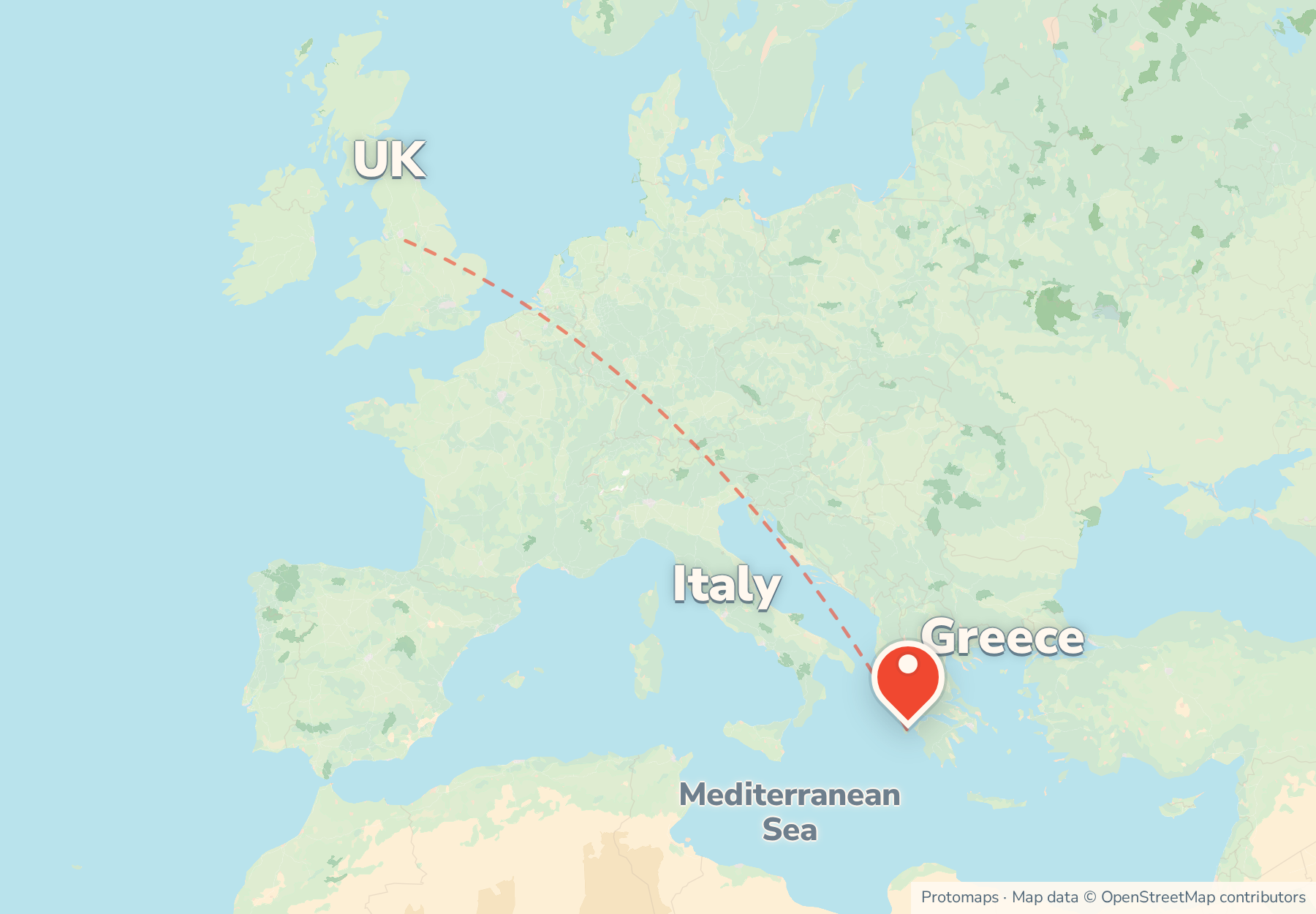
Zante, officially Zakynthos, is the green Ionian island where the Mediterranean’s loggerhead turtles nest. The turtles change where families stay and swim. The nesting bay holds the island’s shallowest, calmest water, protected by marine park rules that keep whole stretches quiet, uncluttered and free of jet skis. Around it sit proper family resorts on flat ground, a 3½-hour flight and transfers measured in minutes.
On this page
A family verdict at a glance
The quick read before the detail: who Zante suits, the season to aim for and what to nail down before you book.
Best for
Shallow protected bay water, real turtles seen properly, short transfers and an island greener than the Aegean.
Maybe not for
Car-free families or October half term. The buses are thin and the autumn rain arrives hard.
Best ages
It works from babies up, with June and September the easiest months.
Best areas
Tsilivi as the default, Kalamaki for the turtle bay, Alykes and Alykanas for quiet, Vasilikos for the calmest coves.
Why families pick it
The turtle boat morning, quick transfers and quiet beaches inside the marine park.
Check before you book
The cot, the air conditioning, a child seat for the transfer and the hire car booked early for peak weeks.
A turtle nursery and a green island
Laganas Bay is the Mediterranean's most important loggerhead nesting ground, with over two thousand nests in each recent season, and Greece's first national marine park wraps the whole bay. The rules affect where you can sit: nesting beaches open 7am to sunset, towels stay near the waterline on the strictest sand, boats crawl at six knots and the jet skis are gone. The protected stretches are the quietest, calmest toddler water on the island.
The second draw is the Ionian itself. Zante gets around three-quarters of a metre of rain a year, almost double a typical Cycladic island and mostly in winter, which is what keeps it green. The summers are effectively dry, with almost no rain in July or August. There's no meltemi on this side of Greece, so mornings are still, boat trips rarely cancel and no coast needs avoiding for wind. In return the heat is more humid, there are more mosquitoes than the dry Aegean islands, and October turns wet fast.
A quick gut checkIs Zante right for your family?
Worth comparing if
You want warm shallow water, real turtles your children can see without harming them and quiet resorts on flat ground.
Weigh it up if
You won't hire a car or you're set on October half term.
To sort out before booking
The car and its child seat, the cot and air conditioning, and which side of Laganas Bay your hotel actually sits on.
The numbers, the basics and the ages
Everything you'd want to skim first: the quick facts, the everyday practicalities and how Zante changes as children grow.
Quick facts for UK families
Money, plugs, language and the basics
- Zante is the third biggest Ionian island, mountainous and cliff-bound on the west, flat and sandy on the east and south, which is where every family resort sits.
- The Venetians ran it for three centuries and called it the Flower of the East; the 1953 earthquake explains why the capital looks modern rather than Venetian.
- The currency is the euro and cards are widely accepted; the buses and some tavernas prefer cash.
- Sockets are the round two-pin European type, so UK plugs need an adapter. The voltage matches the UK.
- The language is Greek. English is spoken everywhere tourists go.
- The clocks run two hours ahead of the UK, so a UK bedtime falls around Greek dinner time.
- Drink bottled water and use it for formula feeds everywhere on the island; resort taps often run brackish.
- Your GHIC card covers state healthcare; 112 works for everything and 166 calls a Greek ambulance directly.
- Hotels add a nightly climate fee at check-in, up to €15 at five-star places in season, which packages rarely include.
Zante by age and stage
Babies
Ten-minute transfers and bath-warm shallows at Gerakas and Porto Koukla. Pack the plug-in mosquito repellent.
Toddlers
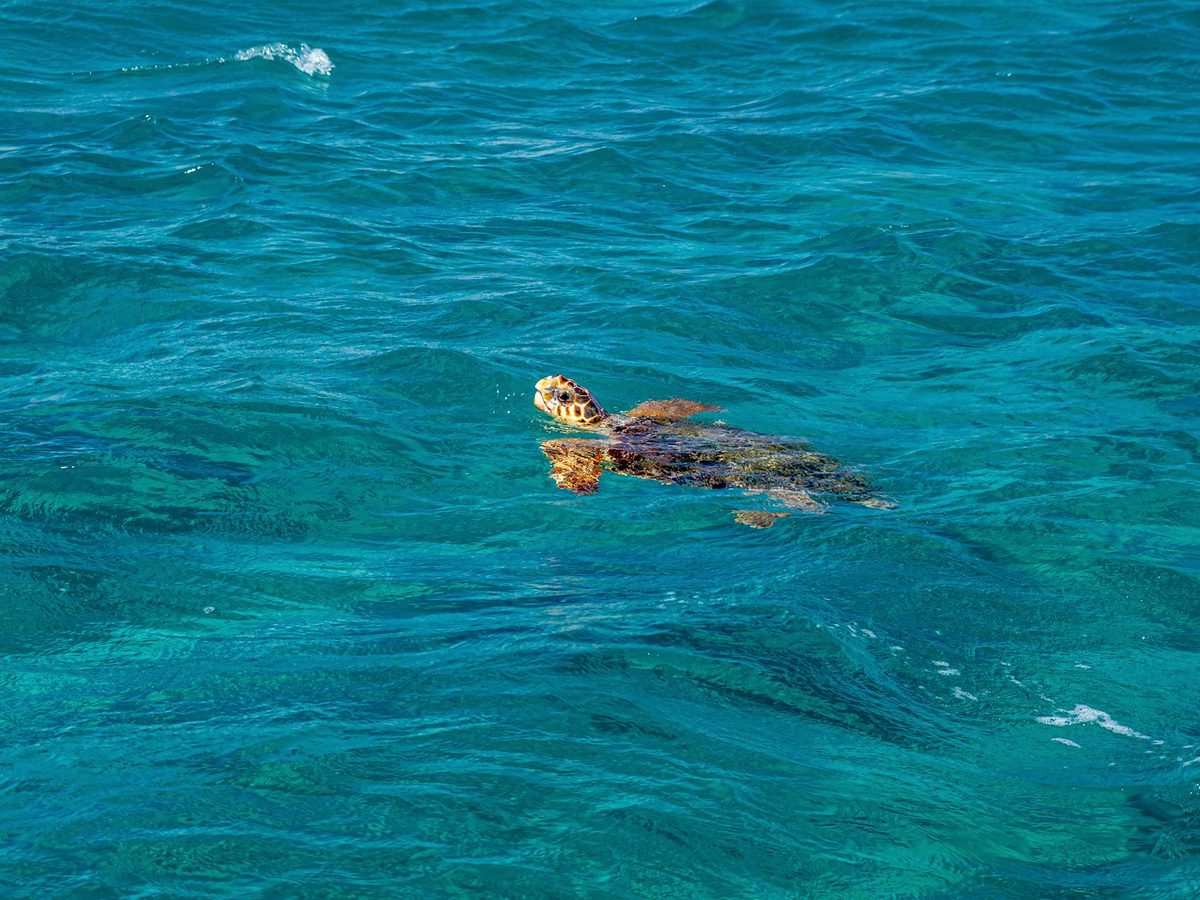
Knee-deep water for further than they can wade, pigeons on Solomos Square and a turtle surfacing beside the boat.
Preschoolers
Old enough for the Blue Caves hour, deer-feeding at the stone park and the waterpark's junior slides, and to grasp why the nests are roped off.
Young children
Up for the full Navagio boat viewing, snorkelling on the Marathonisi trips and the evening fun parks.
Where to base yourselves
The resort coasts side by side, an orientation map of the island and what the beaches are really like underfoot.
Where to stay with young children
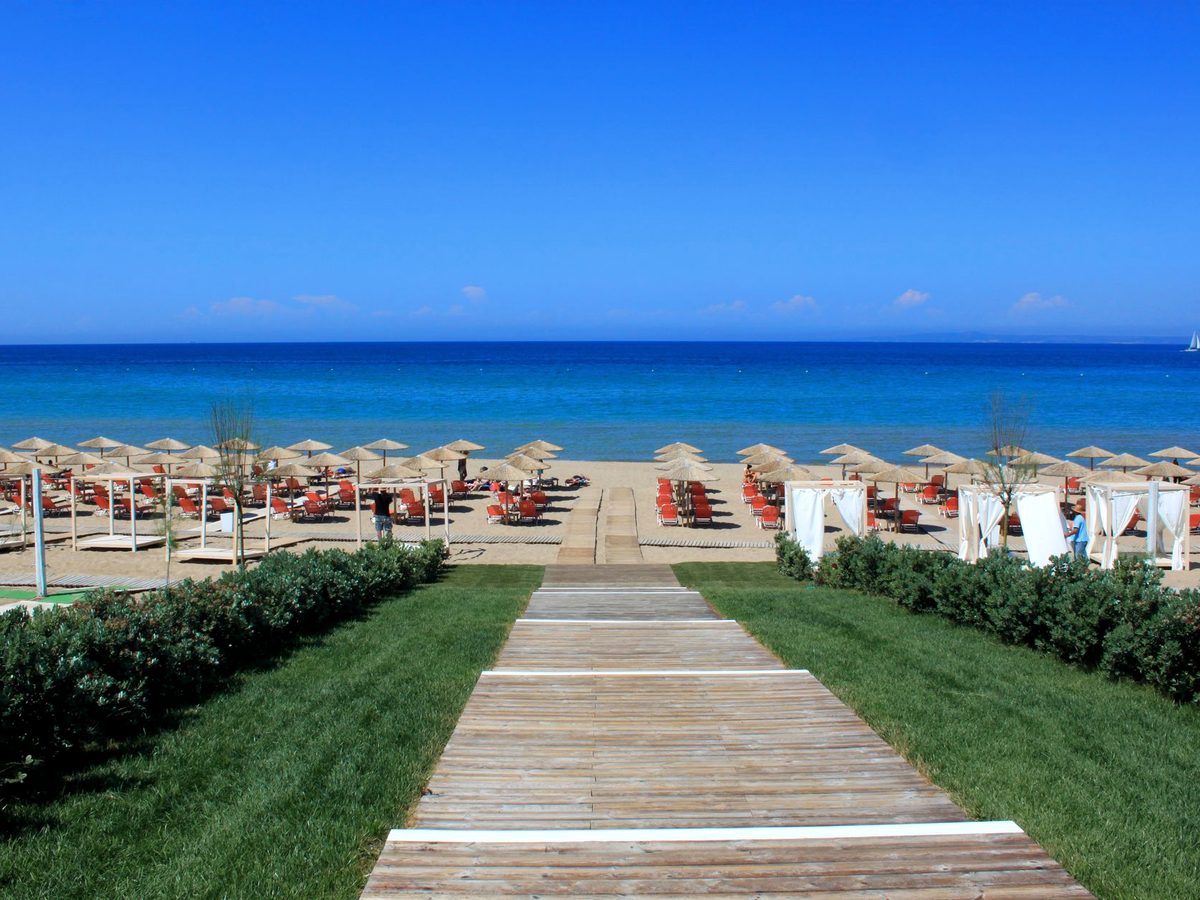
Tsilivi is the family default: golden sand with a gradual shelf, a Blue Flag, lifeguards in season and a flat resort with playgrounds, a small waterpark, a four-acre mini-golf and the shops set a couple of streets back so the beachfront stays calm. Two small caveats: there are pebbly patches at the waterline, so bring beach shoes, and departing aircraft climb out this way by day. Alykes and Alykanas, two villages on the quieter north-east coast, have shallow sandy bays on the flattest ground on the island, with old salt pans to wander behind the beach; they suit families who want somewhere traditional with an early bedtime, and the buses are thinnest out here, so budget for the car.
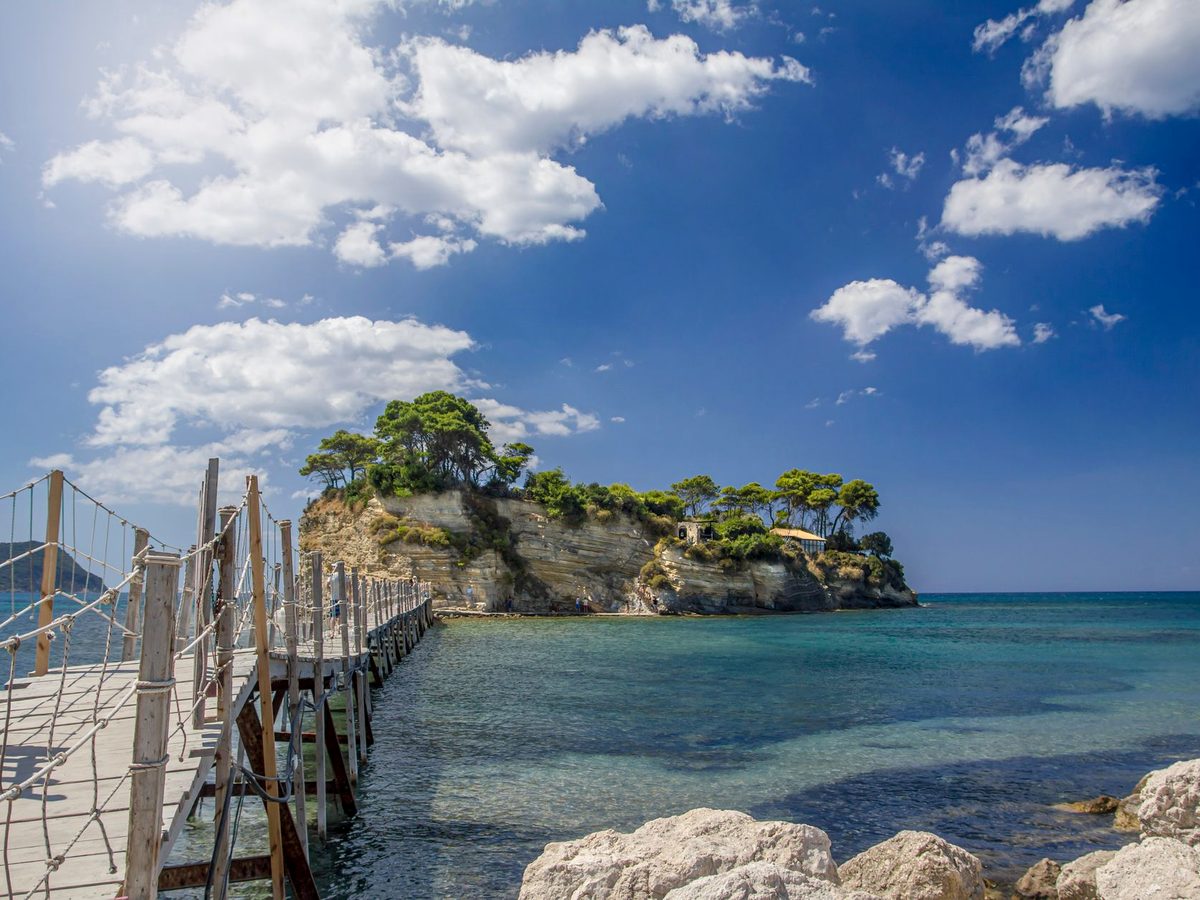
Laganas Bay needs explaining, because the island's party strip and some of its calmest toddler water sit on the same bay. Laganas itself is the resort every family guide says to avoid as a base, but the bay it fronts is protected turtle water with long, gently shelving sand, and the quiet corners at either end are where families stay. Kalamaki, ten minutes from the airport on the bay's eastern side, is the turtle-side family resort: gently shelving sand kept clear and calm by the park rules, with the trade-off that arrivals pass overhead through the day. At the western end, Agios Sostis and little Porto Koukla are quieter still, very shallow, taverna-backed and slow, with the Cameo island footbridge for the photo and the turtle boats from the small harbours.
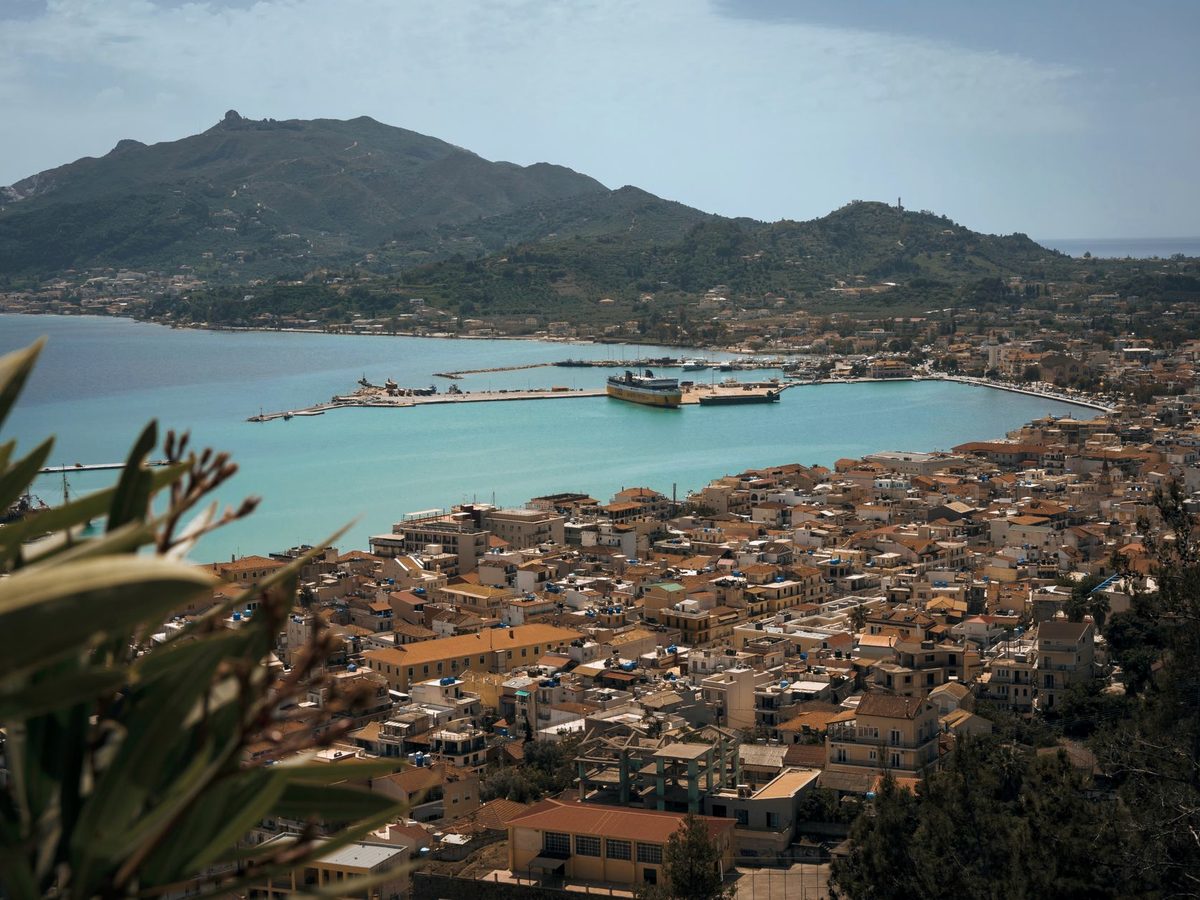
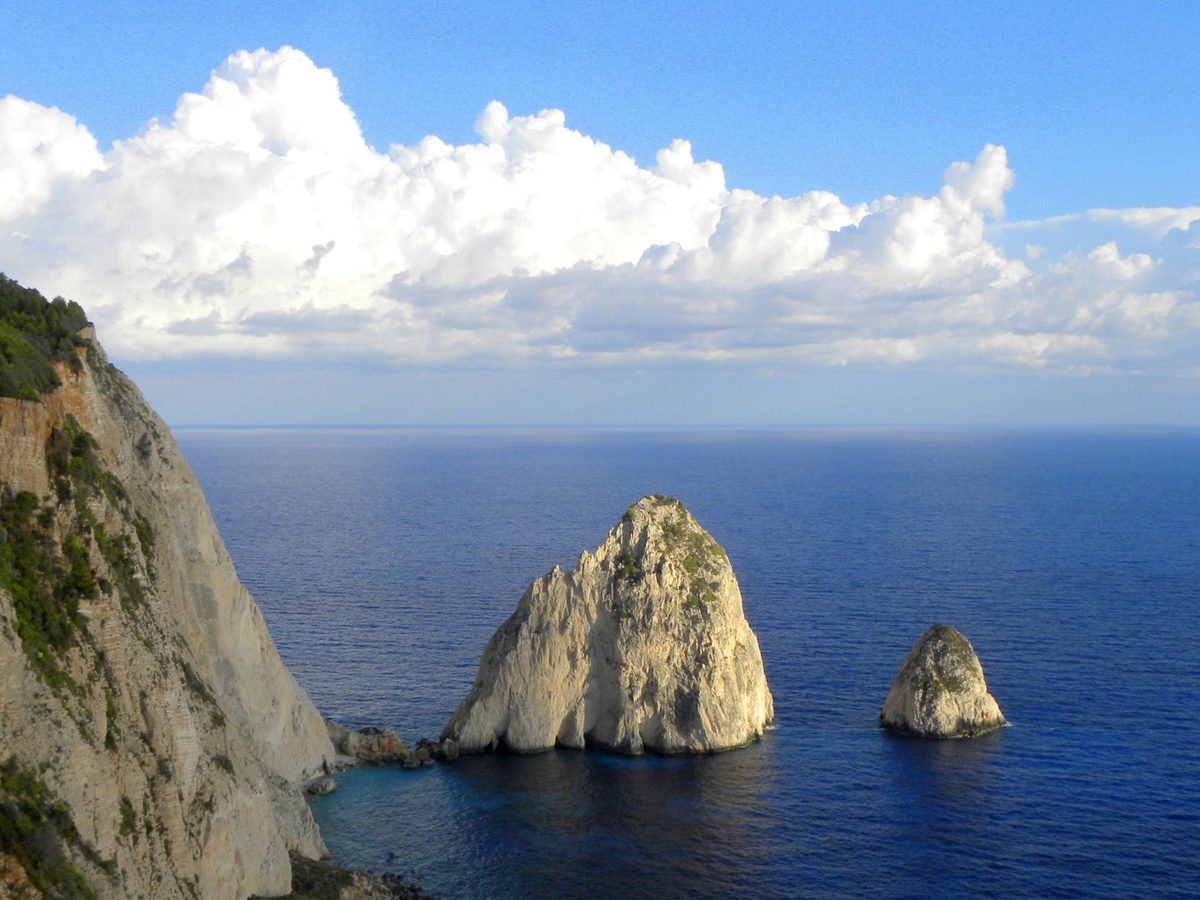
The Vasilikos peninsula, 25 to 40 minutes out, has the most sheltered swimming on the island: a string of calm, east-facing sandy coves along one road, ending at Gerakas (more on that beach below). It runs dearer than the resort norm, the watersports cluster at Banana and St Nicholas gets loud on summer afternoons, and a car is part of the deal. Argassi, between town and the peninsula, has a lively strip and a weak, narrow beach: a base for exploring rather than a beach holiday in itself. Zakynthos Town is the cultural half-day rather than the base, and the west coast is cliffs and viewpoints, not for swimming with small children.
| Area | Transfer | The beach | The feel |
|---|---|---|---|
| Tsilivi | About 20 min | Golden sand with a gradual shelf and some pebbles at the waterline | Flat, walkable, playgrounds and mini-golf, with the commercial road set back from the beach. |
| Alykes and Alykanas | About 30 min | Two sandy, shallow bays on the quieter north-east coast | Low-rise and traditional, on the flattest ground on the island. Quiet evenings; a car helps. |
| Kalamaki | About 10 min | Gently shelving turtle-bay sand, kept uncluttered by the marine park rules | Quiet by law next to noisy Laganas, with planes passing overhead by day. |
| Agios Sostis and Porto Koukla | 15 to 20 min | Very shallow, calm water in the bay's gentle western corner | Small, taverna-backed and slow, with the bay's warm shallow water and none of the strip's noise. |
| Vasilikos | 25 to 40 min | A string of sheltered sandy coves down the green south-east peninsula | Greener and dearer, with the island's best swimming spread along one road. You'll need a car here. |
| Argassi | 10 to 15 min | A narrow strip of sand and pebble, the weakest beach of the bases | A lively strip without the Laganas excess: handy for reaching Vasilikos, not for its own sand. |
Map of the main family areas
An orientation map of the areas above, the airport, the town and the big days out. The numbers match the key beneath.
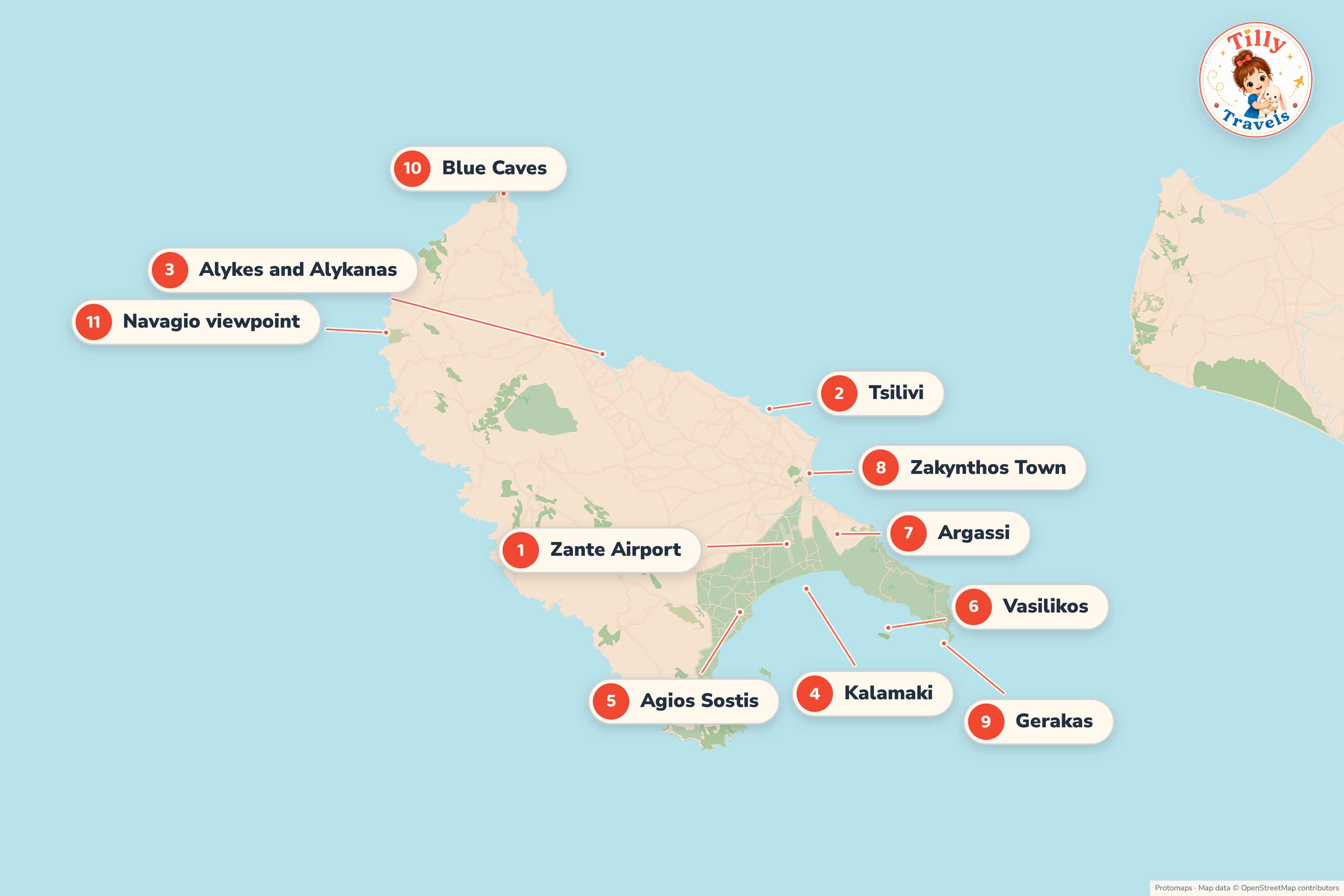
- 1Zante Airport On the plain by the bay
- 2Tsilivi The family default
- 3Alykes and Alykanas The quiet north-east
- 4Kalamaki The turtle-side resort
- 5Agios Sostis The bay's gentle corner
- 6Vasilikos The sheltered coves
- 7Argassi A lively strip, weak beach
- 8Zakynthos Town The half-day capital
- 9Gerakas The toddler swim, with rules
- 10Blue Caves The hour-long boat
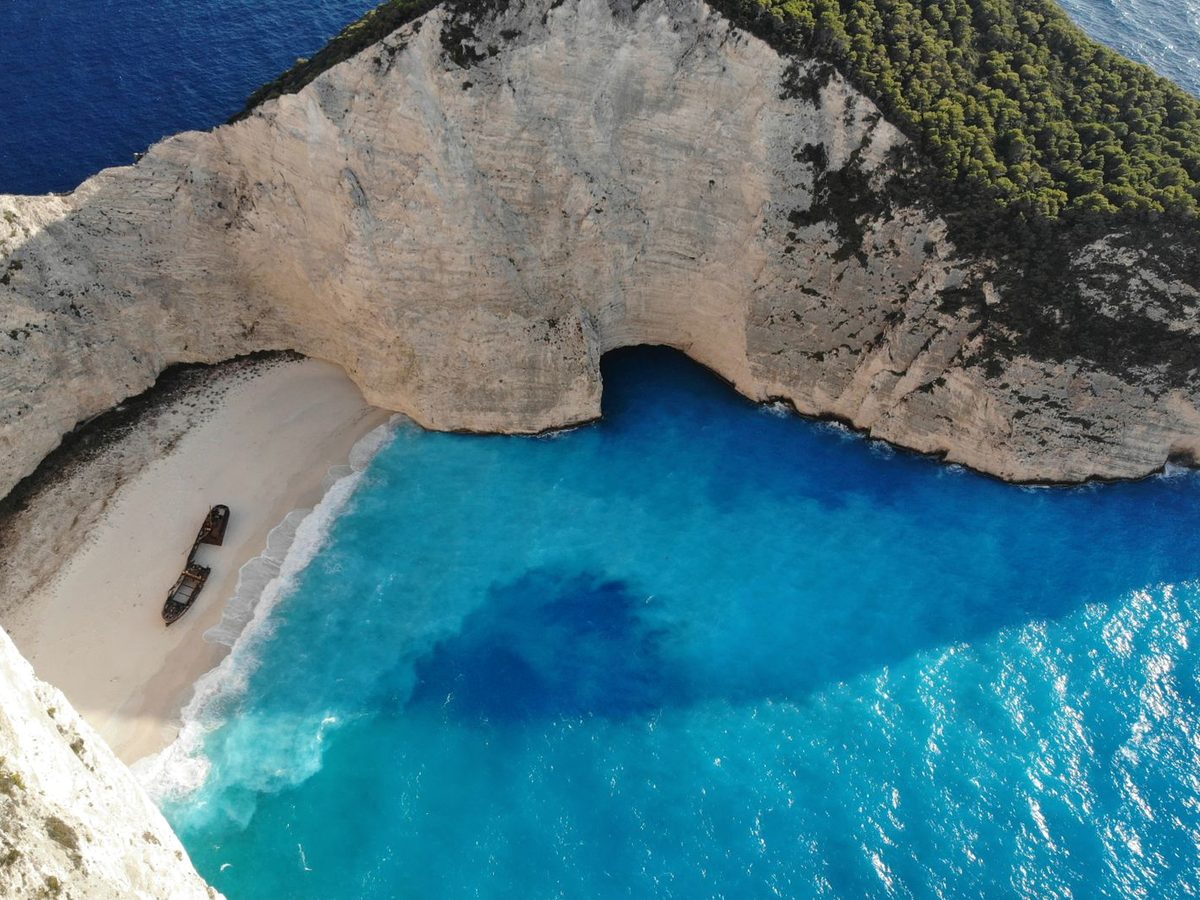
- 11Navagio viewpoint Viewing only in 2026
Beaches, and the rules that come with them
The toddler list clusters in the south and east. Gerakas, at the tip of Vasilikos, is the standout: sand that stays knee-deep further than a toddler can wade, a Blue Flag and marine park protection that caps numbers and keeps boats out entirely. Gerakas has no toilets or showers on the sand, a five-metre towel line and an unpaved final stretch that's easier with the carrier, so treat it as a morning trip rather than a day camp; the free turtle centre at the top has the loos. Porto Koukla and Agios Sostis stay shallow a long way out, and Tsilivi and Kalamaki are the everyday beaches. Alykes and Alykanas are gentle too, though one report of a sharper drop-off at Alykes is worth a parent's eye with wobbly waders. St Nicholas on Vasilikos has fine sand and the island's biggest watersports centre, so it's better in the morning before the engines start.
Zakynthos has around a dozen Blue Flags in 2026, clustered where families actually swim, four along the Tsilivi strip, two at Alykes bay, and Gerakas, Banana, Kalamaki and Limni Keriou among the rest. Lifeguards cover the main beaches from June to September; quiet coves have nobody, so you're the supervision. Beaches to skip with small children: Xigia's sulphur cove, cold, deep and a hundred steps down; Makris Gialos, deep close in; Cameo island, pebbles and ladder entries, a photo stop rather than a swim; and the whole west coast, which is for the camera. Pack beach shoes for Tsilivi's waterline and the pebblier coves.
Weather, days out and the daily shop
When to go month by month, the outings that suit small children, eating out and where to stock up.
Weather, April to October
The figures below are long-term station normals, and recent summers run a degree or two warmer, so read July and August as low thirties with humid nights around 21 degrees. Midsummer is bone-dry, June green and gentle, October wet.
| Month | Daytime high | Overnight low | Rain | Wet days | Sea temp |
|---|---|---|---|---|---|
| January | 14.5° | 7° | 125 mm | 11 | 17° |
| February | 15.5° | 7° | 63 mm | 7 | 16° |
| March | 17.5° | 8.5° | 62 mm | 8 | 16° |
| April | 20.5° | 10.5° | 26 mm | 4 | 17° |
| May | 25° | 14.5° | 14 mm | 3 | 19° |
| June | 30° | 18.5° | 14 mm | 1 | 23° |
| July | 33.5° | 21° | 3 mm | 0 | 26° |
| August | 33.5° | 21.5° | 5 mm | 1 | 27° |
| September | 29° | 18.5° | 58 mm | 4 | 26° |
| October | 24.5° | 15° | 95 mm | 6 | 24° |
| November | 20.5° | 12° | 165 mm | 10 | 21° |
| December | 16.5° | 8° | 142 mm | 9 | 19° |
Typical monthly averages from weather-station records. Sea temperature is the open-water figure, so a sheltered bay can feel a degree or two warmer.
June is the family pick: 28-degree days, a 22-degree sea and the turtle season under way. September matches it with a warmer sea and quieter sand. October half term is the gamble, for the reasons in the questions below. In high summer, beach early, shade through the middle, out again at five, and use the mosquito kit in the evenings.
Filling the daysThings to do with little ones
For the turtle morning, the boat choice matters. Short licensed glass-bottom boats run from Laganas harbour, Agios Sostis and Limni Keriou, one to three hours among the bay's surfacing loggerheads, many landing for an hour on Marathonisi, the turtle-shaped islet with its capped, unspoilt beach. Morning departures mean calmer water for small stomachs, and which operator you pick matters for the turtles: the park code holds boats to slow approaches and a respectful distance, so favour the operators who advertise the code rather than a guaranteed sighting. Ashore, the free marine life centre behind Gerakas beach has turtle displays pitched at children, a few minutes from the swim, and there are conservation kiosks in town and Kalamaki too.
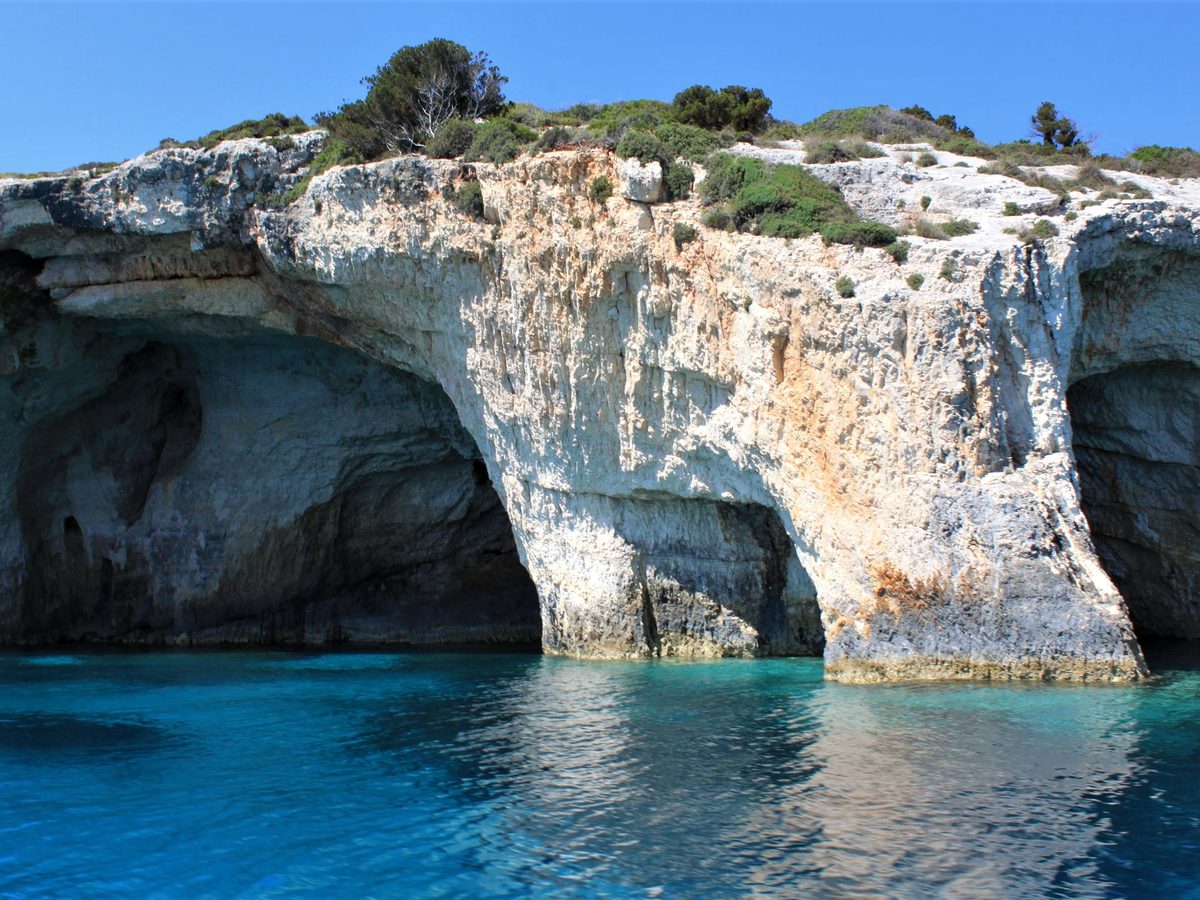
The north fills one good day. The Blue Caves boats from Agios Nikolaos do the glowing-water hour cheaply, with no age limit and shade on board, the most toddler-sized boat trip on Zante; the bigger boats add a Navagio viewpoint from the water. The clifftop viewing platform is the free land option, with small children carried or held firmly back from the unfenced stretches either side. Askos Stone Park, inland nearby, hand-feeds fallow deer and raccoons at toddler height around old stone water cisterns; the loop is rocky carrier country, so phone ahead before you go (+30 26950 31650). On the way home, Volimes sells the honey and the lace, and the olive tree at Exo Hora, claimed to be two thousand years old, makes a quick stop.
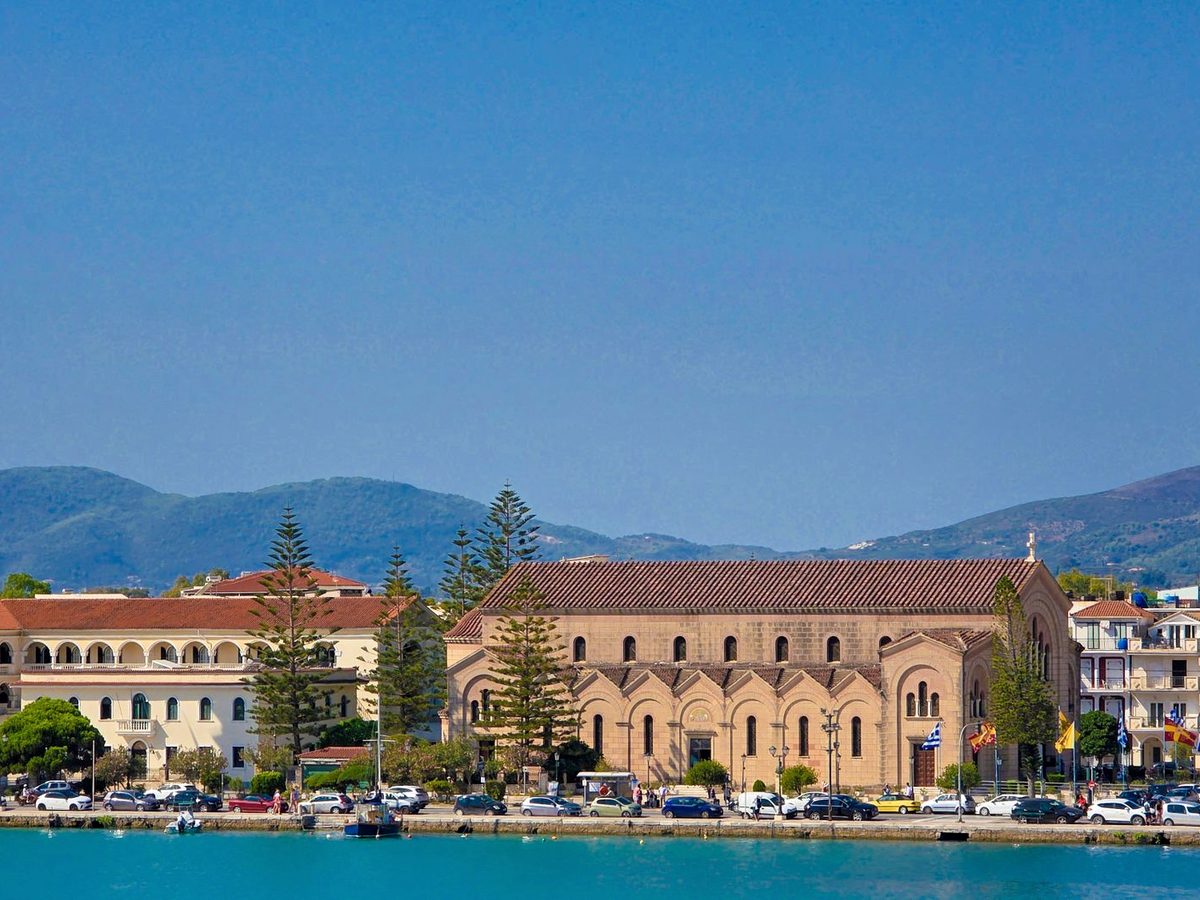
Evening attractions keep Greek hours. Zante Water Village near town opens late May, daily in July and August but closed Sundays either side, with a baby pool, a children's tower and under-fours free, at €25 an adult and €20 a child (last checked June 2026); Tsilivi's smaller in-resort waterpark suits little ones, with a gentler set of slides; it publishes no prices, so confirm them on the door. Tsilivi's four-acre Fantasy Mini Golf gives threes-and-under free entry and a toddler play area, and the fun parks at Tsilivi and Kalamaki open their bouncy castles from five and six in the afternoon. The free half-day in Zakynthos Town is flat marble all the way: Solomos Square's pigeons, the harbourfront, Agios Dionysios church with its Venice-style bell tower, then ice cream up at the Bohali viewpoint with the town spread out below. The Venetian castle above it has ruins in a shaded pine wood, a few euros and closed Tuesdays, and the 1850s olive press at Lithakia does a free, short tasting tour that ends with bread and oil.
Eating out with children
Greek tavernas welcome children: bread arrives unasked, nobody minds a wanderer and the family sitting starts at six, two hours before the locals eat. High chairs are common but not universal, so a clip-on seat travels well. The quiet-corner tavernas at Porto Koukla put the bay a few metres from the table, and Bohali's terraces do the sunset over town.
Easy toddler food is everywhere: tzatziki and bread, yoghurt with the island's thyme honey, giant baked beans, pastitsio, souvlaki and watermelon, with the local oil-cured ladotyri cheese for the grown-ups. A charged bottle of water tends to arrive by default, the island habit, and a gyros stays the cheapest good lunch in Greece.
Milk, nappies and pharmaciesSupplies and the first-day shop
The big shops cluster on the roads out of town near the airport: one Lidl on the Keri road and an AB Vassilopoulos towards Laganas, with Kritikos in Tsilivi the resort-side option. That cluster needs a car, and the resorts themselves run on minimarkets, open late and on Sundays at a premium. Land, collect the car, do one big shop, then top up locally. Nappies run Pampers or the Greek market leader Babylino, fresh milk fills every chain chiller, and the supermarkets close on Sundays, so plan the restock for a weekday.
First-stage formula lives in the pharmacy in Greece, at around €13 to €14 a tin (last checked June 2026), under the Almiron name, Aptamil's sister brand, with actual Aptamil tins common too. Pharmacies are everywhere and good with tourists; Depon is the children's paracetamol, Nurofen for children the ibuprofen, and the hospital publishes the island's out-of-hours duty rota online.
Getting around, a real week and the admin
Transfers and hire cars, what a week actually looks like, the health and document checks and a list to pack against.
Getting there and around
The airport sits on the coastal plain beside the bay, and because of the turtles there are no take-offs or landings roughly 10pm to 5am: runway lights and noise disturb the nesting beaches next door. So there are no overnight arrivals to land into, and a badly delayed flight rolls to the next day rather than the small hours. Transfers are short, ten minutes to Kalamaki and 40 to the far end of Vasilikos, with fixed taxi fares posted at the rank. The taxi association hires proper baby seats for €8 a trip if you ask ahead. Greek law requires child seats for under-12s below 135 centimetres, so book the seat with whatever you book.
This is a hire-car island. The buses run a handful of weekday services from town, nothing on Sundays and last departures in the early evening, fine for one town trip and not for living on. Cars run from about €20 to €30 a day in June with child seats a few euros more, the east and south are flat easy driving, and the west coast roads wind and sign-post badly, so use the sat-nav for the viewpoints. Fuel costs a little more than the mainland, a UK photocard licence needs no extra permit, and the quad bikes you'll see around Laganas are excluded from standard travel insurance.
What a real week looks likeA realistic week with little ones
Collect the car, one big shop on the airport belt and an early taverna dinner.
The bay or the local sand in the morning, lunch and a nap, then back to the water until an early taverna dinner.
A short licensed glass-bottom boat from the bay harbours, with Marathonisi's hour of sand if the trip lands there.
The hour-long Blue Caves boat, the Navagio viewpoint and an animal stop at Askos on the way back.
A final swim and a slow pack before the transfer back.
With young children, you can fill a Zante week comfortably on the bay, the pool, one turtle boat and one northern day.
The practical adminHealth, documents and the boring bits
Check the GOV.UK Greece advice before booking and travelling. Passports need to be issued within the last ten years and valid three months beyond departure, children's included. Carry a GHIC each plus real travel insurance. The state system runs through Zakynthos General Hospital just outside town; the resort walk-in clinics, unusually plentiful here and listed by the FCDO, are private and bill your insurer, with paediatric cover at the Laganas and Kalamaki clinics among others. The British Vice Consulate on the island keeps a 24-hour line.
The emergency numbers are 112 for everything and 166 for a state ambulance. The hazard list is short and ordinary: very high summer UV, so hats, suits, cream and midday shade for babies; mosquitoes at dusk, more of them here than on the drier Aegean islands, so pack plug-ins and infant-safe repellent; and the sea rules above. There's an earthquake question further down. Taverna cats will come over to a toddler with chips, so it's look, don't grab, then wash hands.
Before you payBooking checklist
- Check no excursion in the package promises a swim at Shipwreck Beach; it's closed for 2026.
- Book the hire car early for July and August, with the child seat on the booking.
- No car? Pre-book transfers with seats, or use the taxi association's €8 baby seats.
- Confirm the cot and the air conditioning, especially for July and August.
- Pack plug-in mosquito repellents, infant-safe spray and after-bite cream.
- Pack beach shoes and a carrier for Gerakas, Askos and the castle's pine paths.
- Going for the turtles? Book a licensed boat that follows the park code, not a guaranteed-sighting one.
- Bring formula for the first days and buy bottled water for feeds throughout.
- Budget the nightly climate fee, paid at the hotel and rarely in the package.
- Recheck the GOV.UK Greece advice and every passport before you go.
Resort guides in Zante
We've researched these places to stay in Zante for families with young children. Each guide covers what it's like, who it suits and what to check before you book.
Questions, links and the last word
The things families ask most, the official pages worth a bookmark and when this guide was last refreshed.
Common parent questions
Will we actually see turtles?
In season, very probably. Adult loggerheads surface in Laganas Bay all summer and day-boat sightings from May to August are close to routine. What you won't see is nesting or hatching, which happens at night on closed beaches, and that's what the rules are protecting. Pick a licensed boat that follows the park code, slow approaches and a respectful distance, and walk away from any operator promising a guaranteed sighting or throwing food to draw turtles in. Both push boats into chasing and crowding the turtles.
Can we swim at Shipwreck Beach?
No. Navagio is closed to all landings until at least the end of October 2026 after a cliff collapse, swimming in the cove is banned and boats hold off the beach. You can still see it properly: the clifftop viewing platform is free, and the two-hour boat runs from Porto Vromi view the wreck from the water. Any excursion sold as "swim at Shipwreck Beach" this year is overselling.
Is Laganas a problem for families?
To sleep in, yes: the bars and clubs run late and it suits the 18 to 30 crowd, not a toddler's bedtime. The beach is a different matter, because the same marine park rules that protect the turtles keep jet skis off the bay and cap the sunbeds. Base at one of the calmer ends of the bay and you get the shallow sand without the nightlife.
Why do some beaches close at sunset?
Because the loggerheads nest on them at night, and lights, noise and trampled sand kill nests. The restrictions run through nesting season, and even the sunbeds come off the sand each evening so nothing blocks a nesting female or a hatchling. For a family that means a quieter, emptier beach; bring your own shade and water and plan it as a morning.
Does October half term work here?
Probably not. Zante's October rain normal is around 95 millimetres, over one and a half times September's, and in late September 2025 a single day dropped 113 millimetres, flooding the Alykes road and cancelling flights. The sea is still warm and plenty of October days are fine; the odds just aren't. September is the safer half-term-ish bet, and there's almost nothing indoors here for a wet day, so a washout is hard to rescue. For reliable October warmth, look at Rhodes or the Canaries instead.
Can we buy our usual formula and nappies?
You can, with two cautions. Stages differ slightly from the UK versions, so run any swap past your HV or GP before you travel rather than mid-holiday. Make up every feed with bottled water too, because resort taps often run brackish and the local clinics advise visitors to drink bottled. Stage-one formula is a pharmacy buy in Greece, not a supermarket one.
Do we need a hire car?
More than on any other Greek island we cover, though you can manage car-free if you must: base in Tsilivi or Kalamaki where the beach, shops and tavernas are walkable, take taxis for the airport and one or two outings, and accept that Gerakas, the Blue Caves and the animal park stay off the list. Most families will be happier with the car.
Should we worry about earthquakes?
Know about them, plan nothing differently. The Ionian is Greece's most seismically active corner, which is why the town was rebuilt in concrete after the 1953 quake and everything since has gone up to strict codes: the big 2018 offshore quake hurt nobody seriously. If one happens, drop, cover and hold on, then follow hotel staff.
See more Zante photos
Open the photo gallery →Useful links
- GOV.UK Greece travel advice: passport rules, entry requirements and health updates before you travel.
- ARCHELON: the Greek sea turtle protection society, including how to watch turtles responsibly.
- KTEL Zakynthos: the bus timetables.
- Zante taxi association: the fixed airport fares and baby-seat hire.
Last updated 12 June 2026.