Menorca with little ones
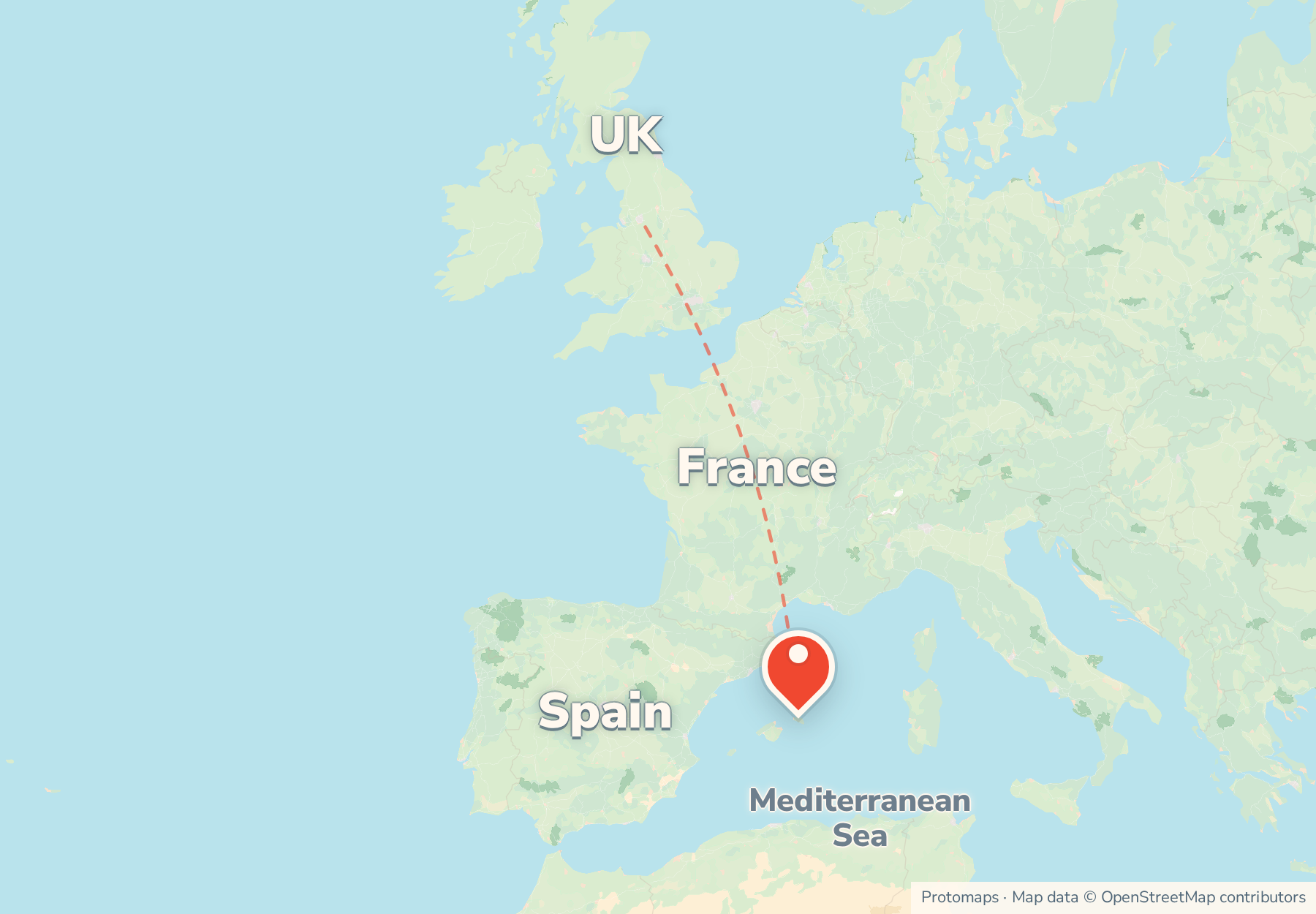
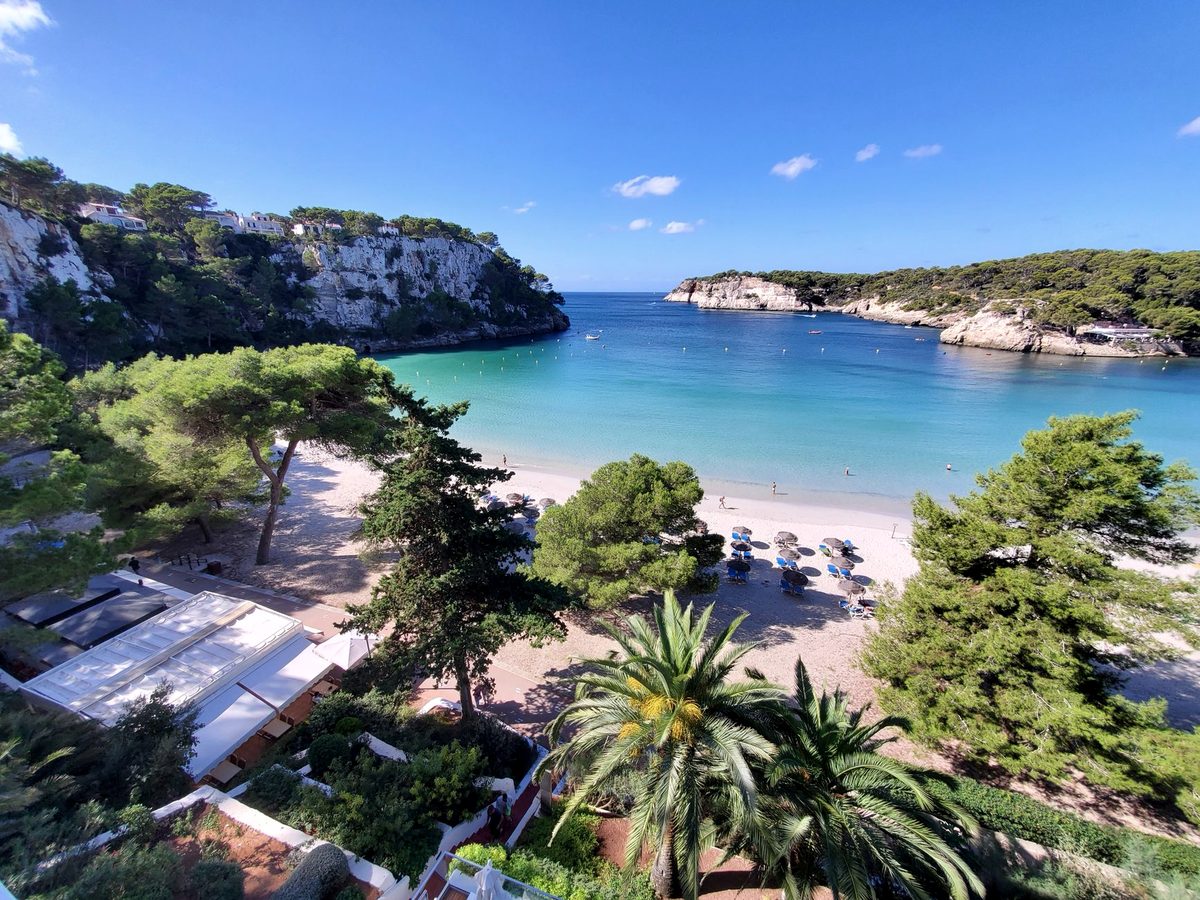
Menorca is the quietest of the main Balearics, an island that banned high-rise building two decades ago and has been a UNESCO Biosphere Reserve since 1993. For families the draw is the south coast, where pine-backed coves of shallow, calm water include Cala Galdana, the main family beach, a horseshoe bay with hotels on the sand. The flight is around two and a half hours, every transfer is under an hour, and the holiday season runs from May to October.
On this page
A family verdict at a glance
The quick read before the detail: who Menorca suits, the season to aim for and what to nail down before you book.
Best for
Sheltered, shallow coves on a short flight, quiet evenings and early dinners on traffic-free quays.
Maybe not for
Winter trips of any kind, or families who want a long list of paid attractions, which the island doesn't have.
Best ages
Babies and toddlers, on the shallow sheltered coves. June and September are the warmest sea with the most room on the sand.
Best areas
Cala Galdana as the default, Punta Prima for the 15-minute transfer, Santo Tomàs for the easiest buggy pushing, Cala'n Bosch for the most to do.
Why families pick it
Low-rise, low-key and unhurried, with beaches, boats and early dinners filling the week.
Check before you book
The dates. The season runs May to October, the resorts close outside it and direct UK flights stop from November to March.
The quiet island and its wind
Menorca takes around one and a half million visitors a year against Mallorca's thirteen million or more, and a 2003 island plan removed tens of thousands of planned tourist beds, banned new high-rise and limited building height. There are no strips and no mega-resorts; the whole island has been a UNESCO Biosphere Reserve since 1993 and its prehistoric stone monuments joined the World Heritage list in 2023.
The tramuntana, the north wind, makes Menorca the windiest of the Balearics and splits it in two: an exposed, undeveloped north coast and a sheltered south where the pine-backed family coves are. When the north wind blows the south coast stays calm; on a rarer southerly the north's deep bays go flat instead. Check the forecast and pick the sheltered coast.
A quick gut checkIs Menorca right for your family?
Worth comparing if
You want calm, shallow swimming for a baby or toddler on a short flight, with quiet evenings and a slow pace built in.
Weigh it up if
You want a waterpark-and-shows holiday, need nightlife within walking distance or measure a resort by its attraction list.
To sort out before booking
What's open in your resort for May or October dates, the cot and air conditioning, and a child seat for the transfer.
The numbers, the basics and the ages
Everything you'd want to skim first: the quick facts, the everyday practicalities and how Menorca changes as children grow.
Quick facts for UK families
Money, plugs, language and the basics
- Menorca is the second biggest Balearic, with around 100,000 residents and one main road linking its two towns.
- The currency is the euro and cards are accepted almost everywhere, while buses sell tickets for cash or through the local MOU-T app.
- Sockets are the round two-pin European type, so UK plugs need an adapter. The voltage matches the UK.
- The languages are Spanish and Menorquí, the local Catalan. English is spoken throughout the resorts.
- The clocks run one hour ahead of the UK, so a toddler's 7pm bedtime is 8pm local, which lines up with when restaurants open for the family sitting.
- Tap water is hard and heavily chlorinated, and everyone drinks bottled. For feeds, use bottled water: local campaigners have flagged elevated nitrates in Maó's supply, which boiling doesn't fix.
- The Balearic tourist tax is added to your accommodation bill, charged per adult per night and waived for under-16s; it tapers after a week.
- Your GHIC card covers state healthcare here, and 112 is the emergency number.
- The town supermarkets are the cheap shop; the resort minimarkets charge a fair bit more for the same basket.
Menorca by age and stage
Babies
A short flight, a one-hour time shift, transfers under an hour and very calm, shallow water at Cala Galdana. Bring a carrier for the cala paths.
Toddlers
Shallow, sheltered coves, the glass-bottom harbour boat at Mahón and sand in every direction.
Preschoolers
Old enough for the calas cruises, the zoo's goat-feeding and splash park, and a "boat-shaped tomb" story at the stone monuments.
Young children
The waterpark, longer stretches of the coast path and kayaks at Fornells come into range. If your child wants a big theme park, there isn't one here.
Where to base yourselves
The resort areas side by side, an orientation map of the island and how to reach the virgin calas.
Where to stay with young children
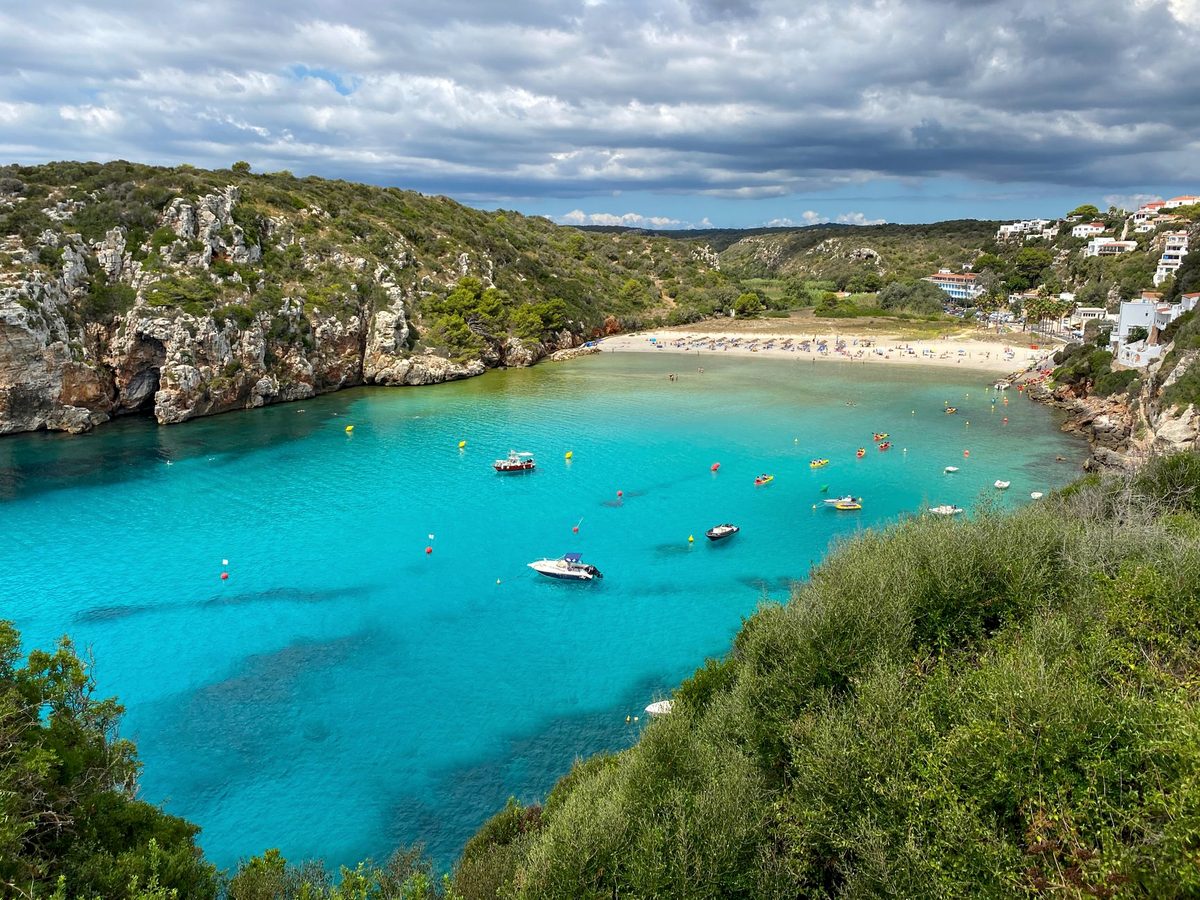
Cala Galdana is the natural default. It's a deep, sheltered bay on the south coast, white sand under pine-clad cliffs, with water that shelves so gently a toddler can wade for ages, lifeguards in season and three hotels at or near the sand, one of which, the Artiem Audax, is adults-oriented, so check before you shortlist. The resort behind is small, with enough supermarkets and restaurants for a week, flat at beach level with hills behind, and the better-known coves are next door: Cala Mitjana is a 20-minute walk, buggy-passable until the final rough stretch, and Macarella a boat ride or a 40-to-60-minute carrier path through the pines.
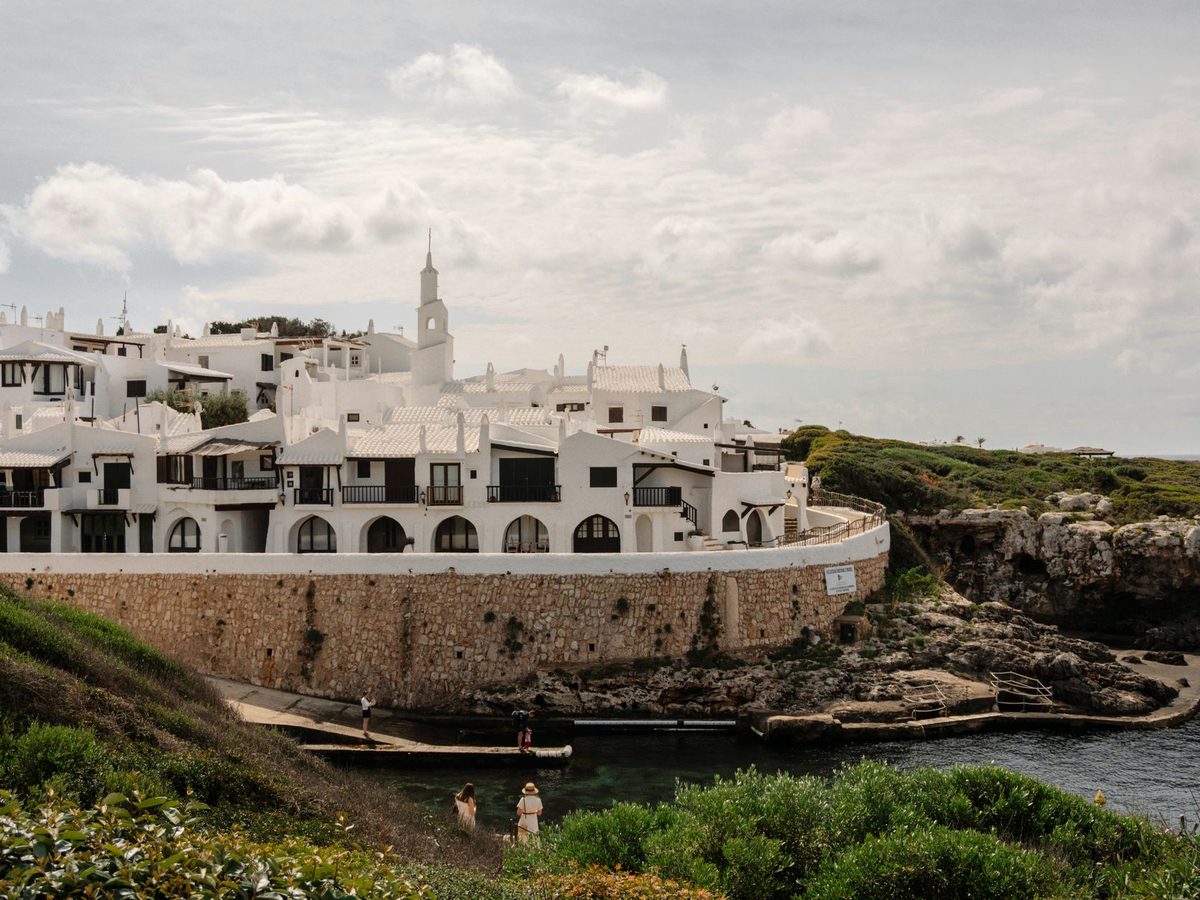
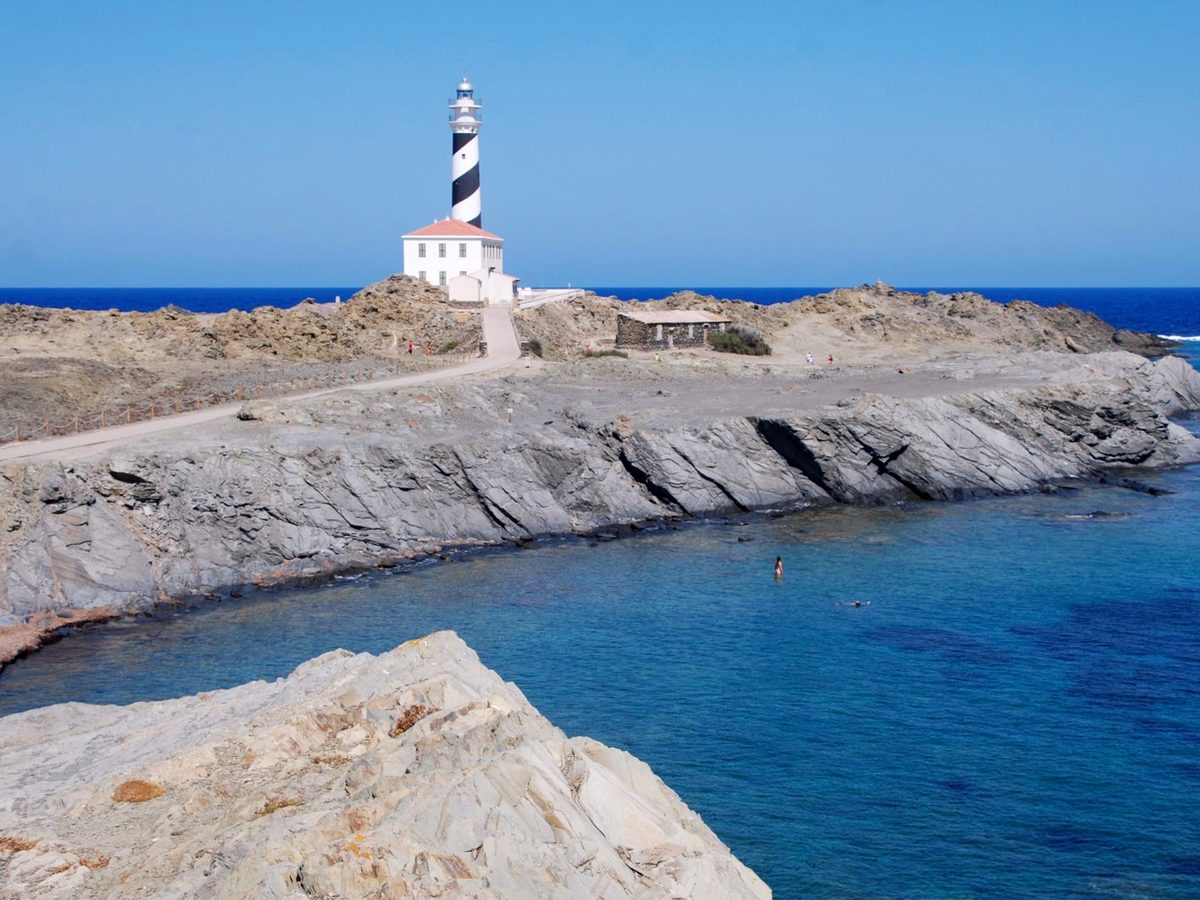
The south-east corner is less scenic but more convenient. Punta Prima sits 15 to 20 minutes from the runway, a compact, flat grid behind a wide, square beach with clear shallow water and a lighthouse on the horizon; it faces open sea, so watch the flags on breezy days. Evenings are quiet. Binibeca, just along the coast, is villa country around a small, sheltered cove with the much-photographed white village beside it, and Son Bou and its quieter neighbour Santo Tomàs share the island's longest beach, 1.6 miles (2.5 km) of open sand with dunes behind; on a southerly wind it gets real waves, so watch the flags. Santo Tomàs has a long, flat promenade that makes it the easiest resort for buggies on the island.
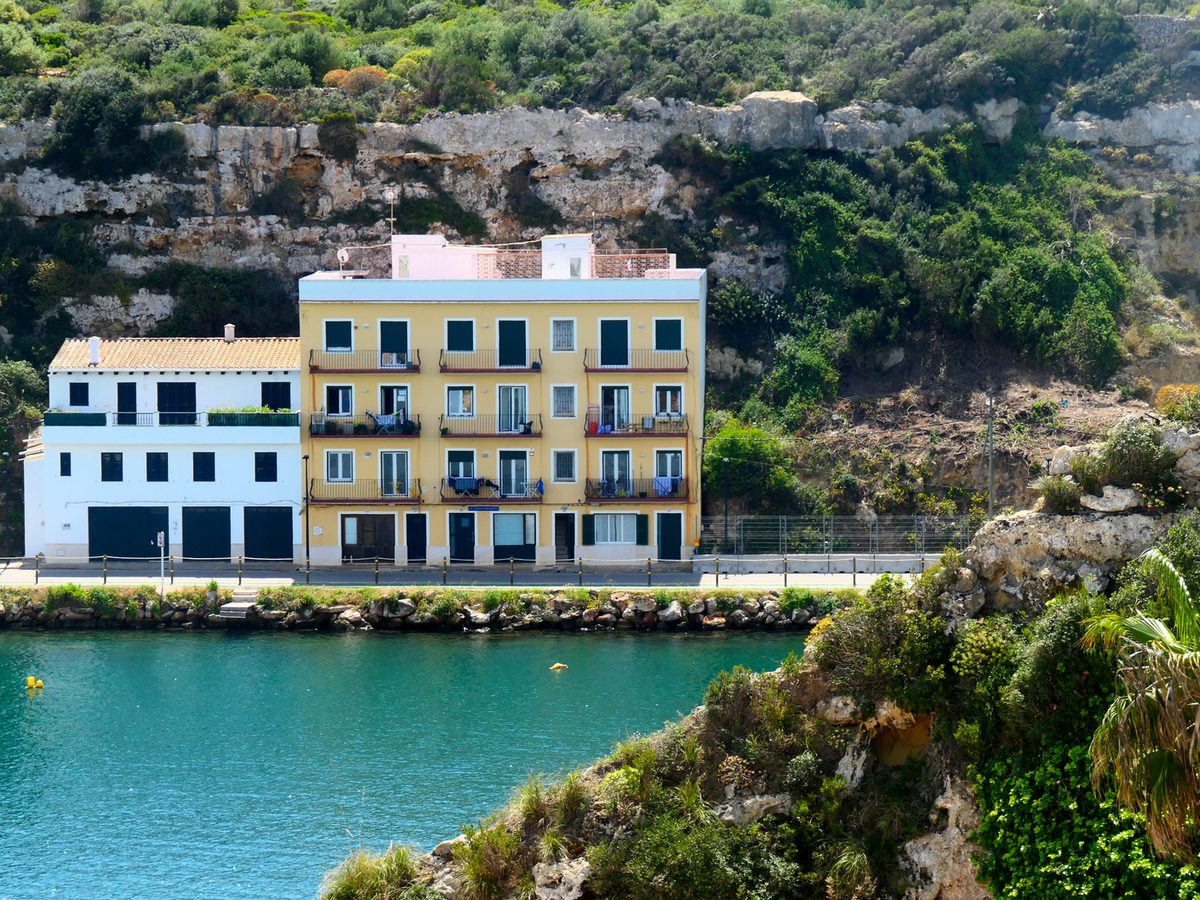
At the west end, Cala'n Bosch packs the most into one purpose-built, flat resort: a marina with boat trips, two beaches, the AquaRock waterpark and Ciutadella 15 minutes away, though it's the longest transfer on the island. Arenal d'en Castell, the main north-coast option, curls around a near-circular bay that stays calm when much of the north doesn't, though the paths between resort and sand are steep. The towns work too: Ciutadella is flat, compact and shaded, with small beaches a short drive away, while Mahón sits on a cliff above its harbour, with more steps between town and water than is comfortable with a buggy.
| Area | Transfer | The beach | The feel |
|---|---|---|---|
| Cala Galdana | 40 to 45 min | A horseshoe of shallow, calm water under pine-clad cliffs | The main family beach, with hotels on the sand and the virgin calas next door by boat or footpath. |
| Son Bou | 25 to 30 min | The island's longest beach, open and south-facing, with dunes behind | Lots of space. Two big beachfront hotels, the rest low-rise. Waves to respect on a southerly wind. |
| Santo Tomàs | 30 to 35 min | A long, flat beach next to Son Bou, with a paved seafront the length of it | The easiest resort for buggies, thanks to its long flat promenade, and quiet in the evenings. |
| Punta Prima | 15 to 20 min | A wide, square beach of clear shallow water with a lighthouse view | The shortest transfer on the island, compact and flat, with quiet evenings. |
| Cala'n Bosch | 50 to 55 min | Two beaches around a marina, the main one calm and sheltered by the inlet | The most to do in one flat, purpose-built resort, including a waterpark with the island's only wave pool. |
| Binibeca | About 20 min | A small, sheltered cove of white sand behind a big rock outcrop | Villa country near the airport, with the white village on its doorstep. |
| Arenal d'en Castell | 30 to 35 min | A near-circular bay, deeply sheltered: one of the calmest swims on the north coast | Quiet, though the paths between resort and sand are steep. |
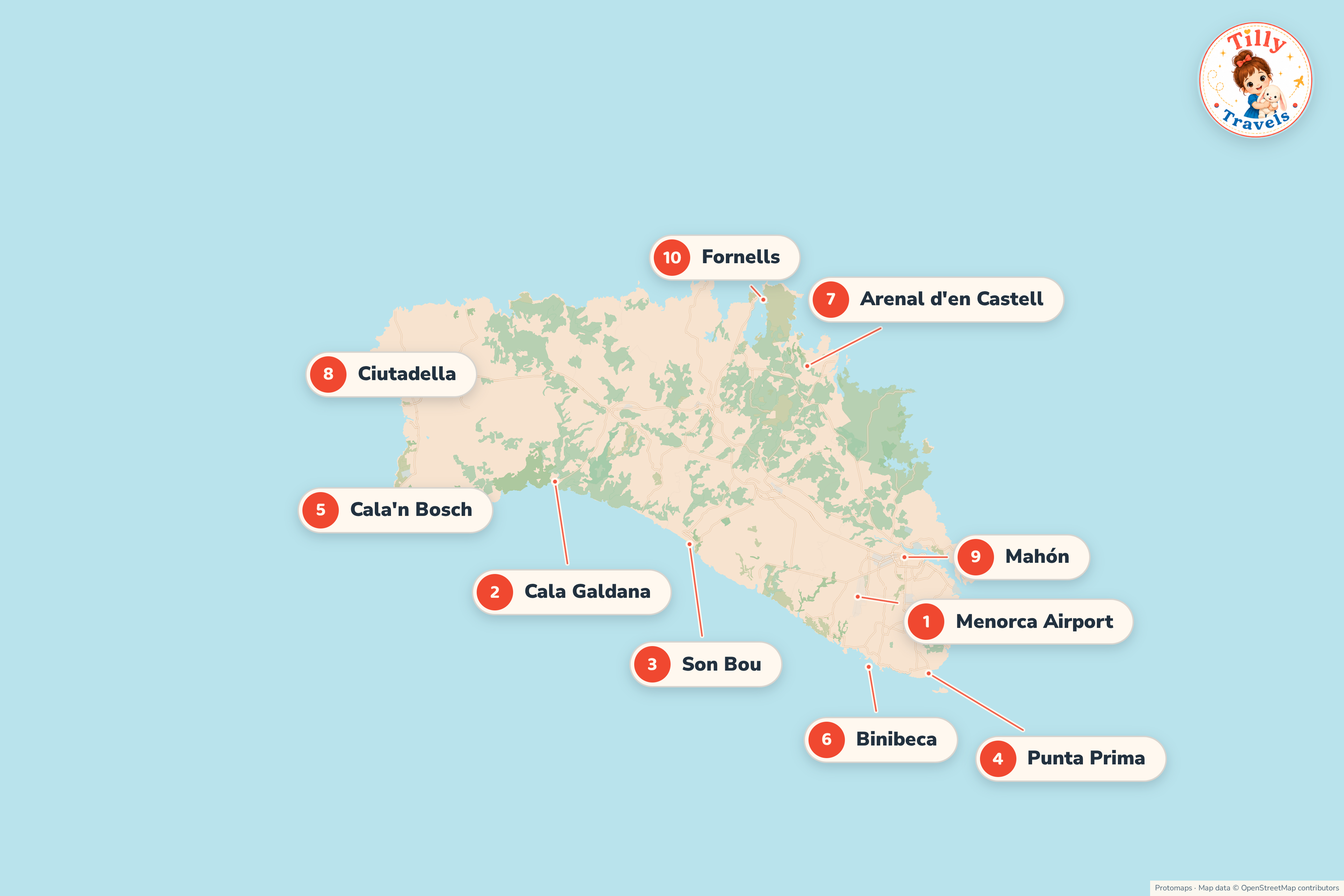
Map of the main family areas
An orientation map of the areas above, the airport, the towns and Fornells. The numbers match the key beneath.
- 1Menorca Airport East end, near Mahón
- 2Cala Galdana The family beach
- 3Son Bou The longest sand
- 4Punta Prima The 15-minute transfer
- 5Cala'n Bosch Marina and waterpark
- 6Binibeca The cove and the white village
- 7Arenal d'en Castell The sheltered north bay
- 8Ciutadella The old capital
- 9Mahón The harbour town
- 10Fornells Lunch on the north bay
Beaches, calas and reaching them by boat
The everyday swimming is the resort list above, sorted by the wind rule: Cala Galdana, Binibeca's cove and Cala'n Bosch on northerly days, Arenal d'en Castell and the very shallow Es Grau when a southerly blows. Lifeguards staff the main beaches from roughly June to September, the Spanish flag system applies and red is enforced. Jellyfish turn up some weeks rather than all summer, usually blown onto one coast at a time, so switching coasts avoids them too.
Menorca holds only four Blue Flags, at Son Bou, Punta Prima, Cala en Porter and Binibeca's cove, fewer than other Spanish islands because most councils here have stopped applying for them. A missing flag usually means an opt-out, not a problem. The exception is Cala Galdana, whose 2025 flag loss was about water rather than paperwork; see the questions below for what that means in practice.
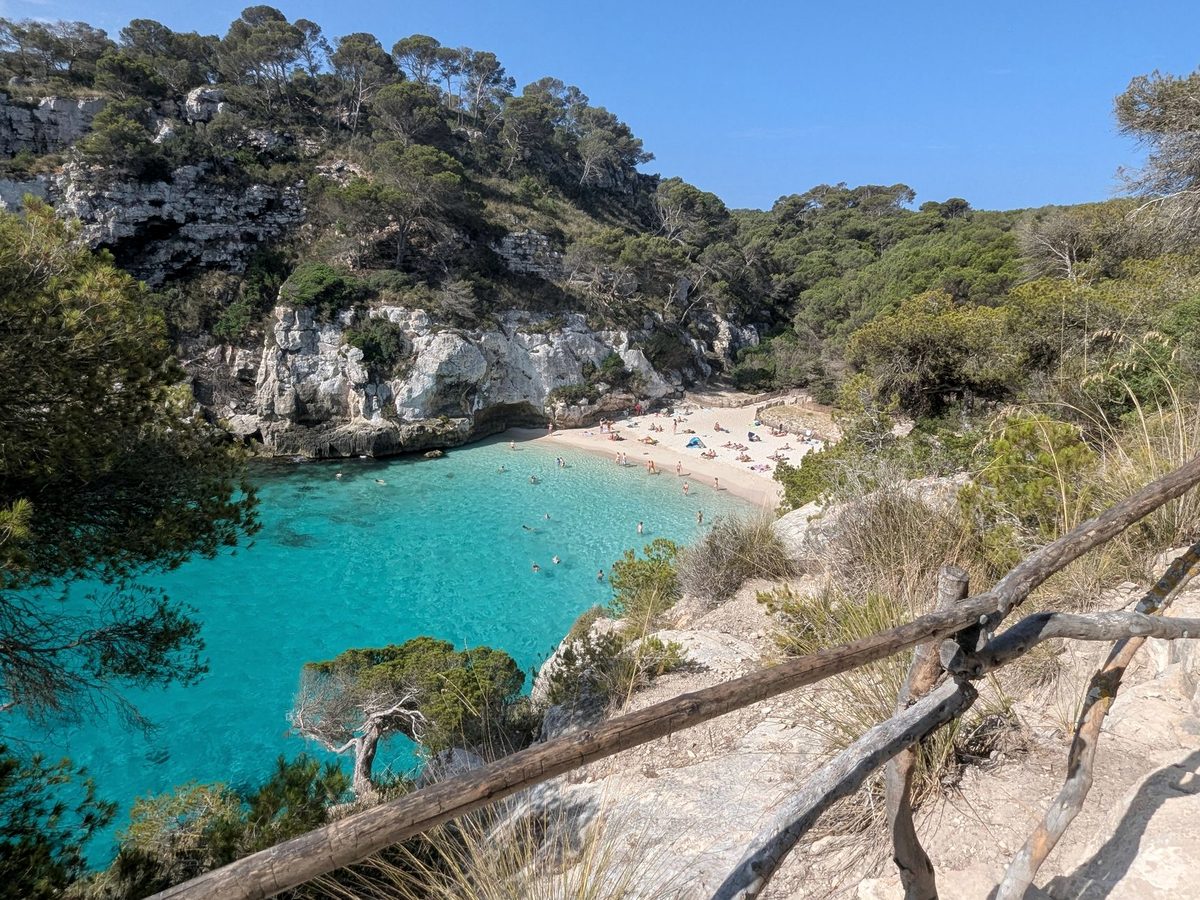
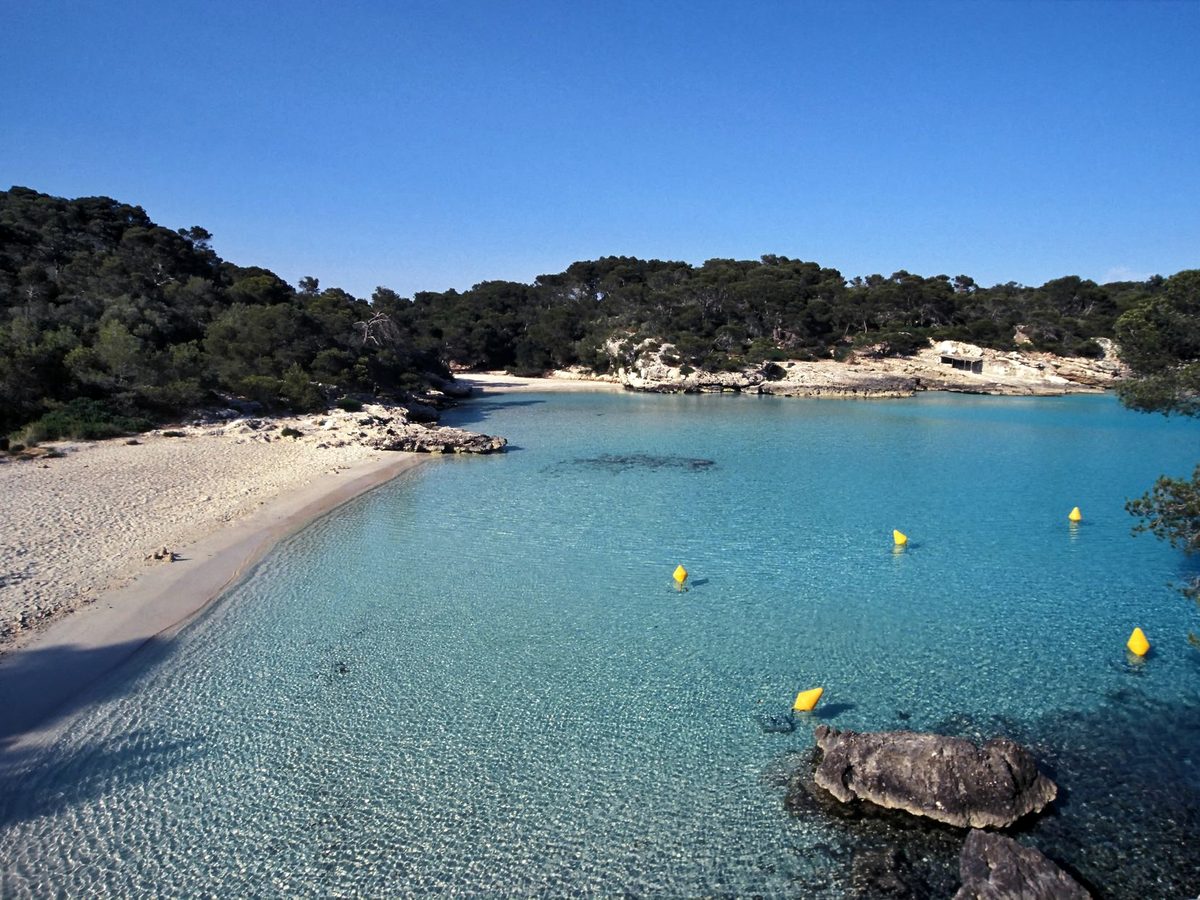
Then there are the virgin calas, Macarella and Macarelleta above all: the much-photographed coves with white sand and clear water, with no sunbeds, no cafés, no shade to rely on and no buggy-passable paths. In summer you can't drive to them; cars are banned from June to September and the small shuttle buses from Ciutadella fill fast. With little ones, go by boat. Cruises from Cala Galdana and Cala'n Bosch run past or into the same coves with shade, toilets and snacks aboard.
Weather, days out and the daily shop
When to go through the season, the boats and days out that suit small children, eating out and where to stock up.
Weather, May to October
The figures below are official long-term averages (1981 to 2010) from the airport weather station, and they only cover the months that matter, because Menorca is a summer island. July is essentially rain-free, September's warm sea comes with short, heavy showers between sunny spells, and the tramuntana can blow for a couple of days in any month.
| Month | Daytime high | Overnight low | Rain | Wet days | Sea temp |
|---|---|---|---|---|---|
| January | 14.5° | 7.5° | 62 mm | 8 | 15° |
| February | 14.5° | 7° | 52 mm | 7 | 14° |
| March | 16.5° | 8.5° | 38 mm | 5 | 14° |
| April | 18.5° | 10.5° | 39 mm | 5 | 16° |
| May | 22.5° | 14° | 31 mm | 4 | 18° |
| June | 27° | 18° | 15 mm | 2 | 22° |
| July | 29.5° | 21° | 5 mm | 1 | 26° |
| August | 30° | 21.5° | 22 mm | 2 | 27° |
| September | 26.5° | 19° | 79 mm | 6 | 26° |
| October | 23° | 16° | 73 mm | 6 | 23° |
| November | 18.5° | 11.5° | 113 mm | 9 | 20° |
| December | 15.5° | 9° | 56 mm | 8 | 17° |
Typical monthly averages from weather-station records. Sea temperature is the open-water figure, so a sheltered bay can feel a degree or two warmer.
With young children, June and September are the months to aim for: warm sea, manageable heat and space on the sand. July and August work with the usual hot-weather routine, beach before 11, shade or pool through the early afternoon, beach again from five, and air conditioning confirmed before booking.
Filling the daysThings to do with little ones
There are few paid attractions on Menorca, and under-threes go free at nearly all of them. The easiest one with a baby or toddler is the glass-bottom catamaran around Mahón harbour: exactly one hour on flat, calm water, an underwater cabin that toddlers find interesting and ice creams on board, for €18 an adult, €9 a child and under-twos free (last checked June 2026). The calas cruises from Cala Galdana and Cala'n Bosch are the bigger version, two to three and a half hours along the southern coves; one west-coast operator carries buggies and will warm baby food on board.
Lloc de Menorca, the small zoo off the main road near Alaior, is the classic paid half-day: a lemur walk-through, dwarf goats to feed, a playground and a little splash park, compact enough to finish before the nap, and the option for toddlers on the eastern side of the island. The waterparks both sit at the west end, AquaRock in Cala'n Bosch with its wave pool and toddler splash zones, and Aqua Center at Los Delfines; Splash Sur near Punta Prima shut in 2025 and hadn't reopened as of June 2026, so the south-east goes without. Cova d'en Xoroi, the cave bar in the cliffs at Cala en Porter, is a daytime novelty stop with a steep staircase, so carrier only, and small children find the cave terraces properly exciting.
The free list fills the rest. Monte Toro, the island's 358-metre summit, is a drive-up viewpoint with a café and a view over the whole island. Es Grau is the shallowest, safest toddler paddling on the island, staying knee-deep a long way out, and the Sa Gola loop beside it is the one flat nature walk you can do with a buggy. The Talayotic stone monuments are quick 20-minute stops, not half-day visits, and the Naveta des Tudons, a 3,000-year-old boat-shaped tomb a couple of euros to enter and free for under-eights (last checked June 2026), is the one to pick. Ciutadella's old town is buggy-friendly for a morning: market, arcades and gelato. Fornells, the fishing village on the big northern bay, has a flat, palm-lined harbour walk and somewhere for an early dinner. The white lanes of Binibeca Vell look centuries old but were built in 1972 and are privately owned, with requested visiting hours; go early, push the buggy quietly and don't peer into anyone's kitchen.
Eating out with children
Family tourism is Menorca's core trade. Children's menus are standard, highchairs are common in the resorts and ports, and the Spanish to ask is "¿tienen trona?". Locals eat at nine, but the harbour-front places open from about six for exactly your sitting, and the quaysides at Cales Fonts and Fornells are traffic-free, so a toddler who's finished eating can get down and walk.
The local cheese is an easy choice for children: Mahón cheese is on every menu, and the young tierno version is mild enough for small children. For the adults, there's grilled fish on the harbours, ensaimada pastries for breakfast and pomada, the local gin with cloudy lemonade, while the caldereta de langosta at Fornells is the local lobster stew, priced as a once-a-trip event rather than a lunch.
Milk, nappies and pharmaciesSupplies and the first-day shop
The big shops cluster around the two towns: Mercadona, Lidl and Aldi all have branches at Mahón and Ciutadella, the local chain Binipreu covers the eastern half, and a large Eroski outside Sant Lluís is the practical stop for Punta Prima and Binibeca. The resorts themselves run on minimarkets, well stocked, open long hours and noticeably dearer, so the cheapest week starts with one big town shop on day one. Nappies are sold mainly as Dodot, the Spanish Pampers; formula runs Almirón for Aptamil, with similar staging but not identical recipes, so bring enough of your own and treat local stock as backup. The island dairy Coinga puts fresh local milk in most supermarkets, rather than only the UHT milk that's standard in Spain.
Pharmacies, marked by the green cross, are the only place for medicines, with Apiretal as the children's paracetamol and Dalsy the ibuprofen, both dosed by weight. Baby-kit hire firms deliver cots, buggies and sterilisers to villas and hotels across most of the island, and one meets arrivals at the airport; check your corner is covered.
Getting around, a real week and the admin
Transfers and hire cars, what a week actually looks like, the health and document checks and a list to pack against.
Getting there and around
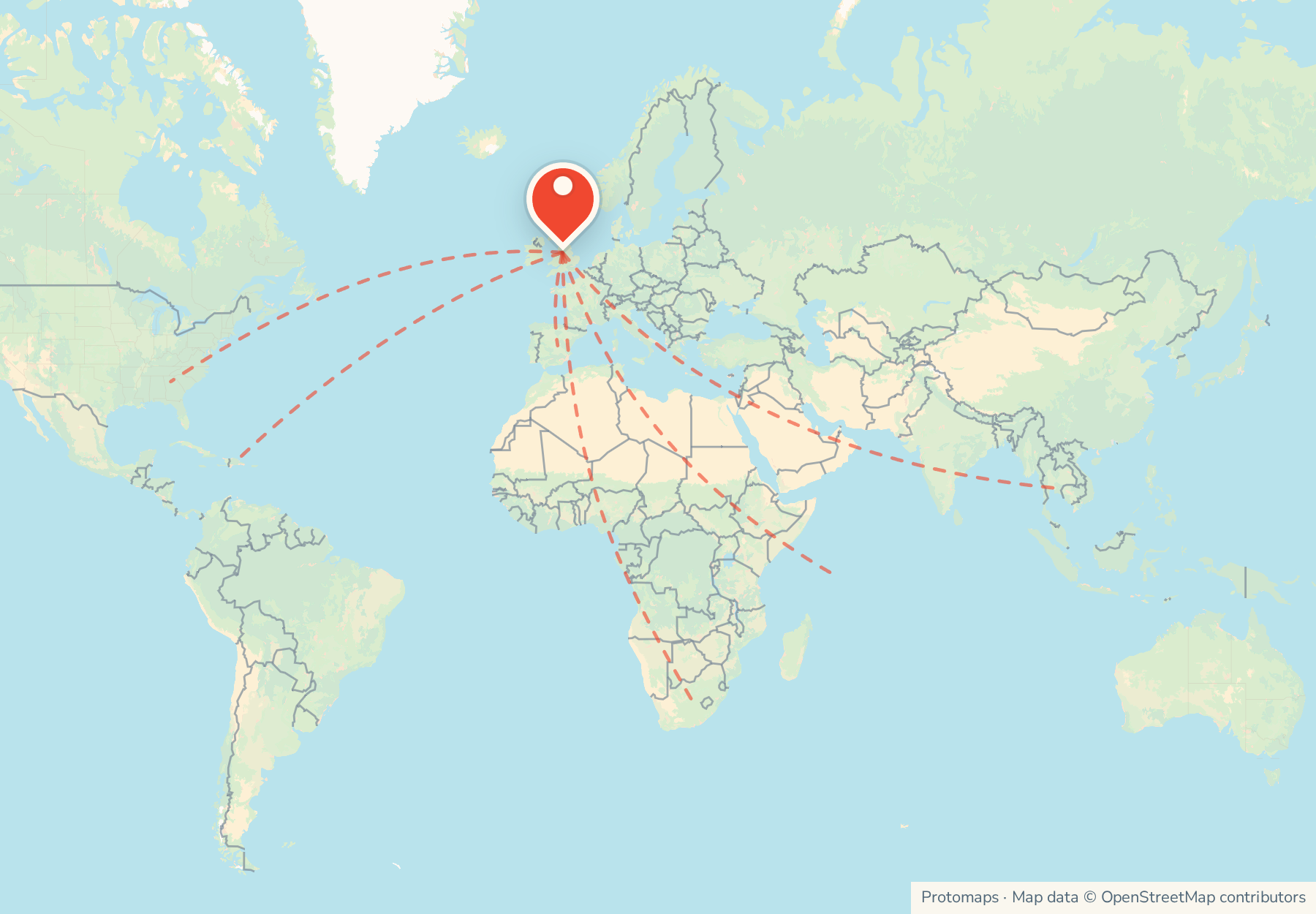
The airport is small and quick, and the transfer times in the table above are short by any island's standard. Spanish law requires a proper child seat for anyone 135 centimetres or under, riding in the back, and the street taxis don't carry them, so pre-book a transfer with the seat specified or bring your own. Summer flights run from a dozen or more UK airports.
A hire car suits the rest of the island better than the calas, which ban private cars from June to September. Use it for Monte Toro, Es Grau and the supermarket run. The Me-1 road runs the length of the island in about 45 minutes, driving is quiet and easy, and the local hire firms have airport desks with child seats to book ahead, which sell out in peak weeks. The buses connect Mahón, Ciutadella and the resorts well enough for town trips, and in summer the small shuttle buses from Ciutadella are the only land route to Macarella.
What a real week looks likeA realistic week with little ones
You can use the first afternoon: pool, supermarket run and an early dinner on the quay.
The bay in the morning, lunch and a nap, then back to the sand or the pool until an early dinner.
The hour-long harbour catamaran from Mahón with the smallest, or a calas cruise from Cala Galdana or Cala'n Bosch with a toddler.
A final swim, a slow pack and the short run back to the airport.
With little ones, the bay, the pool, one boat and one town morning will comfortably fill a Menorca week.
The practical adminHealth, documents and the boring bits
Check the GOV.UK Spain advice before booking and travelling. Passports need to be issued within the last ten years and valid three months beyond departure, children's included. Carry a GHIC each, which covers the public system: the island's hospital, Mateu Orfila in Mahón, has 24-hour A&E and paediatrics, and Ciutadella's Canal Salat health centre runs a 24-hour urgent service for the west end. The private clinics in both towns want travel insurance instead.
The emergency number is 112. The hazards are the ordinary southern ones: strong summer UV, so hats, cream and midday shade for babies, sea conditions that follow the flags and the occasional jellyfish week. The cliff paths above the calas have unfenced stretches, so a free-walking toddler is safer back in the carrier.
Before you payBooking checklist
- Check the dates against the season: May to October, with edges that close early and open late.
- For May or October, ask the hotel what's open in the resort that week.
- Confirm the cot and the air conditioning for July and August.
- Book the transfer with the right child seat, or bring your own.
- Hiring a car? Reserve the child seat when you book it, not at the desk.
- Plan the calas by boat, not by car park.
- Pack a carrier for the cala paths and a first-day shop list for the town supermarkets.
- Bring enough formula and any medicines your child relies on.
- Confirm the cancellation terms and your travel insurance.
- Recheck the GOV.UK Spain advice and every passport before you go.
Resort guides in Menorca
We've researched these places to stay in Menorca for families with young children. Each guide covers what it's like, who it suits and what to check before you book.
Questions, links and the last word
The things families ask most, the official pages worth a bookmark and when this guide was last refreshed.
Common parent questions
Can we go in winter?
Realistically, no. The resorts close from around November to April, most restaurants and beach bars with them, and there are no direct UK flights between November and March. Menorca in February is 14 degrees and windy. If you want winter sun, this is the wrong island; the Canaries are the right ones.
How do we see Cala Macarella with a toddler?
There's no shade, no café and no toilet at Macarella, so go early, take your own water, sun cover and a parasol, and plan to be back at the resort for the nap. A morning cruise from Cala Galdana lands you on the sand for an hour and gets you back before lunch, which is the easiest way with a small child. If the sea looks lumpy or it all feels like too much, the calm Mahón harbour boat is the gentler day out instead.
Is the wind a problem?
Less than its reputation suggests in summer. The tramuntana is most frequent between October and April; a July blow tends to mean a day or two of stirred-up sea on one coast while the other stays flat. Any weather app carrying the Spanish AEMET forecast shows it a day ahead, which is enough notice to pick a beach on the sheltered side.
Which resort works without a hire car?
Punta Prima or Cala Galdana. Both are compact, walkable and well stocked, with summer buses to the towns, and street taxis cover the gaps, though they don't carry child seats, so pre-book anything longer. Cala'n Bosch also works, with Ciutadella 15 minutes away.
Should we worry about swimming at Cala Galdana?
Not much, but know the detail. The bay lost its Blue Flag in 2025 because of occasional discharges into the Algendar stream, which crosses the beach; the seawater itself generally tests fine. Swim in the bay and keep paddlers out of the stream mouth, especially after rain.
Can we buy our usual formula and nappies?
You'll find equivalents rather than the exact products, so it's safer to bring enough of your own and treat local stock as backup, especially the formula, where the staging is similar but the recipe isn't identical. Stock up at a town supermarket on day one rather than relying on the dearer resort minimarkets. For feeds, use bottled water rather than tap, which avoids the nitrate problem in Mahón's water.
When is the sea warm enough for little ones?
For comfortable toddler swimming, aim for mid-June onwards. Earlier than that, the sea lags well behind the air, so a hot week in May or early June can still mean a cold sea that little ones only paddle in. A heated pool at the hotel takes the pressure off the sea on either shoulder of the season.
Is there a waterpark?
Yes, but only if you're staying at the west end, where both open parks are. From the south-east resorts they're a 45-minute-plus drive, which is a lot with a small child, so factor that into where you book if a waterpark matters. The smallest children get more out of a toddler splash zone than the slides anyway, and most family hotels have a children's pool that does the same job without the trip.
See more Menorca photos
Open the photo gallery →Useful links
- GOV.UK Spain travel advice: passport rules, entry requirements and health updates before you travel.
- Menorca tourist board: the official island site, including beach and family listings.
- Mou-t Menorca: bus timetables, including the summer shuttles to the calas.
- Yellow Catamarans: times and prices for the Mahón harbour boat.
Last updated 12 June 2026.