NIVA Kuramathi
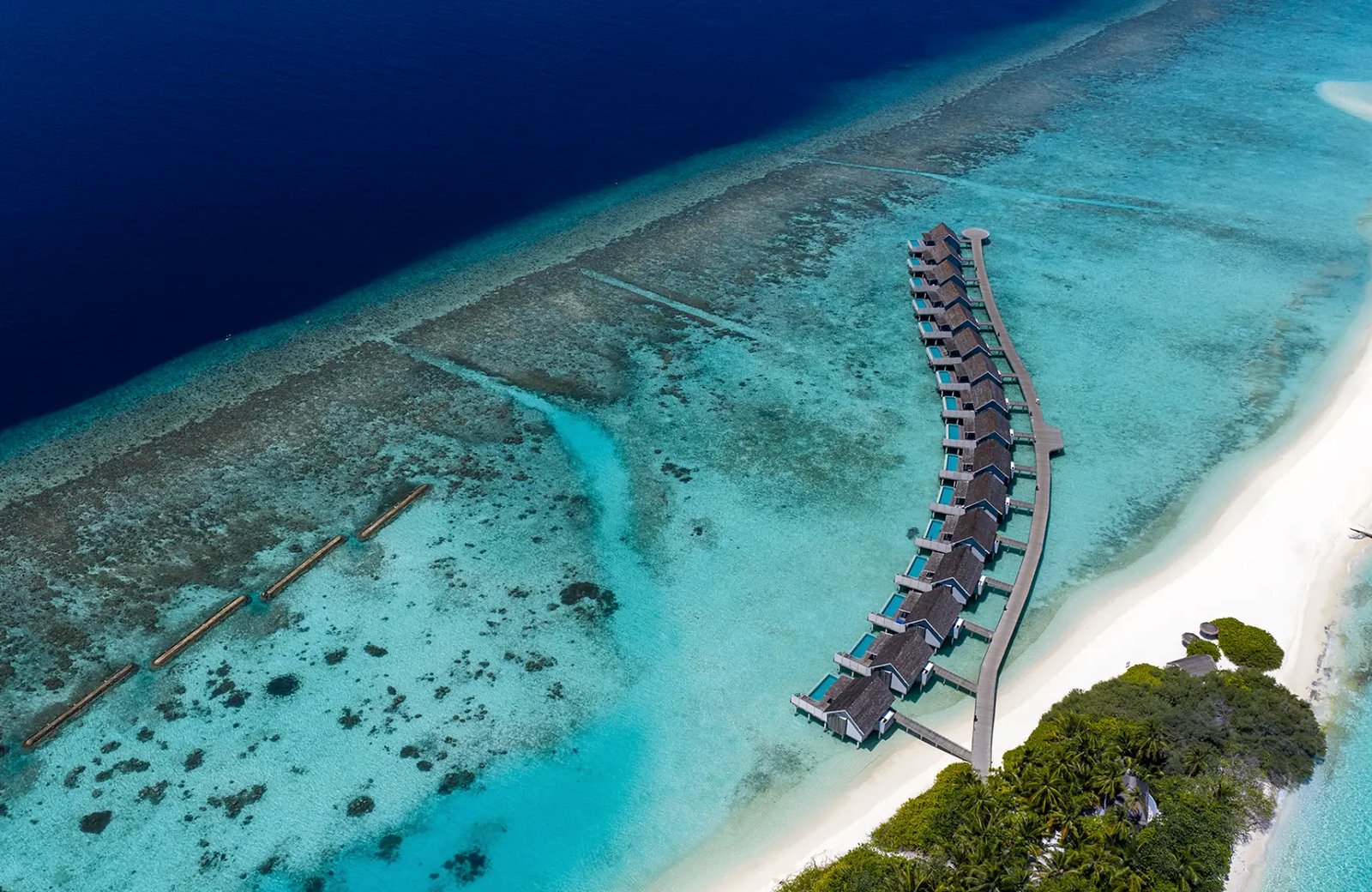
NIVA Kuramathi is a large, green island resort in the Rasdhoo cluster of North Ari Atoll in the Maldives, a 20-minute seaplane or a 75 to 90 minute speedboat from Malé. Formerly Kuramathi Island Resort, it spreads across the biggest island in its atoll, with a house reef the whole way round, a kids’ club and crèche and eleven villa types from beach villas to overwater villas with their own pools.
On this page
- Is it worth it?
- Quick facts
- What the resort is like
- The villas
- Every restaurant and bar
- Pools and water
- The beach and reef
- Babies and toddlers
- Things to do
- The spa and wellness
- The area and days out
- Loves and gripes
- How it compares
- Getting there and when to go
- Weather
- Health and practicalities
- Questions
- Photo gallery
Is it worth it?
The quick read before the detail: who Kuramathi suits, what the board covers and the facts to skim first.
NIVA Kuramathi is a large island resort in the Rasdhoo cluster of North Ari Atoll, and it was Kuramathi Island Resort until the recent NIVA rebrand. It’s the largest of the six islands in the natural Rasdhoo group, over 1.8km long, with a house reef running the whole way round, eleven villa types, twelve restaurants and a kids’ club and crèche that between them take children from babies to twelve. Families come for the space, the reef a few steps off the beach and the breadth of things to do.
The size cuts both ways. There’s room to cycle, walk and explore and a real choice of pools, beaches and restaurants, though you can feel spread out, and getting around means the golf buggies, the electric carts that run around the island. The journey in is either a 20-minute seaplane or a speedboat of 75 to 90 minutes, which is a long ride with a tired young child. Most villas hold two adults and one child, so a family of four needs the two-bedroom house or a second villa. You’ll get the most from it if you want an active, reef-focused week with plenty of choice, and less if you’d rather a small, compact island.
Best for
You want a large island with space to explore, a house reef off the beach, a wide choice of restaurants and pools, plus a kids’ club and crèche that take children from under 3.
Maybe not for
You’d rather a small, compact island, you want a short transfer, or you need two children in their own bedroom without booking the largest house.
Best ages
Any age. Bageecha runs free from 3 to 12 in the day, a crèche takes under-3s, and babysitting covers 0 to 12, both of those for a charge.
What stands out
The scale, the house reef the full length of the island, nine à la carte restaurants, plus the semi-submarine and manta trips families single out.
What to check
Whether a water villa suits a small child, cot and baby-kit availability and your flight time against the last transfer of the day.
Where is it?
Rasdhoo Atoll in North Ari, the largest island in the Rasdhoo group, about 56 km southwest of Malé.
Quick facts for families
What the resort is like
Where Kuramathi sits, how it’s laid out over the length of the island and what its scale means for a week with young children.
NIVA Kuramathi is a large, green island resort, one of the bigger resort islands in the Maldives at over 1.8km long. It has the feel of a small village rather than a private hideaway: inland greenery and trails, a beach around most of the shore and facilities spread along the length and width of the island. It was Kuramathi Island Resort for years, and the NIVA name is a recent rebrand under Versa Hospitality, so the island, its reef and its buildings are the same, with a new brand identity over the top. For the wider country, its atolls and its seasons, see our Maldives guide.
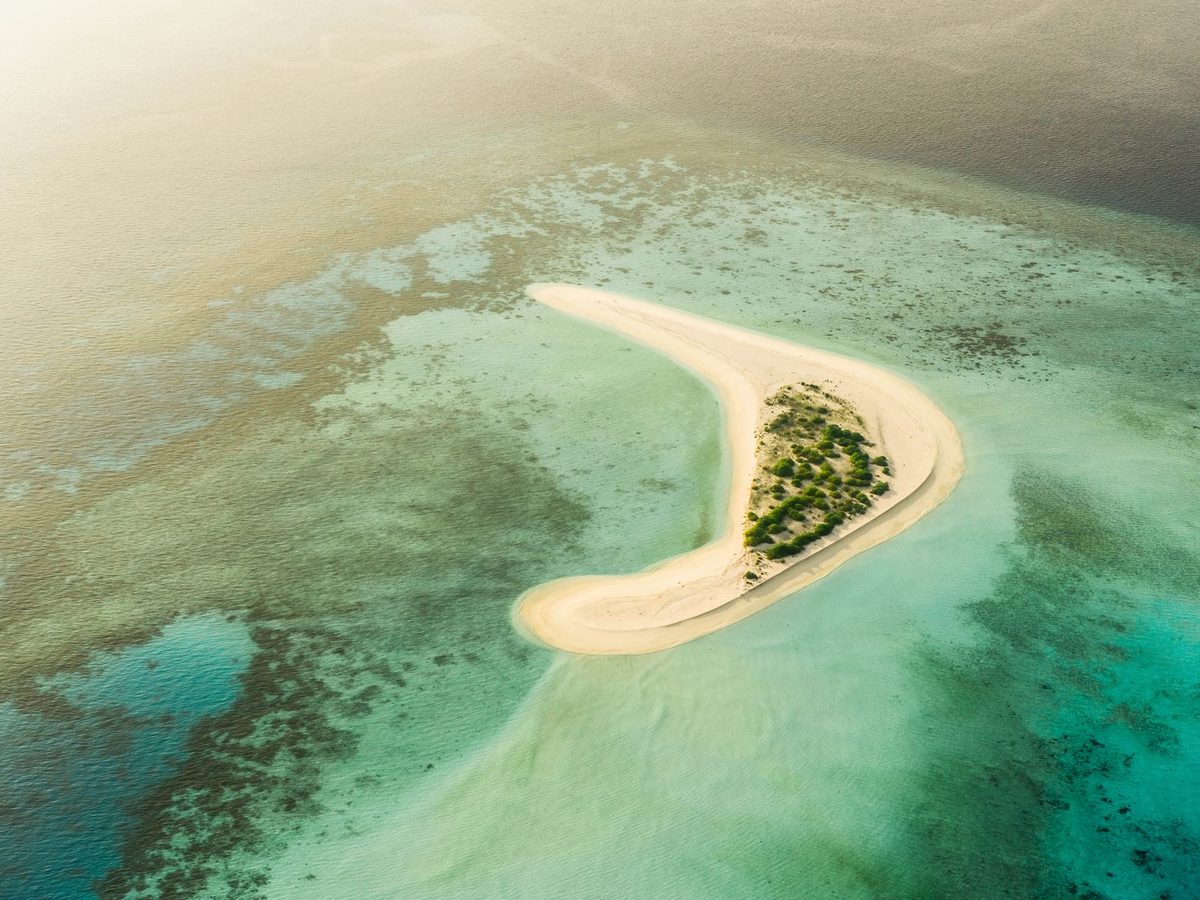
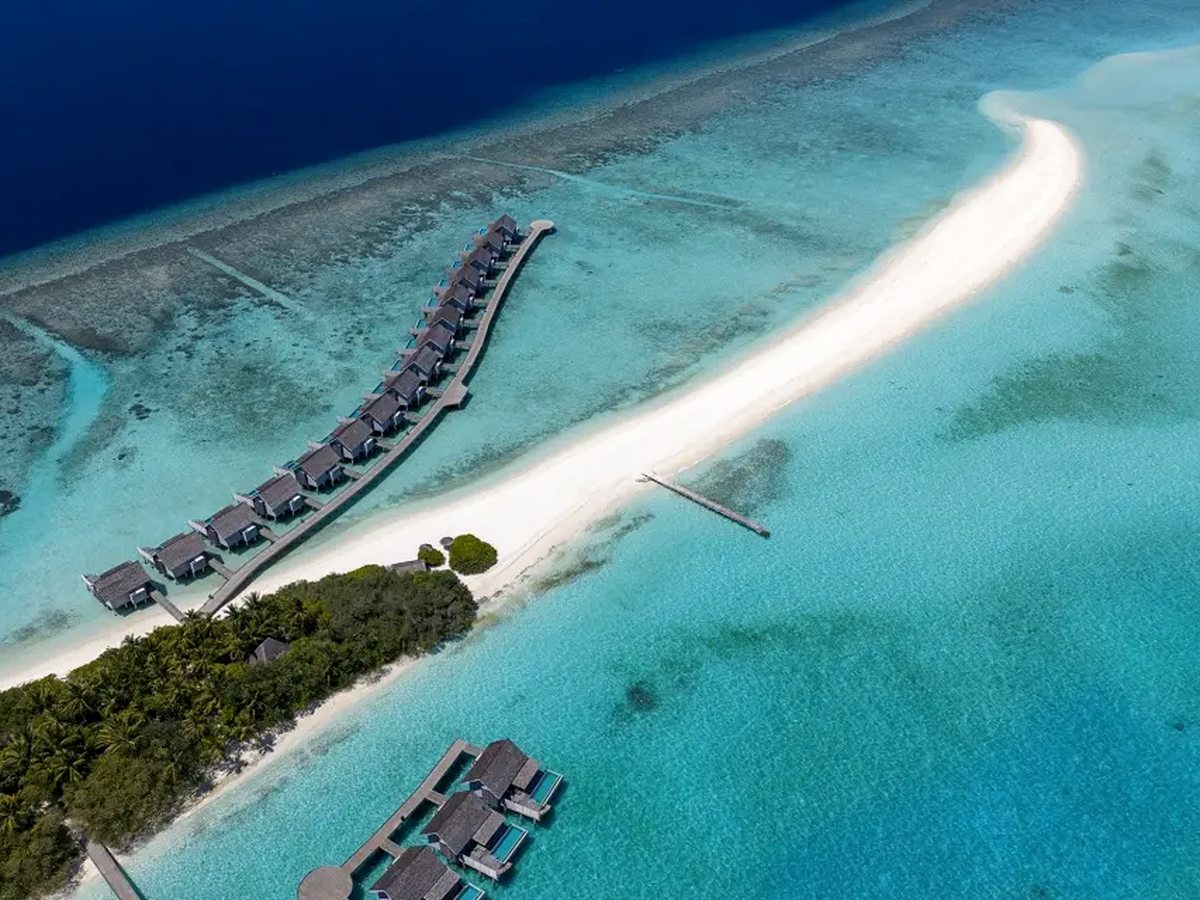
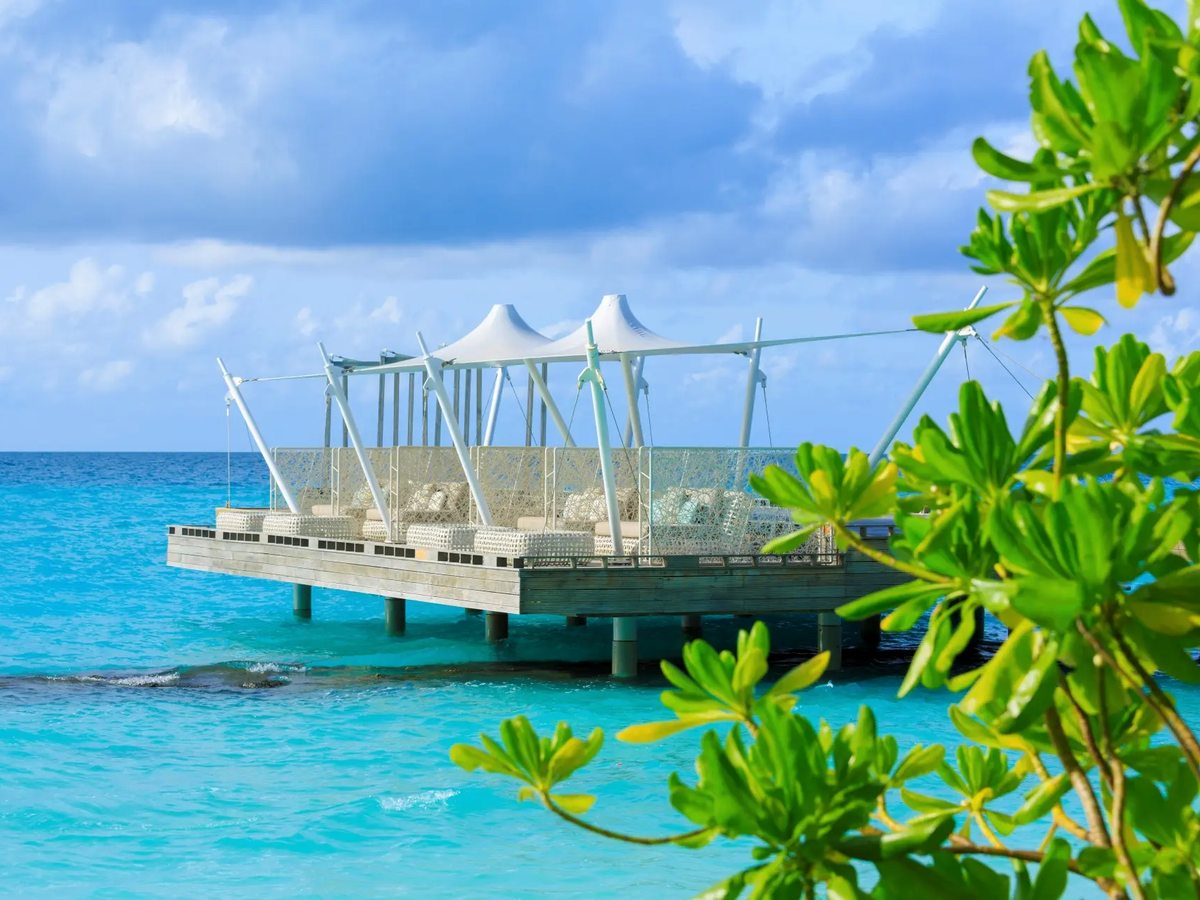
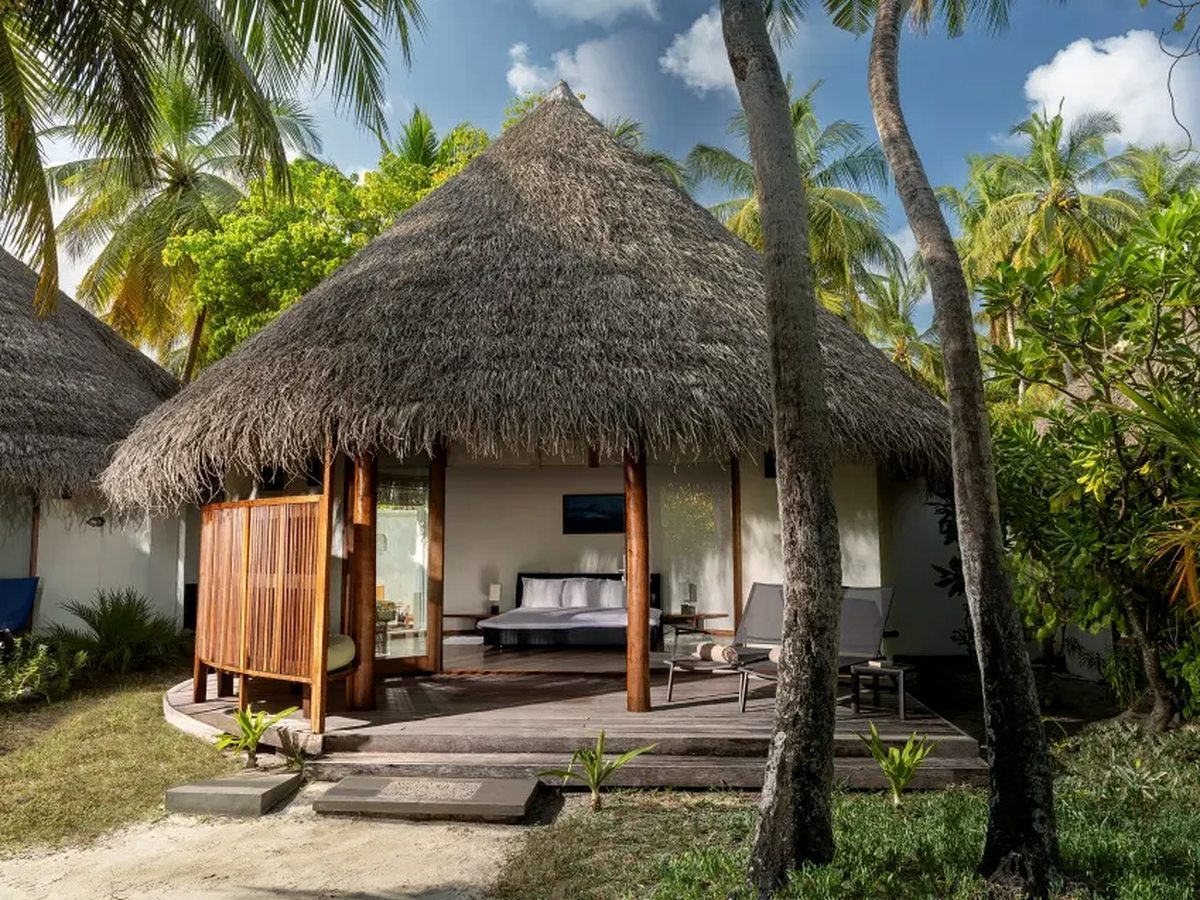
Accommodation runs from beach and garden villas around the shore to overwater villas reached along a jetty, with the Two Bedroom Beach Houses at the top of the island. A sandbank sits off the west of the island and shows at low tide, near the Thundi water villas.
The island is big enough that you’ll want a lift for the longer stretches. Golf buggies, the electric carts many Maldives resorts use to ferry guests about, have stops dotted around the island and run from morning until as late as 1am, so a tired toddler doesn’t have to be carried the whole way back. The sandy paths also take a pushchair, which is the pram to a UK reader rather than the resort’s golf buggy.
The villas
Every villa type with its official size and how many it sleeps, then which suit a family with a baby or toddler.
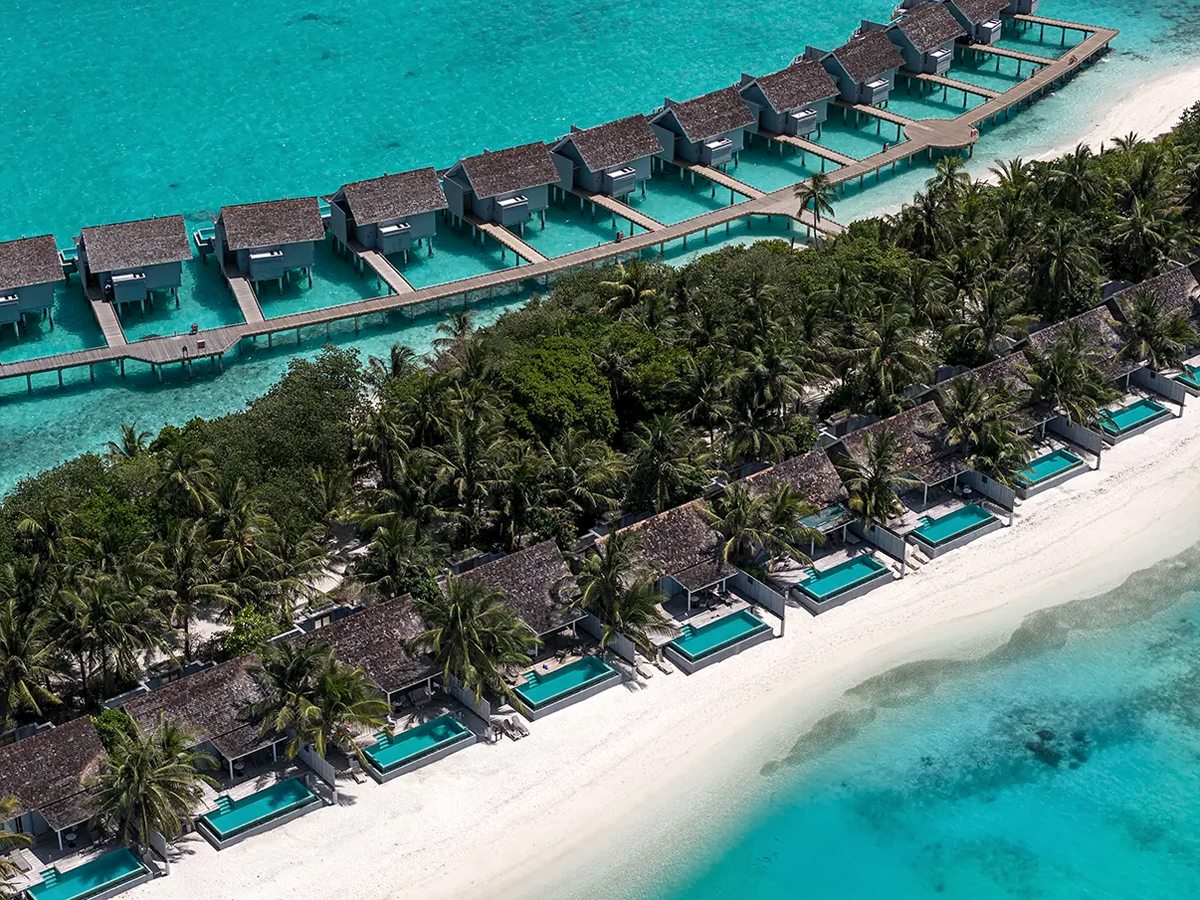
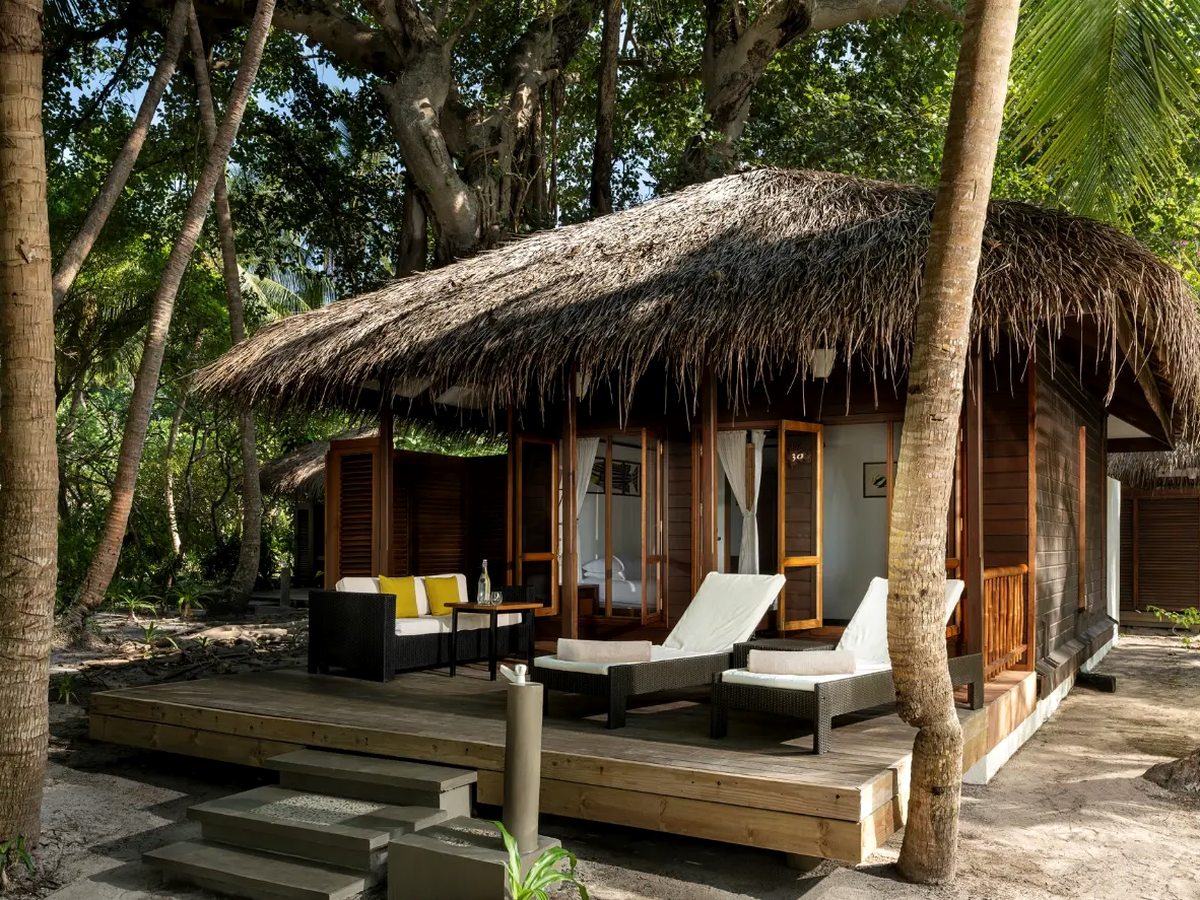
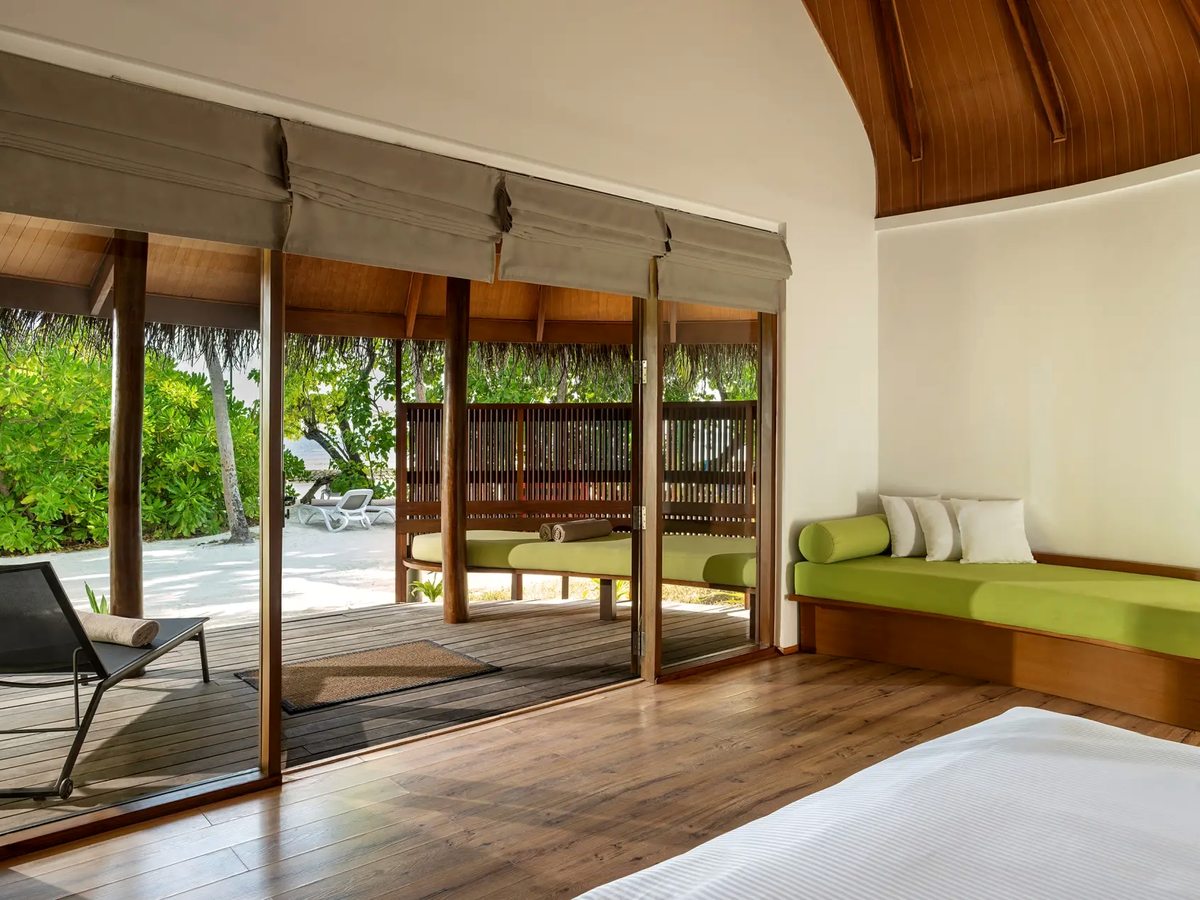
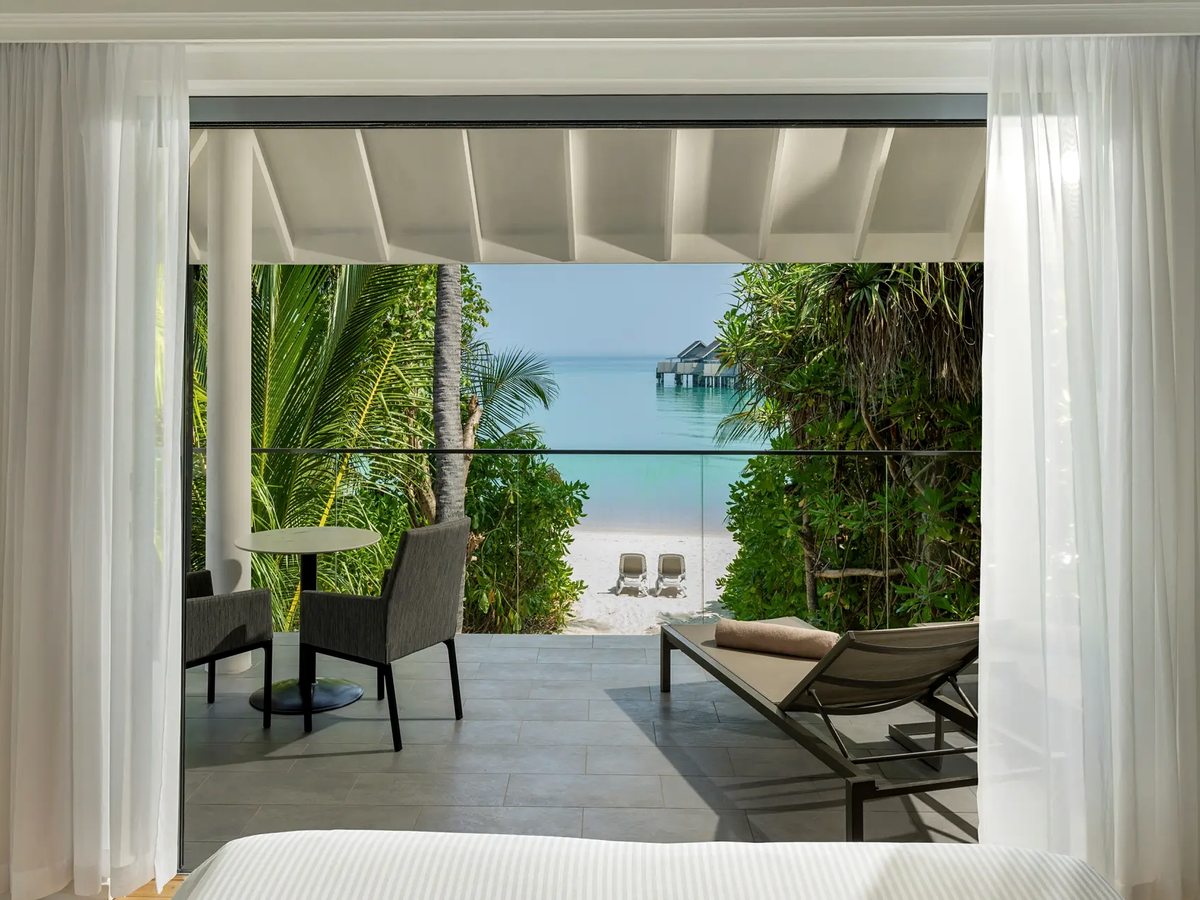
There are eleven villa types and around 348 villas in total, from a 70 m² beach villa up to a 310 m² honeymoon villa, split between beach and garden villas on land and villas built out over the lagoon. Every type except the Two Bedroom Beach House sleeps a maximum of three, which the resort counts as three adults, or two adults and one child under 12. The table is the full line-up with the official sizes, and the guidance after it is which suit a family with young children.
| Villa | Size | Villas | Sleeps | Family notes |
|---|---|---|---|---|
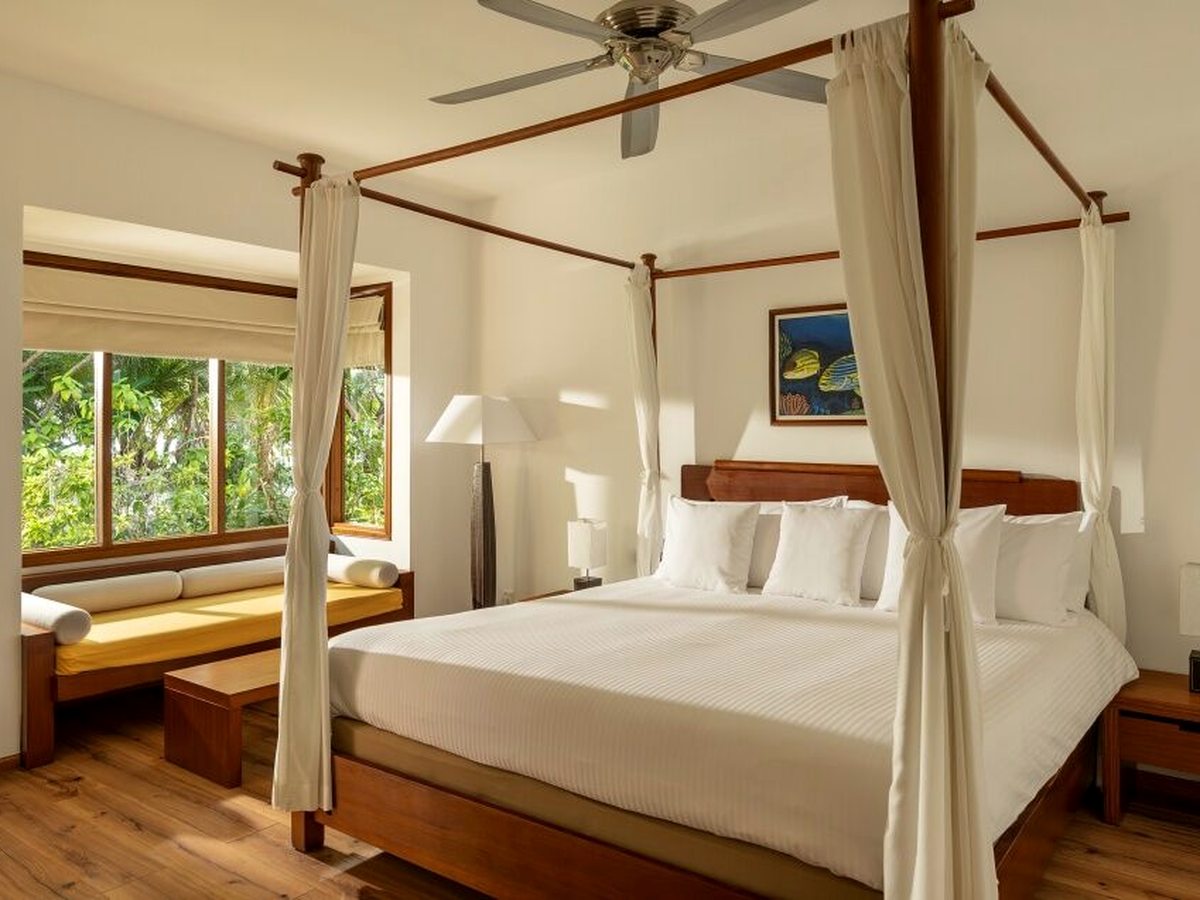
| Beach Villa | 70 m² | 71 | 3 | The entry-level room, beach-facing, with a four-poster king and a sofa and a semi-open bathroom with a rain shower. The most plentiful villa, so the easiest to book. |
| Beach Bungalow | 90 m² | 33 | 3 | Garden-set, with a private hot tub and an outdoor rain shower, a king and a sofa. |
| Superior Beach Villa | 90 m² | 35 | 3 | A circular design with a hot tub and a Nespresso machine, a king and a daybed. |
| Deluxe Beach Villa | 95 m² | 31 | 3 | Lagoon-facing, with a four-poster king and a daybed, plus a Nespresso machine. |
| Two Bedroom Beach House | 205 m² | 35 | 6 | The family villa: two storeys with separate entrances, two king bedrooms and two daybeds, plus a bath and rain shower on each floor. Sleeps six adults, or four adults and two children under 12. At the top of the island. |
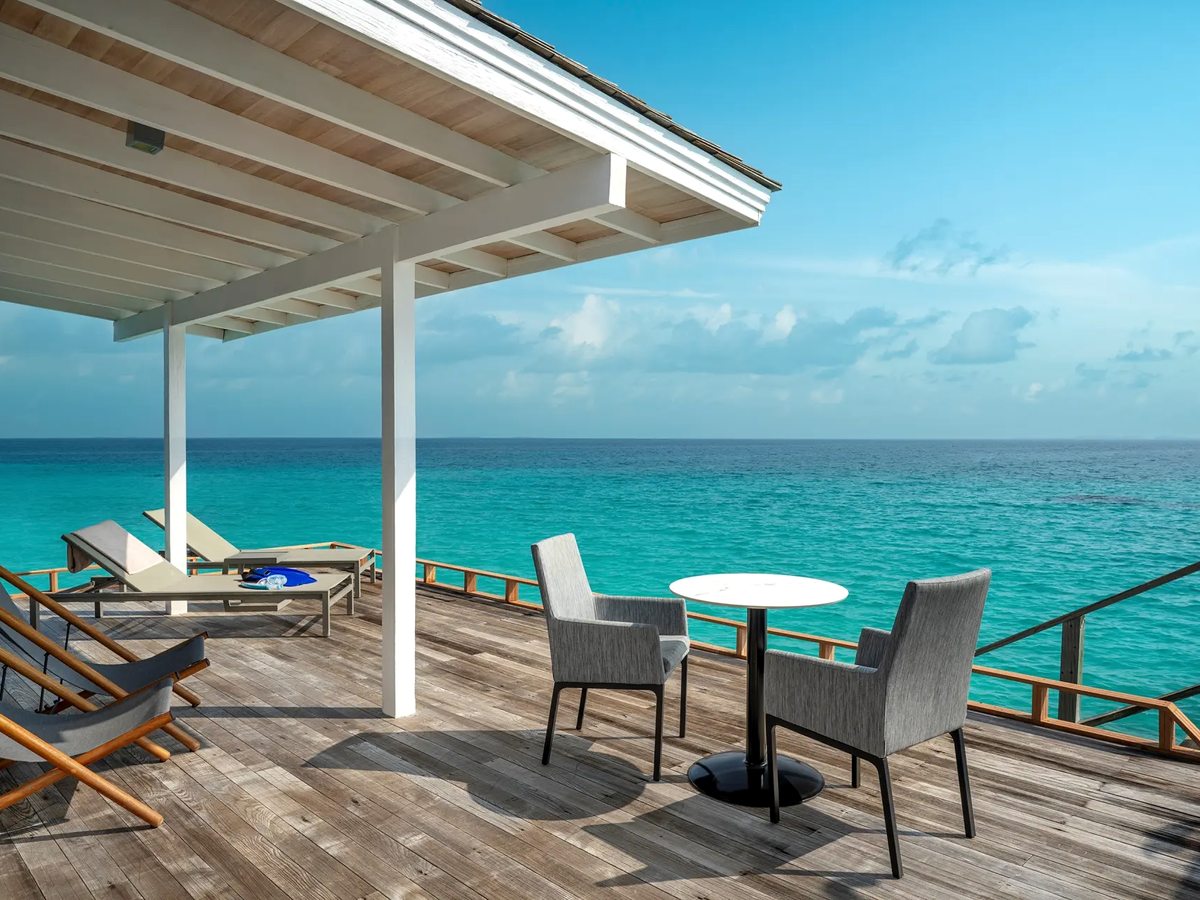
| Deluxe Water Villa | 115 m² | 30 | 3 | Overwater with no private pool, a deep soaking tub and steps down to the lagoon, a king and a sofa, plus a wine chiller stocked with over 30 selections. |
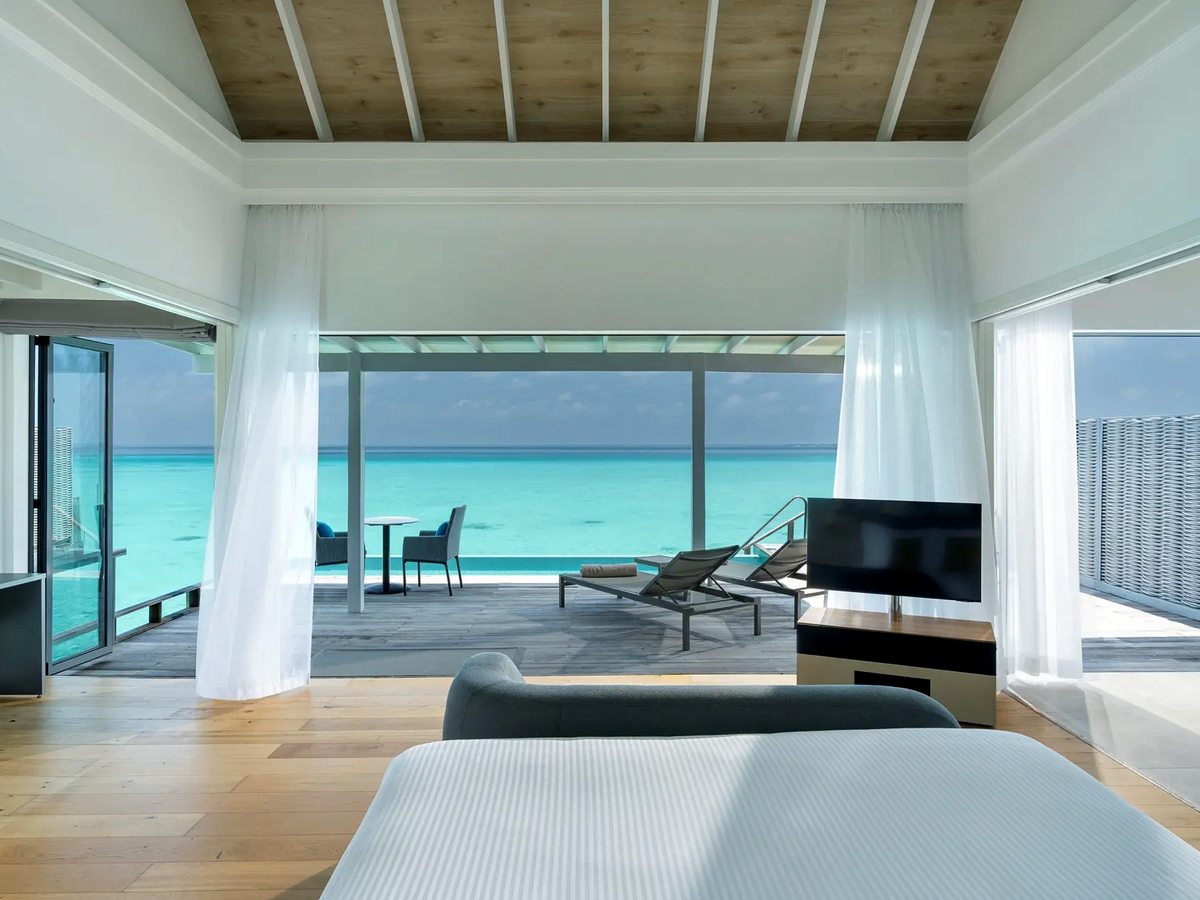
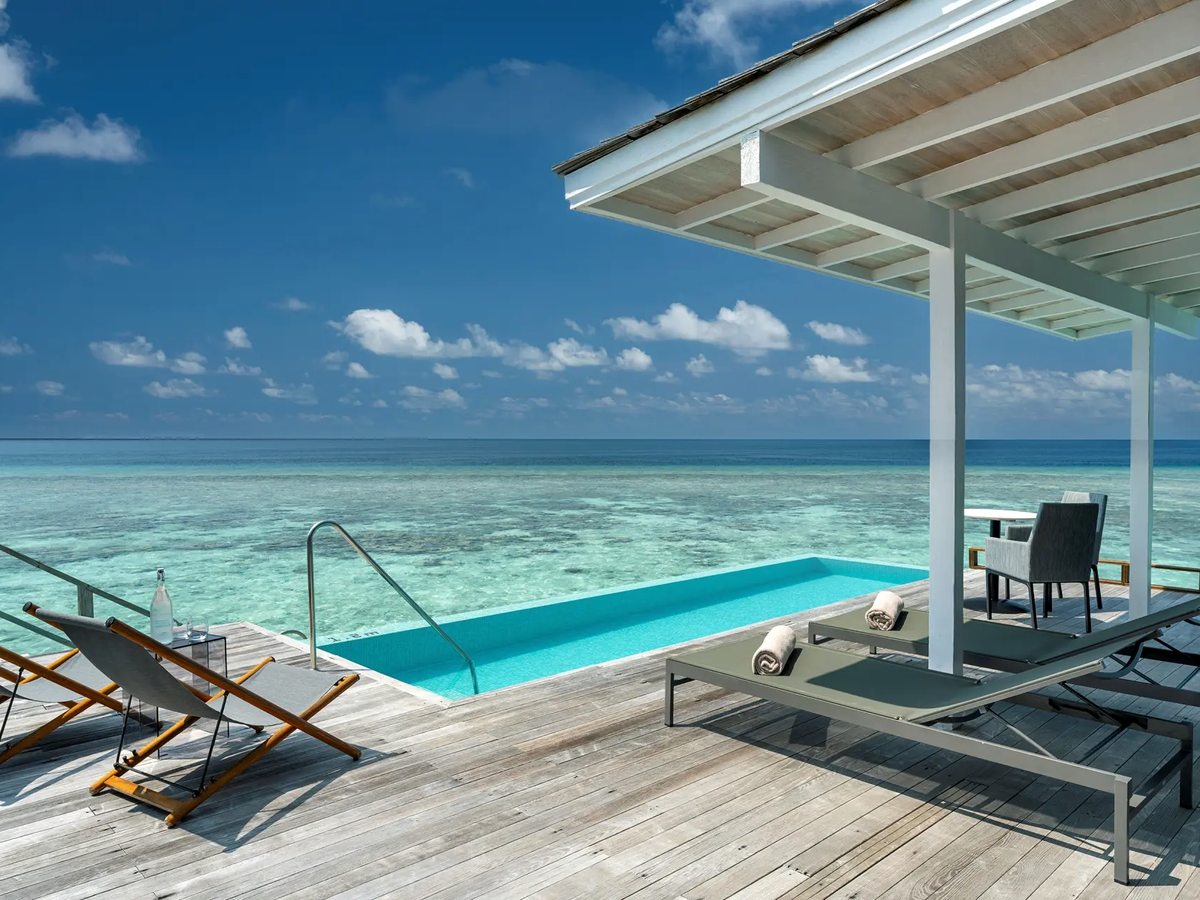
| Water Bungalow with Pool | 117 m² | 50 | 3 | Overwater, with a king and a daybed, a 15 m² infinity pool and house-reef access from the deck. The most plentiful overwater room. |
| Water Villa with Pool | 142 m² | 33 | 3 | Overwater, with an 18 m² infinity pool, dual vanities and lagoon access, a king and a sofa. |
| Pool Villa | 165 m² | 12 | 3 | Beachfront, with a king and a daybed, an 18 m² infinity pool, a private courtyard entrance and a walk-in wardrobe. Only 12 of them. |
| Thundi Water Villa with Pool | 142 m² | 16 | 3 | Overwater, with an 18 m² infinity pool, set near the island’s sandbank and the most secluded of the overwater villas. |
| Honeymoon Pool Villa | 310 m² | 2 | 3 | A garden villa with a 10 m lap pool and an air-conditioned glass sala, a garden pavilion. Only two of them, and in practice a couples’ room. |
For a family, the Two Bedroom Beach House is the clear choice. At 205 m² over two storeys with separate entrances, two king bedrooms and its own bath and rain shower on each floor, it’s the one villa with a proper separate bedroom, and it sleeps up to six adults or four adults and two children under 12. The single beach and garden villas work for two adults and one young child on the sofa or daybed, though there’s no separate room to close on a sleeping baby. There are no interconnecting rooms, so for two children in their own space it’s the Two Bedroom Beach House or a second villa.
The overwater villas are worth a pause with a small child. The booking form lists a children category on every villa, so the system won’t turn a child away, but the resort doesn’t publish any infant or toddler safety policy for the open decks and railings over the water. Don’t take the booking category as a safety clearance. Email [email protected] before booking a water villa with a baby or toddler, and weigh the deck against a beach villa on solid ground.
Every villa has a TV, WiFi, a safe, a minibar, beach towels, bathrobes and a hairdryer, and the sockets are UK-style square-pin at 220V, so no adapter. A Nespresso machine comes in the Superior Beach Villa and above, while the entry Beach Villa has basic tea and coffee making.
Every restaurant and bar
The five board levels, the three buffets and nine à la carte restaurants, the seven bars and how booking works.
Food comes on one of five board levels: bed and breakfast, half board, full board, all-inclusive and Dine Around All-Inclusive at the top. Full board is buffet breakfast, lunch and dinner at your allocated buffet, with drinks charged. All-inclusive adds a wide range of drinks, the minibar drinks, an afternoon high tea from 3 to 5, one visit to a local island in your stay, plus windsurfing and snorkelling gear. Dine Around All-Inclusive adds the à la carte restaurants, subject to booking, selected wines by the glass and a US$35 spa credit towards a body massage for adults between 9 and 3, one credit per person for the stay. Premium dishes and private dining sit outside it.
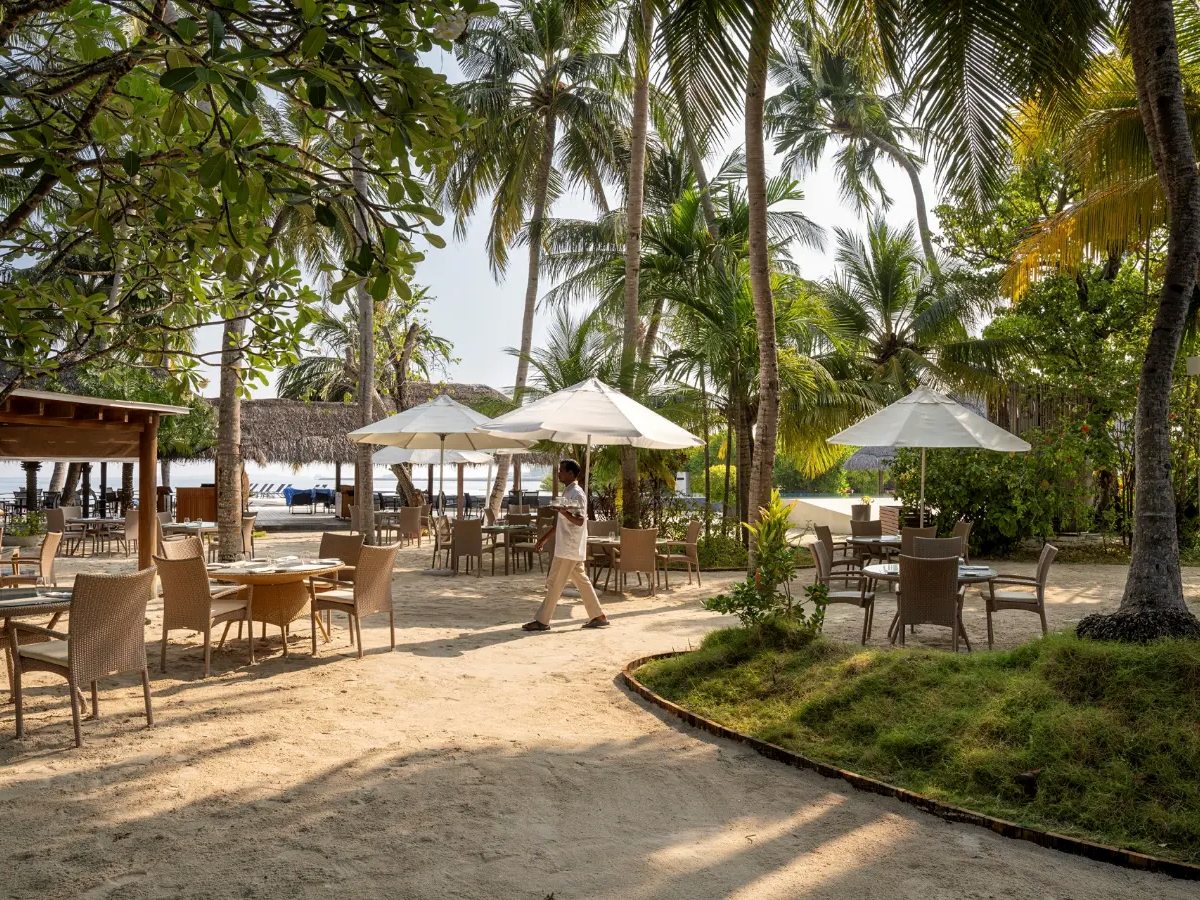
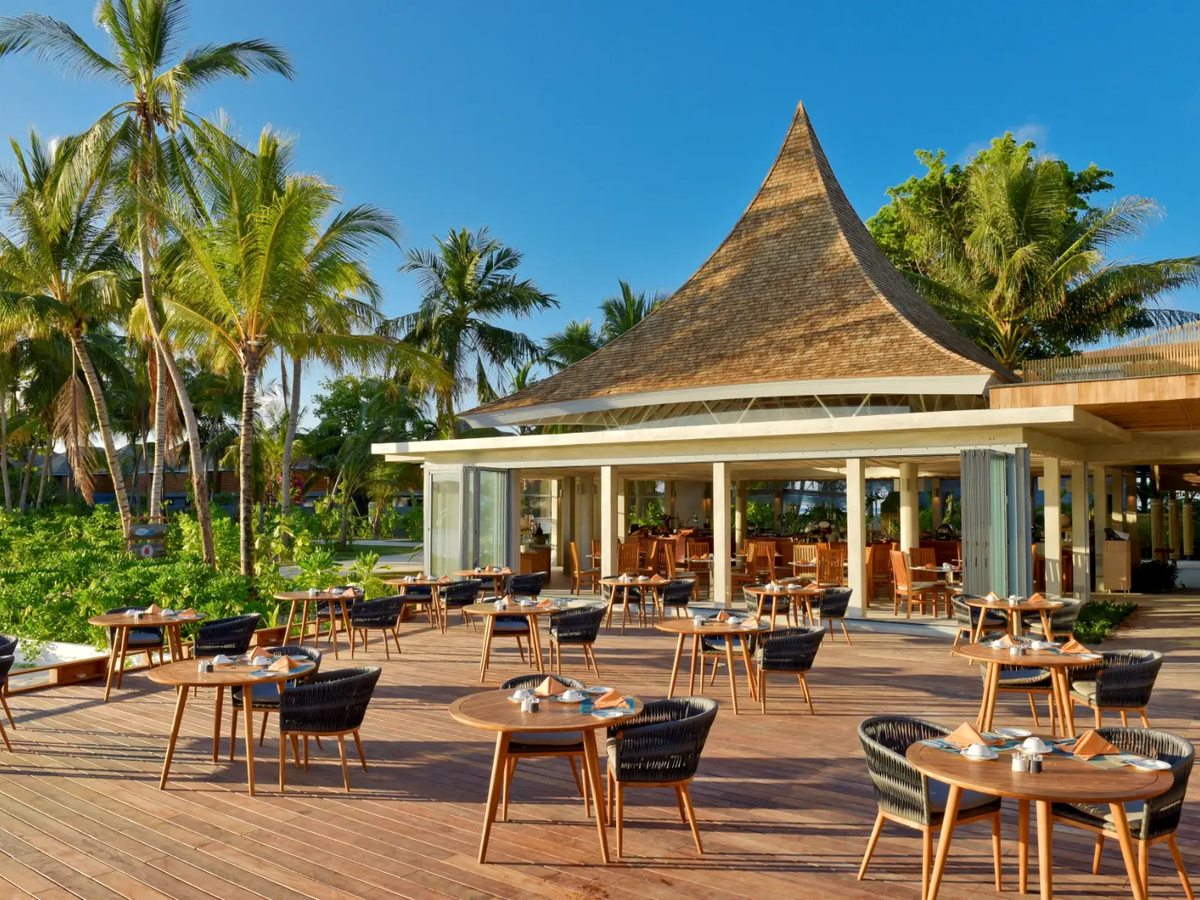
The buffet is the everyday option, and there are three open-air buffet restaurants running the same concept, Haruge, Malaafaiy and Farivalhu. Breakfast is 7:30 to 10, lunch 12:30 to 2 and dinner 7 to 9, with themed evenings and a children’s mini-buffet. It takes walk-ins, which is the practical answer when a young child’s appetite arrives at its own time, and a children’s lunch can also be served at the kids’ club between 11 and 2.
The nine à la carte restaurants cover a wide spread, and dinner at them is likely to need a table booked a day ahead, which is standard for the Maldives.
- The Reef is seafood, European and Mediterranean, overwater, open 7 to 10:30, with catch of the day and wagyu steaks.
- Island Barbeque is seafood and barbecue beside the main Fung Bar infinity pool, 7 to 10:30, with tableside flambé. Children need to be 6 or over here, whatever your board.
- Palm is international and Mediterranean under the palm trees, open for lunch and dinner, with pizza, house-made pasta, seafood and the Gelateria at Palm for ice cream. It’s the most casual of the à la carte rooms and the easiest with young children.
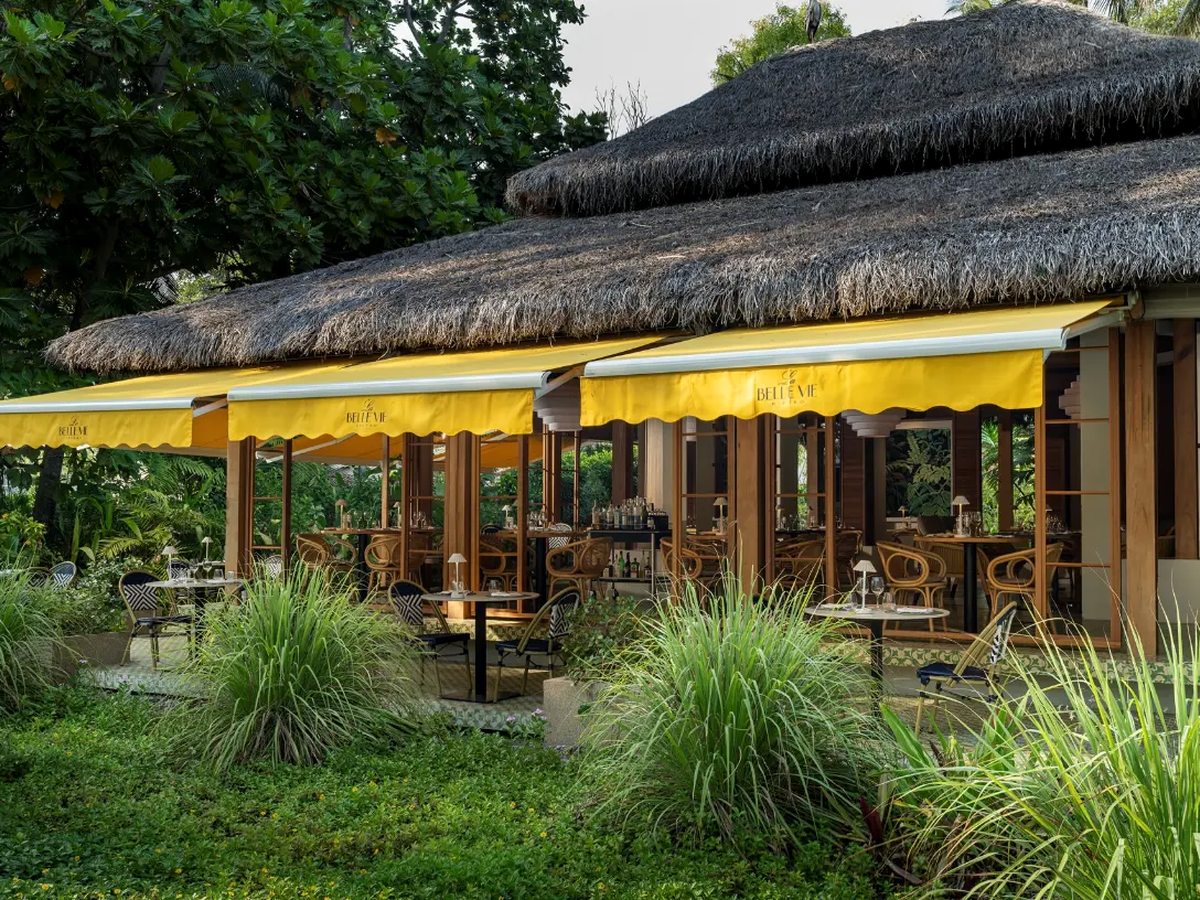
- La Belle Vie is a candlelit French bistro, 7 to 10:30, with sommelier pairings, romantic rather than child-focused.
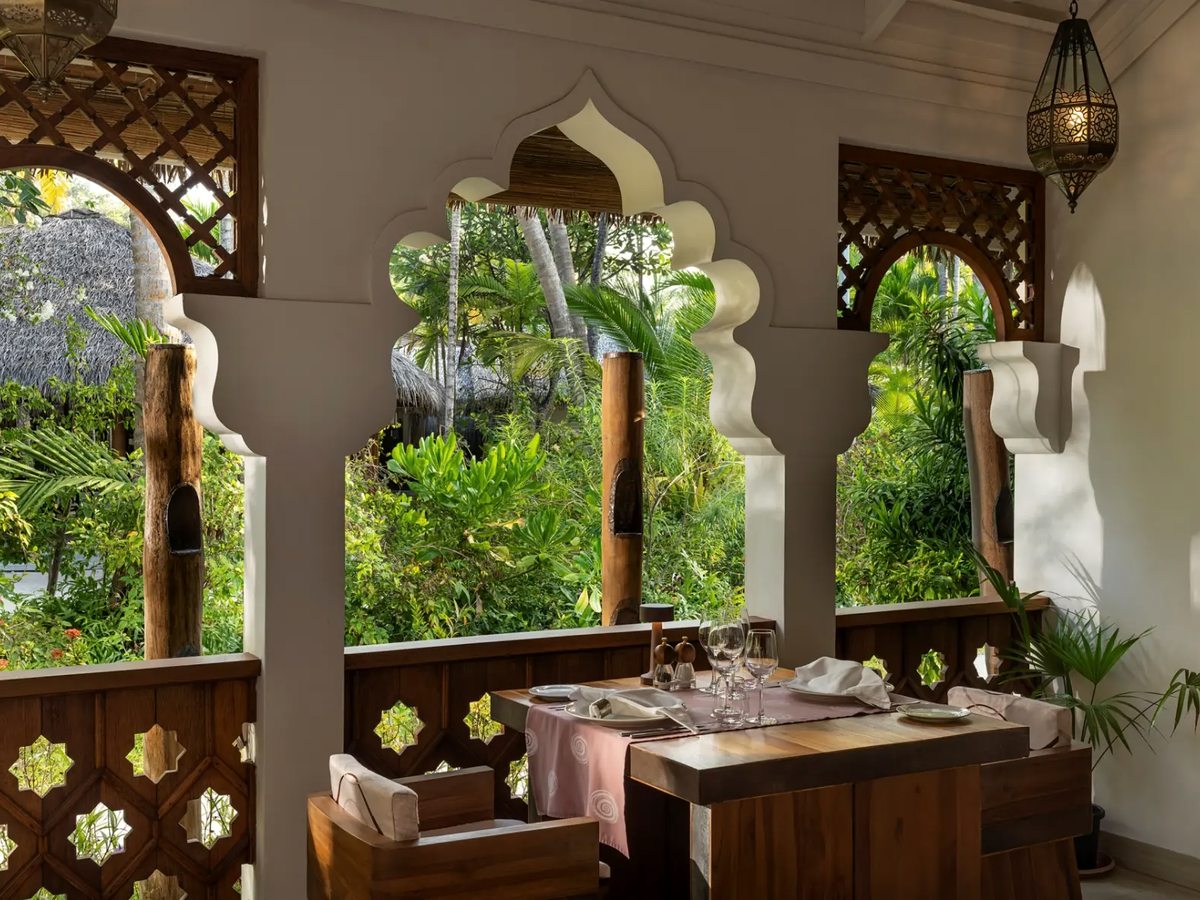
- Siam Garden is Thai, 7 to 10:30, set menu or à la carte, using herbs from the resort’s own garden.
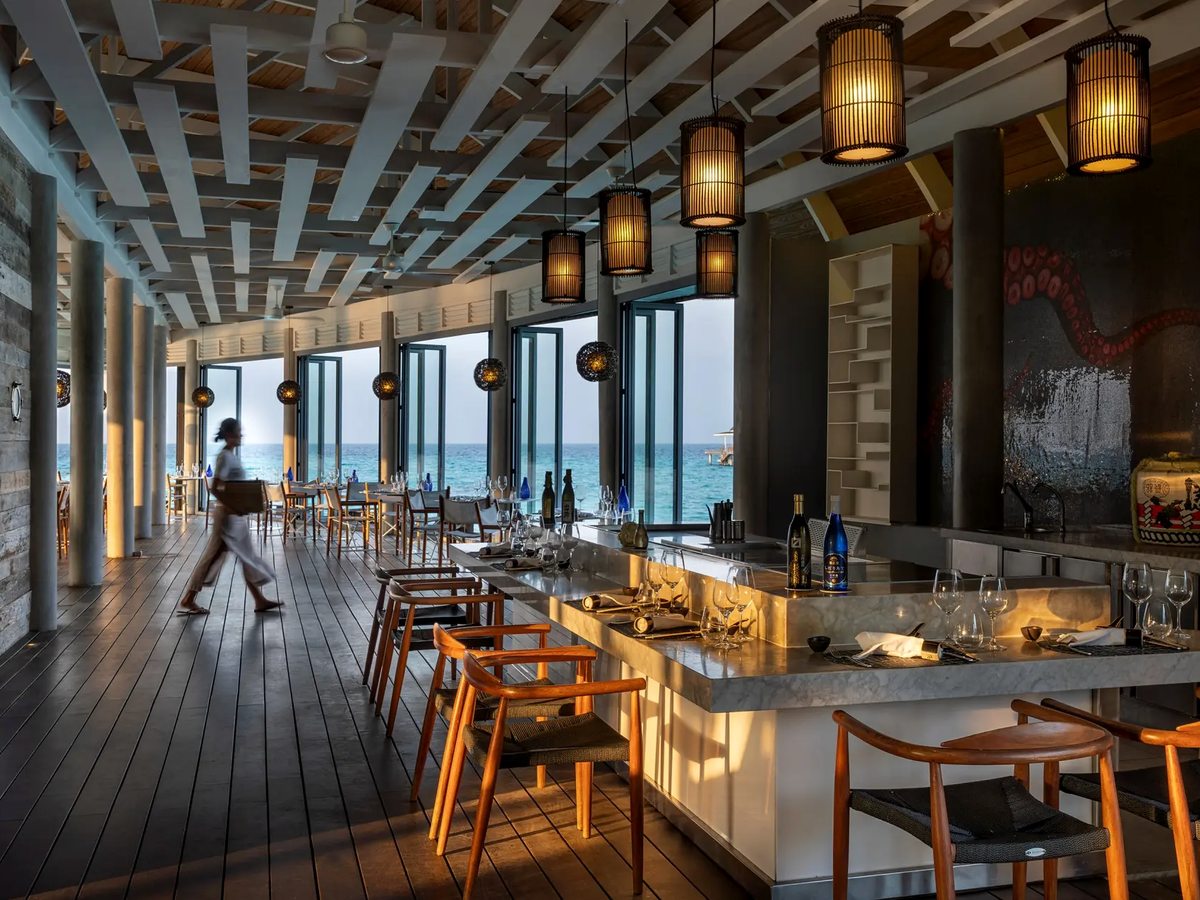
- Kobe is Japanese teppanyaki, overwater, 7 to 10:30, with a hibachi grill and a sushi bar. Children need to be 6 or over here too.
- Inguru serves food from the Indian subcontinent and Southeast Asia, overwater, for lunch and dinner.
- Tandoor Mahal is Indian, 7 to 10:30, with a family Thali sharing platter, biryanis and breads.
- Island Coffee Shop does light bites and fresh brews from 9 in the morning until midnight.
You can also arrange private dining on the beach or in your villa at a time you choose, and the Sky Bar, seven metres above the sea, is by private booking only. Across the island there are seven bars: Fung Bar, Dhoni Bar and Laguna Bar run 9 to 1, the Champagne Loft from 5, the Havana Club wine and cigar bar from 6 with karaoke nights, the beachside Sand Bar late morning and again in the evening and the Pool Bar from 9 to 8.
There’s a children’s mini-buffet at the buffets and the kids’ club, and the kitchens can handle vegetarian, gluten-free and nut-free requests, with complimentary water in the villas and restaurants. Much of the produce is grown on the island: a hydroponic garden supplies around 500 kg of vegetables and herbs a month to Siam Garden, Palm and other restaurants. Dinner is smart casual, and each à la carte restaurant sets its own note, from casual resort-wear at Palm and Tandoor Mahal to the dressier Kobe.
How dining works
The buffet needs no booking, so it’s always the fallback for a family. The à la carte restaurants are likely to need a table booked a day ahead, so plan the ones you want early in the week and pick the earlier sittings if they suit small children. Private dining on the beach or in your villa is arranged with the resort.
Pools and water features
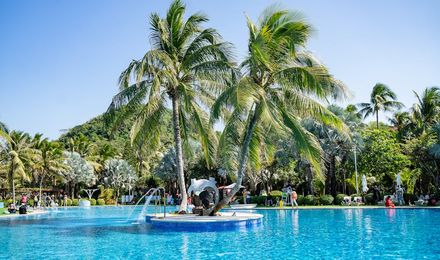
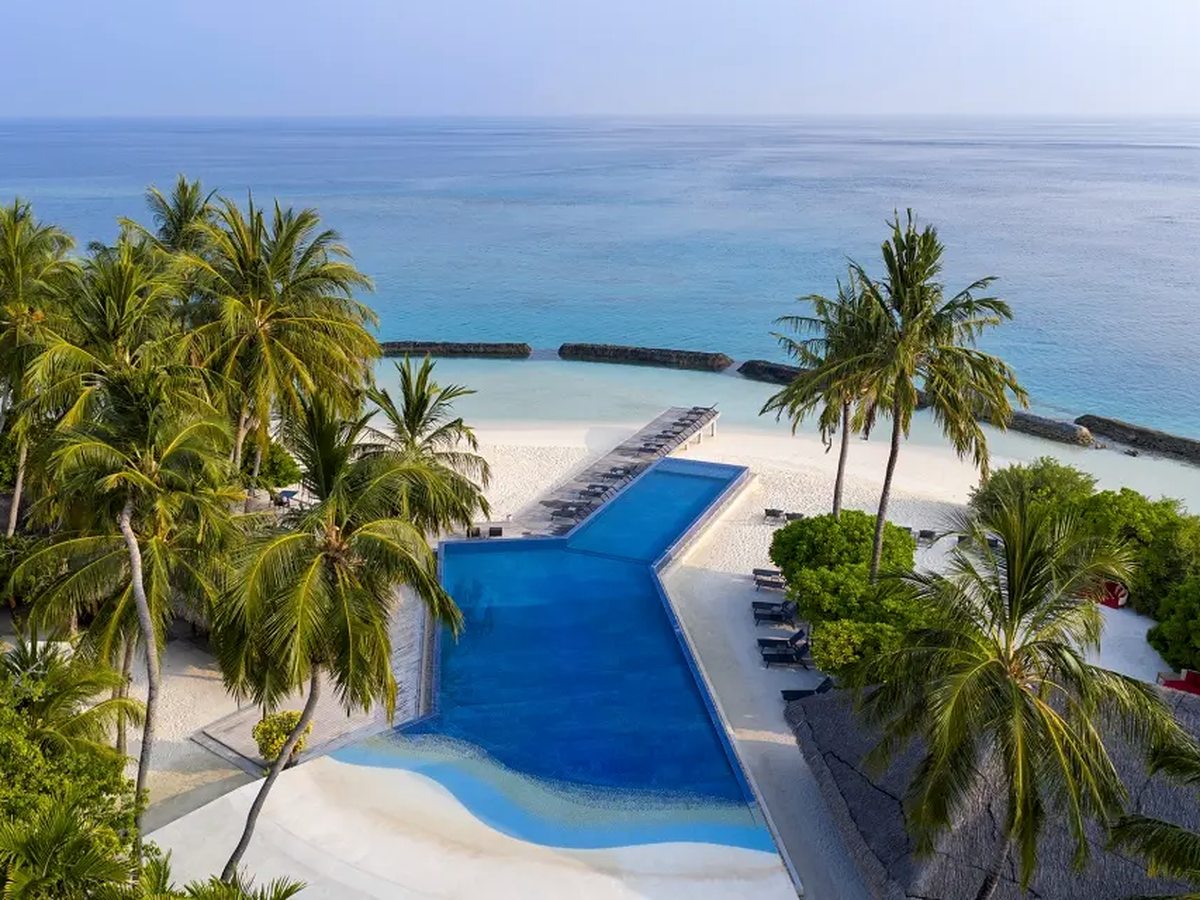
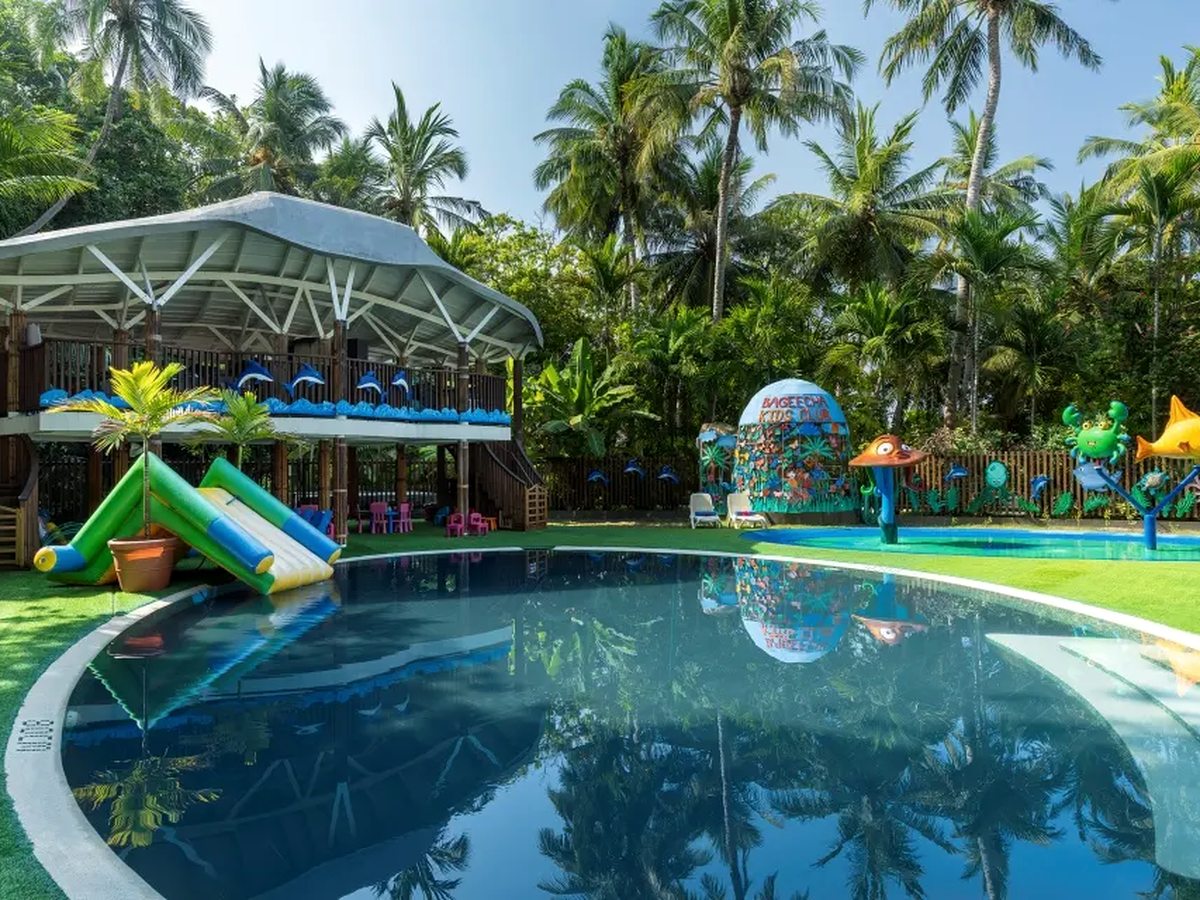
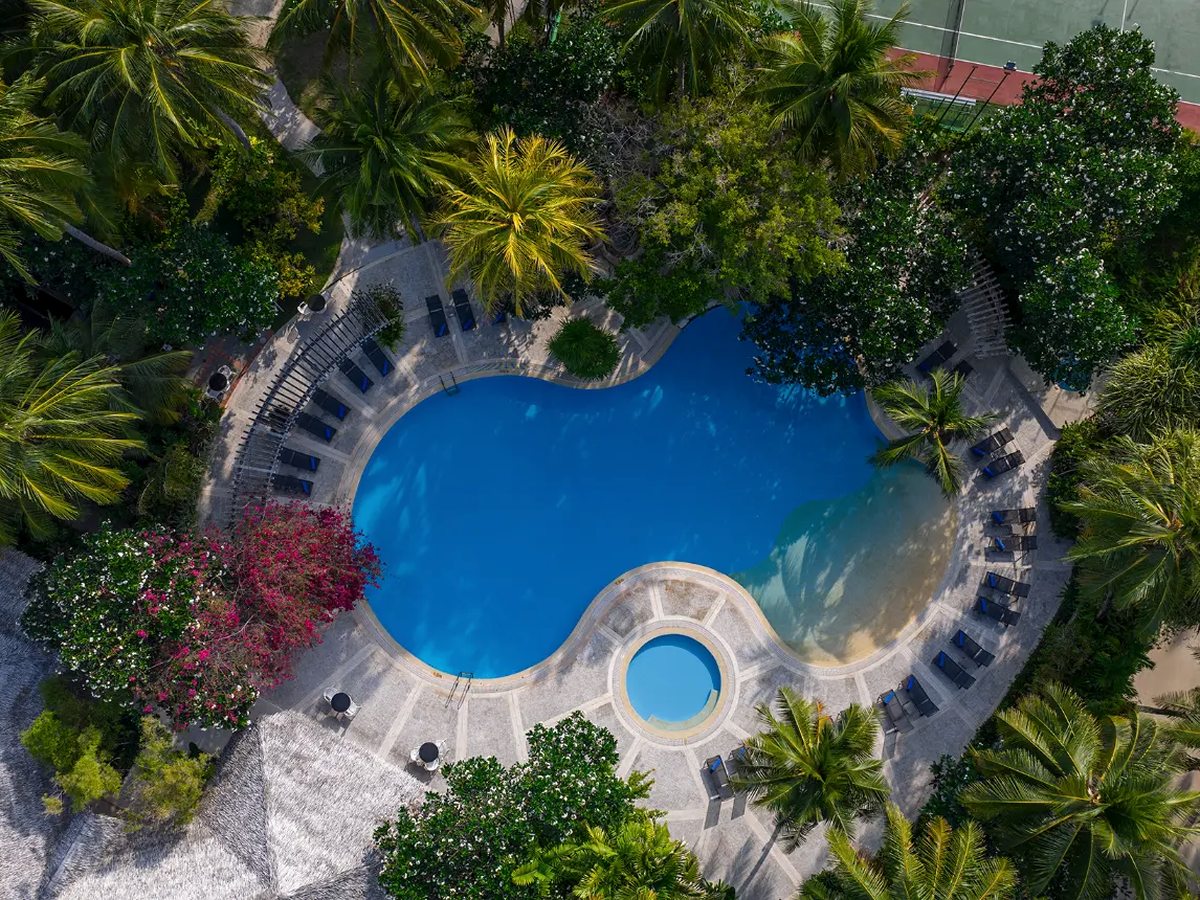
The resort has three established pools of its own, none with a stated size. The main one is the infinity pool by Fung Bar, in the centre of things beside Island Barbeque. There’s a freshwater pool by the Pool Bar in the sports-centre area, and a second infinity pool at Laguna Bar on the sunset side. For children there’s a separate children’s pool in the Bageecha kids’-club complex, and a splash pad in the Bageecha outdoor area. Several villa types have their own private infinity pool as well: 15 m² with the Water Bungalow, 18 m² with the Water Villa, Thundi and Pool Villa, plus a 10 m lap pool at the Honeymoon villa. The Pool Bar serves from 9 to 8.
The beach and house reef
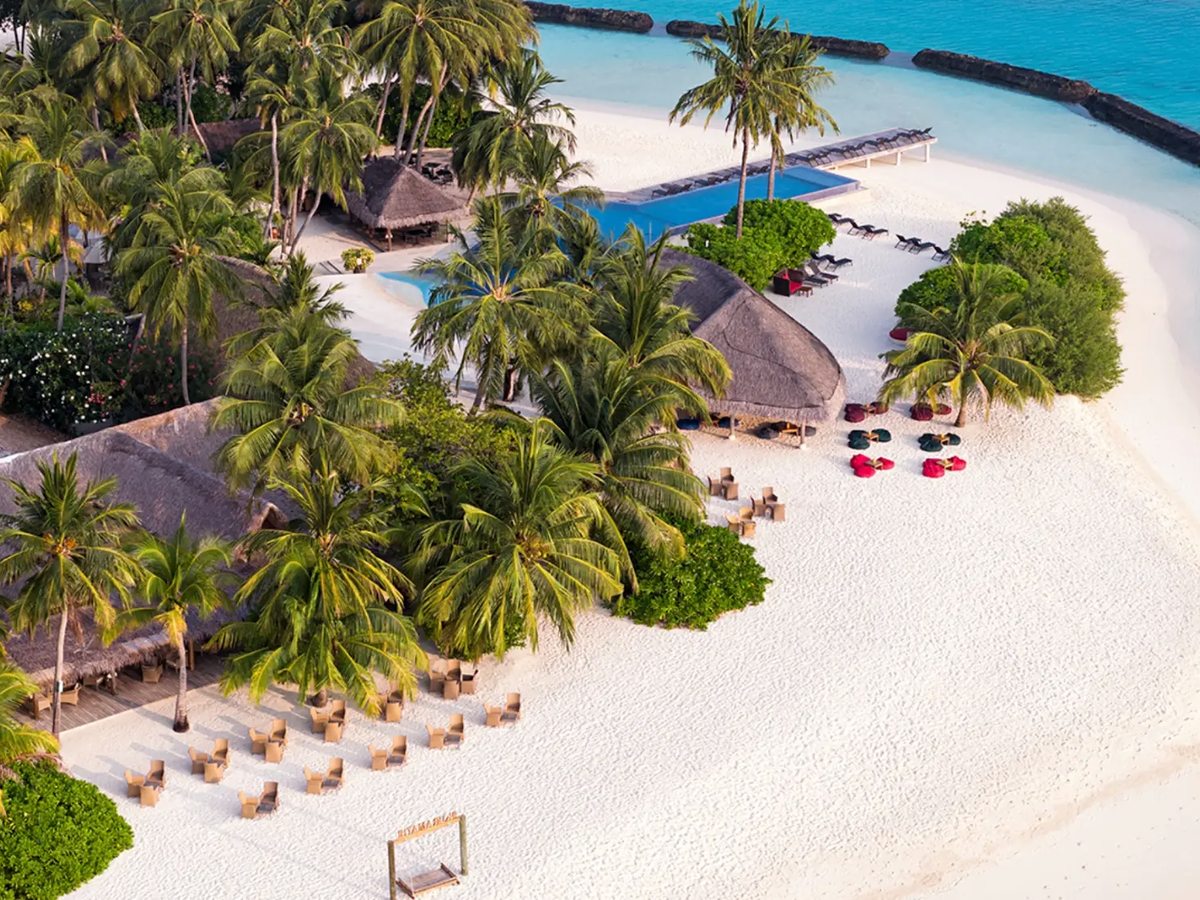
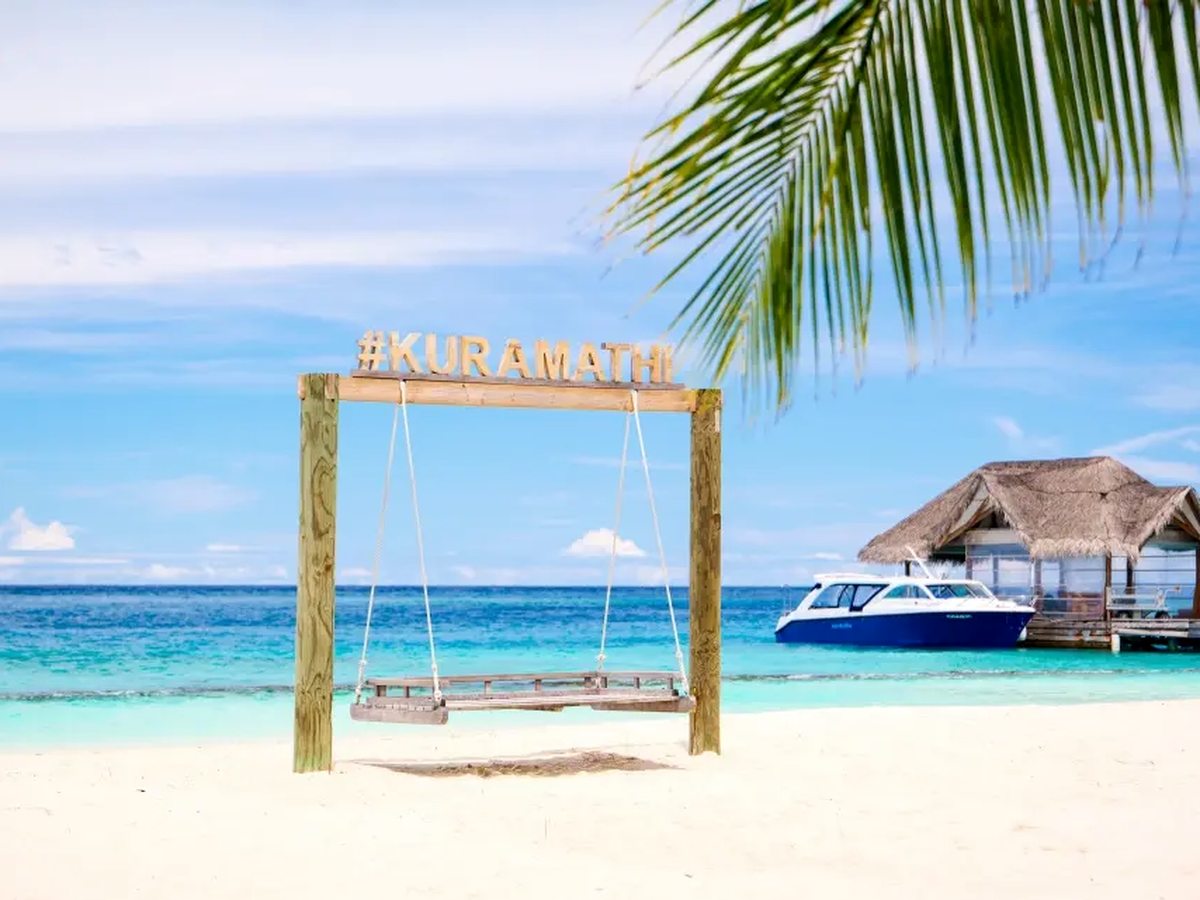
White powder sand runs around most of the island. By family accounts the lagoon shelves gently near the shore in places, so toddlers can stand and paddle close in, though the resort’s own site doesn’t set that out. The sandbank off the west shows at low tide near the Thundi water villas.
The real draw is the house reef, which runs the entire length of the island, so you can snorkel straight off the beach in several spots rather than taking a boat. Green and hawksbill turtles are around all year, along with rays and reef fish. From the beach and the jetty there’s a semi-submarine, pedalos, tubing, a wild dolphin safari, windsurfing, catamaran and dinghy sailing.
Babies and toddlers
The kids’ club, crèche and babysitting, everything there is to do on and off the reef, the spa and the atoll around the island.
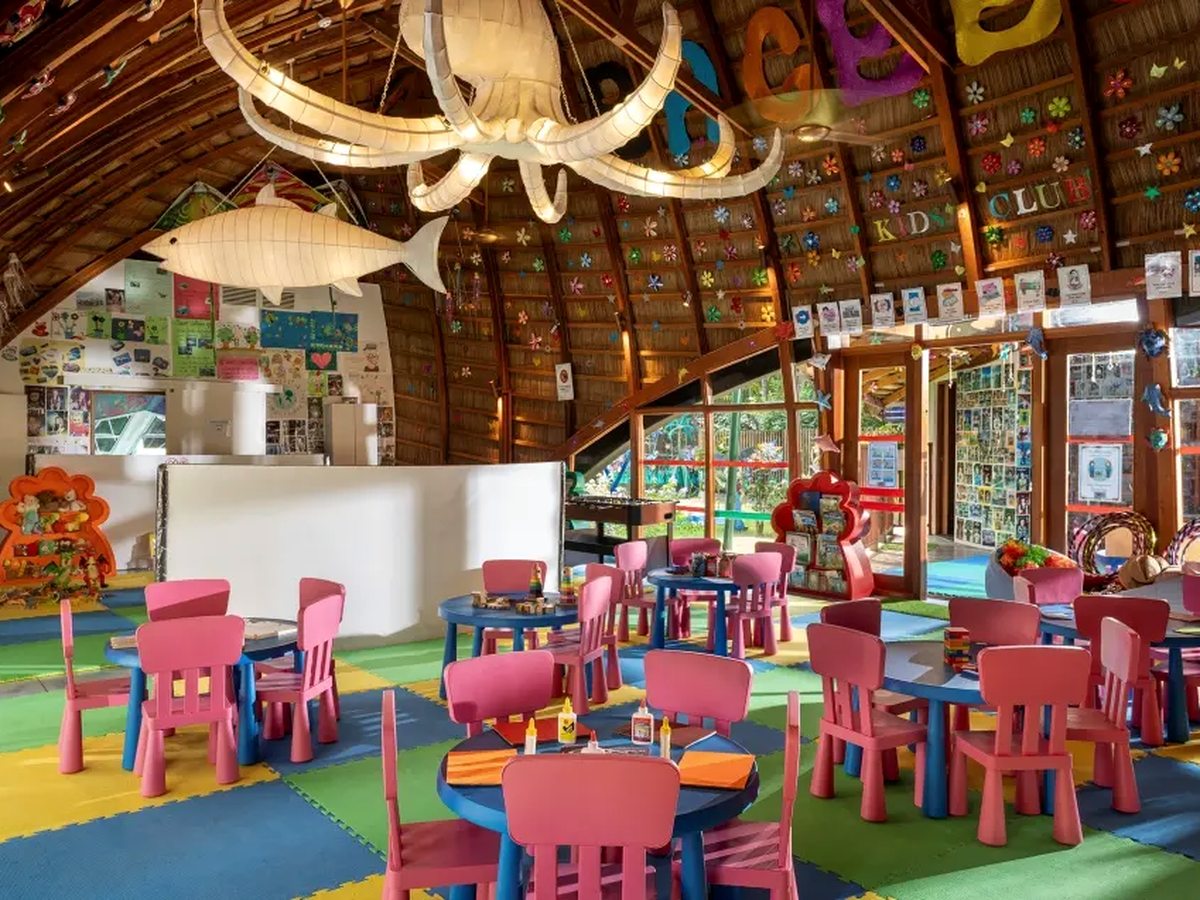
The kids’ club is called Bageecha, and it takes children from 3 to 12, open daily 8:30 to 6:30 and free during those hours. It runs a two-week rotating programme, with arts and crafts, workshops and a reading corner indoors, and a splash pool, barbecues, movie nights and marine sessions with the Eco Centre outside, plus seasonal events at Easter, Halloween and Christmas. The club also has an air-conditioned sleeping room with cots for naps, a TV and DVD room, board games, a whale seesaw, a swing set, a sandpit, a tree house and a soft-toy area for the youngest.
Under-3s are welcomed rather than left out. A crèche in Bageecha takes children below 3 from 8:30 to 6:30, supervised at all times, for a charge. Babysitting covers ages 0 to 12, around the clock on request, also for a charge, with 24 hours’ notice for after-hours care. After 6:30 the Bageecha club itself can stay open by prior reservation until midnight for 3 to 12 year olds, again for a charge, which is a separate thing from babysitting. Rates are paid locally, so confirm the current charge when you book.
The children’s mini-buffet and the kids’-club lunch cover meals, and there’s yoga for children on the activity list. What the resort doesn’t publish is its baby kit: travel cots, high chairs, sterilisers and bottle warmers aren’t listed anywhere official, so don’t count on them until you’ve checked with [email protected], and bring a travel cot as a backstop, especially if a small child is sleeping on a villa sofa or daybed. Baby food and weaning aren’t mentioned either, so ask if you’ll need them.
At the Eco Centre a resident marine biologist and horticulturist run sessions for children with plankton under microscopes and hermit-crab hunts, around an 11-metre sperm whale skeleton on display, and Bageecha teams up with it for marine-treasure mornings. Maldivian cultural sessions for children have long included coconut painting, calligraphy, Bodu Beru drumming, crab racing, shell-necklace making, henna and palm weaving, though the current site doesn’t list them, so confirm what’s still running with the resort.
On and off the reefThings to do
Most of what there is to do is in the water. The house reef is the easiest of it, snorkelled straight from the beach, with a night-dive option. A marine-biologist-led snorkelling safari runs every Wednesday and Saturday from 10 to 12 to the Madivaru and Turtle reefs, and a Turtle Discovery safari visits a hawksbill reef with gear and refreshments included. The Kuramathi Dive Club is a PADI centre with Scubapro kit, beginner Try-Dives and Open Water courses. A Manta Quest heads to the North Ari cleaning stations, best from November to April, though sightings are never guaranteed.
For younger children who don’t want to get wet, the semi-submarine drops 1.3 metres below the surface for air-conditioned window viewing with a marine-biologist guide. There’s a wild spinner-dolphin safari from the jetty, tubing, pedalos, windsurfing, catamaran and dinghy sailing, a private Dhoni charter on a traditional Maldivian boat, jig fishing, snorkelling with nurse sharks, a glass-bottom boat and local-island visits.
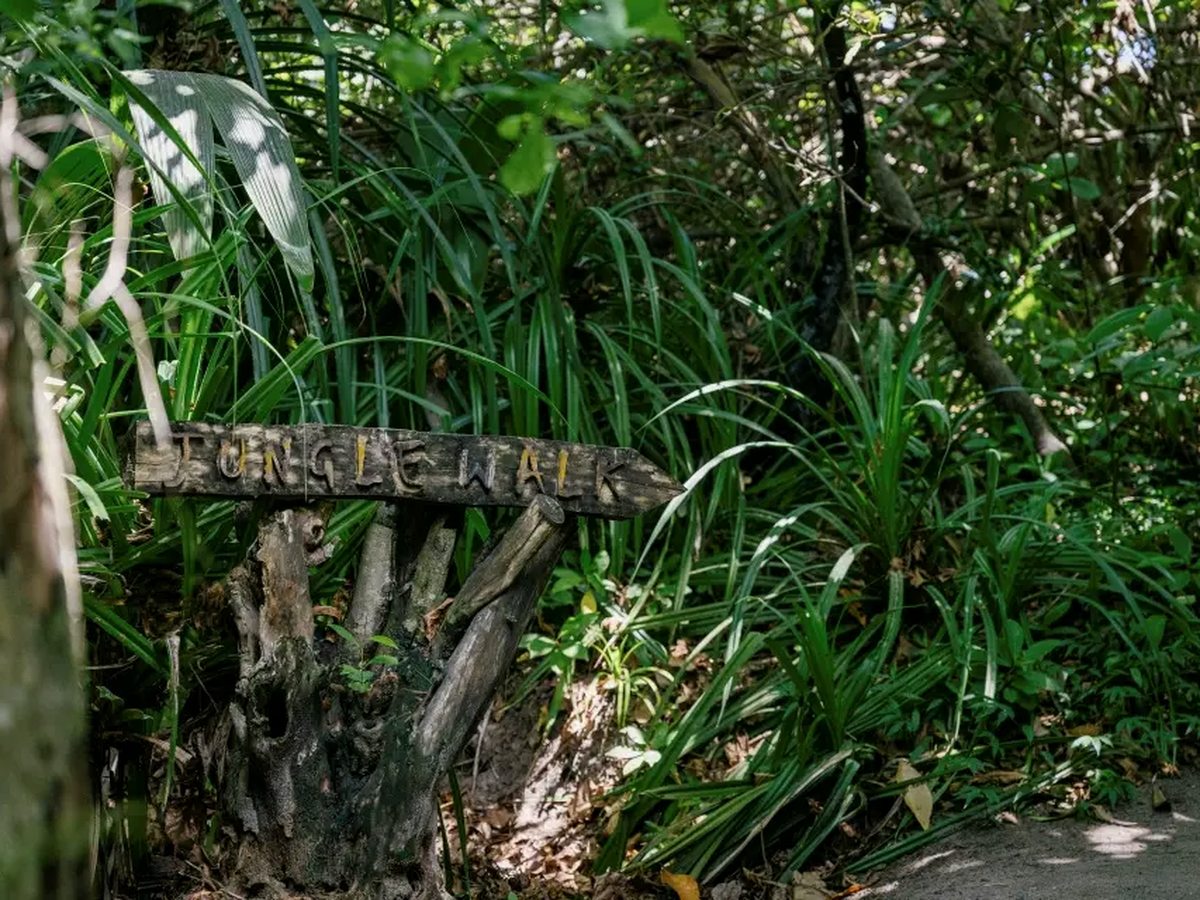
On land there’s a floodlit all-weather tennis court open until 7 with equipment provided, nature trails through banyan roots and guided walks from the Eco Centre. You can adopt a coral frame and get twice-yearly photo updates from the marine biologist, and coral spawning events fall on the April and October full moons. Evenings bring live music, DJs and outdoor movie nights. The resort also holds a current Gold Travelife certification, runs the Muraka coral-regeneration project with over 7,500 fragments on 500 frames, powers 19 buildings with solar panels and supports a monthly swim club for children from the nearby local island of Rasdhoo.
Overwater treatment roomsThe spa and wellness
The spa is LIME Wellbeing, with 13 private treatment rooms in overwater and beach pavilions set in greenery. The wet area has a herbal steam room, a Finnish sauna, a cool dip pool and a jacuzzi. Treatments run across body work, facials, hands and feet, massage, men’s, hair and beauty, couples and signature rituals, using Aromatherapy Associates, the men’s line Obsidian and Margaret Dabbs London for hands and feet, up to a four-day Ayurvedic retreat, and visiting wellness practitioners hold sessions too. There’s sunrise yoga at a beachside pavilion, group Vinyasa and Hatha and private sessions, plus Yoga Nidra meditation and a gym, with tennis rackets to hire at the spa. Prices aren’t listed online, so the spa brochure and price list download from the resort’s site, and the Dine Around All-Inclusive board includes a US$35 spa credit towards a body massage for adults.
Manta countryThe area and days out
Kuramathi sits in the Rasdhoo sub-atoll of North Ari, close enough to Malé for a speedboat but far enough to feel properly away from the capital. The atoll is a well-known marine destination, and its signature is the manta ray, which gathers at cleaning stations from November to April. Whale sharks belong to South Ari Atoll further south, not here, so don’t come expecting them.
The small inhabited island of Rasdhoo is close by and visible from the sandbank, and some guests visit it for a look at local island life, often as the local-island trip that comes with the all-inclusive boards. Malé itself isn’t a practical day out at 75 to 90 minutes each way by speedboat, so in practice the island is the whole holiday.
Loves and gripes
What families rate and what frustrates them, how it compares with two other Maldives resorts, the journey in and the weather.
What families love
- The size of the island, with room to explore, cycle and walk.
- Bageecha and its outdoor facilities, from the splash pool to the tree house.
- The house reef a few steps off the beach.
- The breadth of dining, with nine à la carte restaurants.
- The semi-submarine and the manta trips.
- The Two Bedroom Beach House as a family villa.
Common gripes
- The scale can leave you feeling spread out on a big island.
- The 75 to 90 minute speedboat is long with a tired young child.
- The sandbank can block the view from some west-facing villas.
It’s a large, long-running island resort that places highly in editorial family round-ups, topping one Maldives family-resort list and appearing in TripAdvisor’s own family-resorts list. The Times, quoted on the resort’s own site, describes it as “large, lush and laid-back... a perennial crowd-pleaser”.
Against two other Maldives resortsHow it compares
Against two other Maldives family resorts, Kuramathi stands out for its size, its dining and the reef off the beach.
| What to weigh | NIVA Kuramathi | Niyama Private Islands | Anantara Dhigu |
|---|---|---|---|
| Kids’ club from | 3 years | 3 years, or 12 months with a parent | 4 years |
| Transfer from Malé | Seaplane 20 min, or speedboat 75 to 90 min | Seaplane about 45 min | Speedboat about 30 min |
| Family villa | Two Bedroom Beach House, 205 m² | Two-bedroom via a living-room conversion | Beach and water villas |
| À la carte restaurants | Nine | Fewer | Several outlets |
| House reef off the beach | Yes, the full island length | No dedicated house reef | No direct reef |
| Island size | Large, the biggest in its atoll | Two islands | Smaller |
On price it sits in the mid-to-upper range for the Maldives, above the entry-level islands and below the top-tier resorts. Rates move with the season and the board level, so check the official site for your dates rather than a headline figure.
Seaplane or speedboatGetting there and when to go
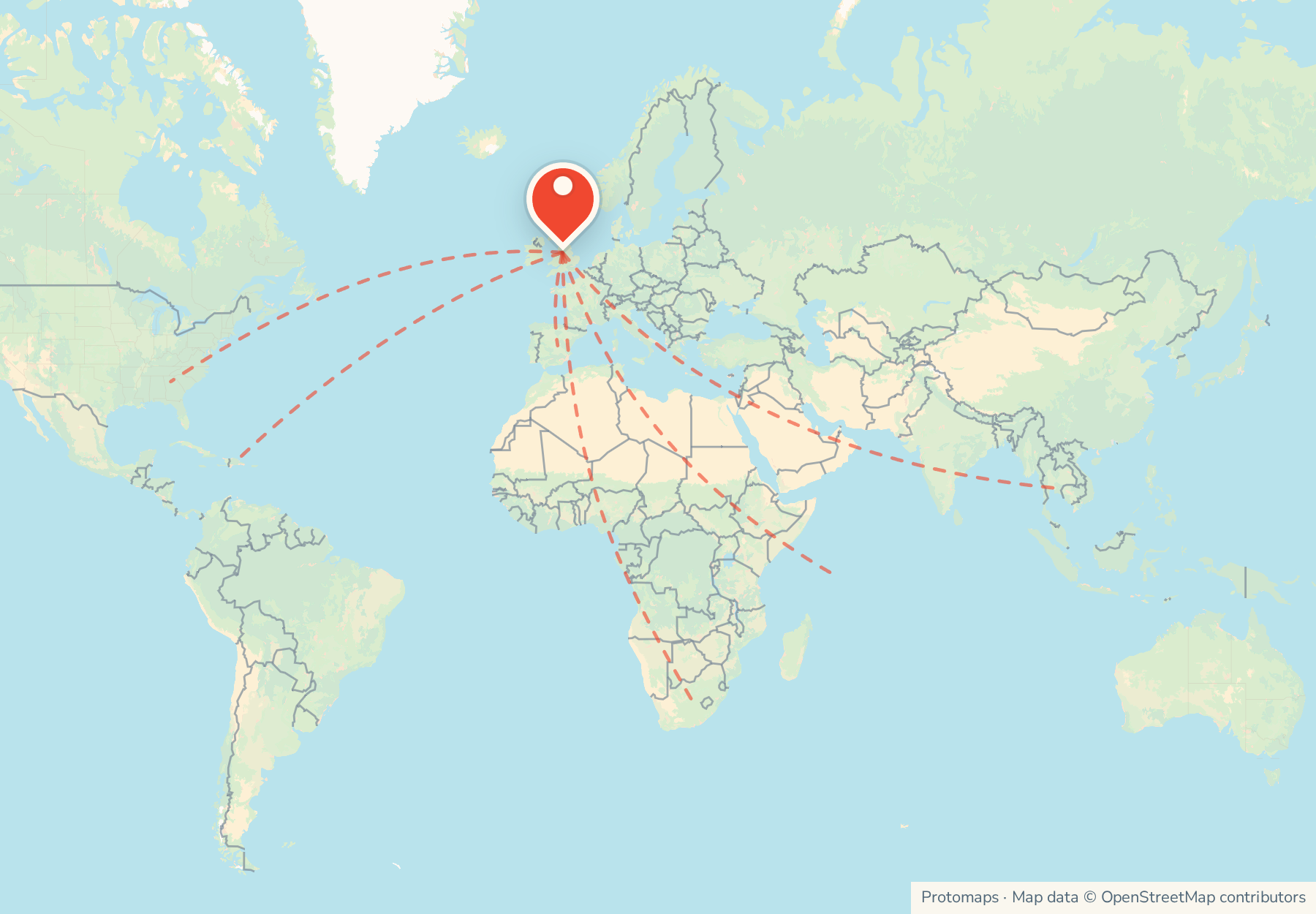
You reach Kuramathi from Velana International Airport at Malé, about 56 km away, with no domestic flight in between. It’s either a 20-minute seaplane or a speedboat of 75 to 90 minutes. Transfers run to a fixed schedule and are arranged in advance rather than laid on automatically, so book yours with the resort or your operator, and expect a possible wait at the airport depending on when your flight lands. Arriving late matters here. After about 3:30 in the afternoon you may miss the speedboat for the day, which can mean an overnight at an airport hotel at extra cost and the crossing the next morning, so aim for a flight that lands earlier and check the last transfer for your booking.
For families the trade-off between the two transfers is real. The seaplane is quick and scenic, but you hold an infant on your lap with no bassinets, and you wait for a departure slot. The speedboat is a long ride with a young child, though it goes straight there.
The island is open all year. December to April is the most comfortable and reliable stretch, with January to April the driest and sunniest, and it sits inside the manta season that runs November to April, so spring half-term and Easter land in prime manta weeks. July and August, the school summer holidays, are wetter but still very workable, with short downpours rather than washed-out days.
Warm all yearWeather
The Maldives is warm and humid all year, and Kuramathi sits in the central band of atolls where the daytime high stays around 30 to 32°C and nights drop to 26 or 27. The sea is warm throughout, about 28°C in January and up towards 30 in April and May. The driest, sunniest stretch is January to April, with January and March the least rainy and eight to nine hours of sun a day. May to December is wetter as the monsoon comes through, but even then there’s six and a half to seven and a half hours of sun most days and the rain tends to come in short heavy bursts. The southwest monsoon from May to September is gentler on this central atoll than on the islands further north.
| Month | Daytime high | Overnight low | Rain | Wet days | Sea temp |
|---|---|---|---|---|---|
| January | 30.5° | 26° | 8 mm | 2 | 28° |
| February | 31° | 26.5° | 38 mm | 3 | 29° |
| March | 31.5° | 27° | 14 mm | 3 | 29° |
| April | 32° | 27.5° | 18 mm | 3 | 30° |
| May | 31.5° | 26.5° | 39 mm | 8 | 30° |
| June | 31.5° | 27° | 14 mm | 4 | 29° |
| July | 31° | 26° | 23 mm | 6 | 29° |
| August | 31° | 26° | 36 mm | 7 | 29° |
| September | 30.5° | 26° | 23 mm | 6 | 29° |
| October | 30.5° | 25.5° | 32 mm | 8 | 29° |
| November | 30.5° | 25.5° | 24 mm | 8 | 29° |
| December | 30.5° | 25.5° | 28 mm | 6 | 29° |
Typical monthly averages from weather-station records. Sea temperature is the open-water figure, so a sheltered bay can feel a degree or two warmer. The resort is open all year.
Health, entry and practicalities
The health, entry and money details for the Maldives, the questions families ask most and where this guide was last updated.
There’s a medical centre on the island with a resident doctor and a hyperbaric chamber for diving emergencies. The Maldives ambulance number is 102, and the nearest fully equipped hospitals are in Malé and Hulhumalé, which is a long way off by boat, so travel insurance that covers evacuation is worth having. Dengue is a health risk in the Maldives and there are mosquitoes on the island with no nets in the villas, so bring or buy repellent, ideally reef-safe.
The sockets are UK-style square-pin at 220V, so no adapter. WiFi is complimentary in the villas and public areas, and the major networks roam reliably. You charge things to your villa account and settle on departure, with US dollars, euros, pounds and Swiss francs and the major cards all taken, so you need very little cash. Only reef-safe sunscreen is allowed, and the resort has a recommended list to download. Dinner is smart casual and swimwear stays at the beach and pool, drones aren’t permitted, smoking is in designated outdoor areas only, and alcohol is served, as it is on Maldivian resort islands.
For UK visitors, a 30-day tourist visa is issued free on arrival with no pre-application, and your passport must be valid and not due to expire within a month of arrival; a damaged passport will be refused. You do need to complete the IMUGA online traveller declaration within 96 hours before you fly, in each direction. A yellow-fever certificate only applies if you’re arriving from a listed country, so not on a direct trip from the UK. As at this guide’s last update there was no FCDO advisory against the Maldives, though wider Middle East airspace disruption can affect some connecting routes, so check with your airline.
The questions parents askQuestions
We land in the evening. Can we still reach the island that day?
Maybe not, if you land late. A flight arriving after about 3:30 in the afternoon can leave you on the wrong side of the last speedboat, which means a night at an airport hotel at your own cost and the crossing the next morning. Ask the resort or your operator for the last transfer time on your dates before you book a late flight.
Can a baby or toddler stay in an overwater villa?
The booking form will accept a child on any villa, but that is the reservation system rather than a safety ruling, and the resort sets out no infant or toddler policy for the open decks and railings of a water villa. Email [email protected] before you book one with a small child. With a crawler the Two Bedroom Beach House on land is the safer choice.
Will the resort provide a cot and baby kit?
Assume nothing until you have asked. Travel cots, high chairs, sterilisers and bottle warmers are not set out anywhere official, so email [email protected] to check what they can supply, and pack a travel cot of your own as a backstop where a young child will be sleeping on a sofa or daybed.
Is there care for our under-3 while we have dinner out?
Yes. There is a crèche in Bageecha for under-3s through the day, staffed and supervised throughout, and babysitting is available round the clock for ages 0 to 12 on request, with a day’s notice for anything after hours. Both are paid on the island, so ask the current rate when you book.
Can the children eat at every restaurant?
Not quite. Children must be 6 or over to dine at Kobe, the Japanese teppanyaki, and at Island Barbeque, whatever board you are on. Younger children have the buffets, Palm and the other à la carte rooms, plus a children’s mini-buffet and a kids’-club lunch, so plan an adult night at Kobe around the childcare.
What do we need to do before we fly?
One task to do before you fly is the IMUGA online traveller declaration, filed within 96 hours of arrival each way. There is nothing to apply for on the visa side, since the 30-day tourist visa is free on landing, and your passport needs at least a month left on it beyond the day you arrive.
What sunscreen and repellent should we pack?
Reef-safe on both counts. The resort only allows reef-safe sunscreen and publishes a list to download, so bring plenty for a high-sun week. Pack repellent as well, since the villas have no mosquito nets and dengue is a risk in the Maldives.
We have two children. Can we all share one villa?
Only in the Two Bedroom Beach House. Every other villa holds three at most, counted as three adults or two adults and a child under 12, and none of them interconnect, so two children in a room of their own means the two-bedroom house or a second villa booked alongside.
See more NIVA Kuramathi photos
Open the NIVA Kuramathi photo gallery →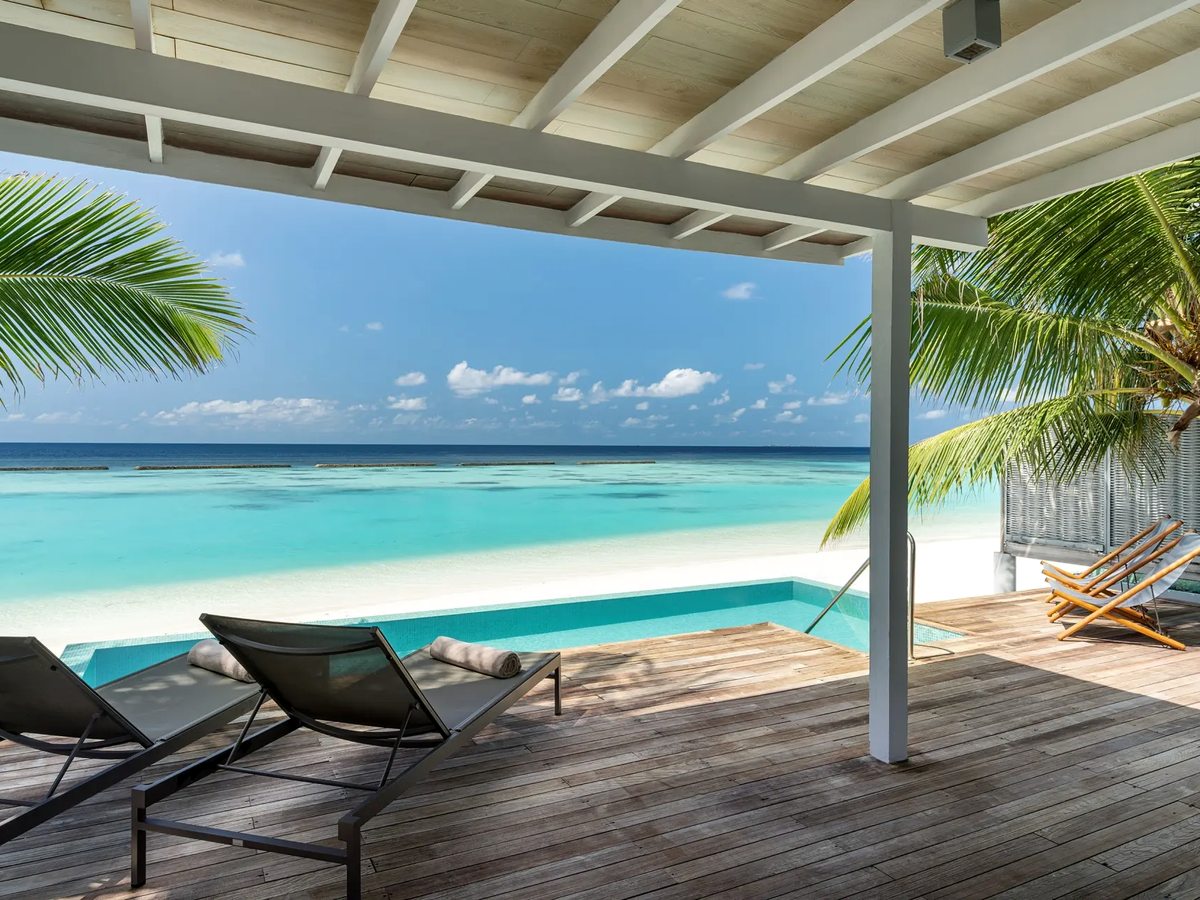
Useful links
- NIVA Kuramathi: the resort’s own site for villas, board levels and the children’s facilities.
- GOV.UK Maldives travel advice: entry rules and safety updates before you travel.
- Maldives with little ones: our guide to the wider country, its atolls and when to go.
Last updated 16 July 2026.