Typhoon Lagoon
Typhoon Lagoon is one of Walt Disney World's two water parks, themed as a tropical beach resort caught by a storm, with a shrimp boat left stranded on the peak of its central mountain. At its heart is one of the largest outdoor wave pools in North America, ringed by a long lazy river, with raft and body slides down the mountain and a big play area built just for young children. It's on the eastern edge of the resort next to Disney Springs, and it makes an easy change of pace from a run of theme park days.
On this page
A family verdict at a glance
A big storm-themed water park with a powerful wave pool, a long lazy river and an unusually elaborate play area built for young children.
Typhoon Lagoon suits families in two situations especially. If you're travelling with a mix of ages, the older children can take on the mountain slides while the younger ones have a whole play area and a lazy river of their own, so everyone has plenty to do in the same place. If your children are all very young, the day really comes down to three places, Ketchakiddee Creek, Castaway Creek and the calm edge of the wave pool. That can be a very good day out, though you'd get a fair amount of the same from a good hotel pool with much less travel and packing, so it's worth thinking hard about the trip across for very young children on their own.
The wave pool puts out waves up to six feet, strong enough to knock a grown adult off their feet, so it isn't a paddling pool for a toddler while the surf is running. It calms between cycles, and the shallow zero-entry edge is manageable for a supervised little one in a life jacket, but it needs watching. Two of the mountain slides also set a 48-inch height limit that rules out younger children, while the other rides and both children's areas set no minimum at all.
Best for
Families with a mix of ages, so the older ones ride the big slides while the little ones have a play area and a lazy river of their own.
For the youngest
A large dedicated children's area, a shallow lazy river and free life jackets down to infant sizes.
Best ages
Works from babies up in Ketchakiddee Creek and Castaway Creek. The big slides need 48 inches, so realistically around seven or older.
The wave pool
Waves reach six feet on the surf cycles. The calm spells at the shallow edge suit a supervised little one, and a board and a foghorn signal when the big surf starts.
What to check
It closes for refurbishment for part of the year, so confirm it's the water park that's open on your dates.
Where is it?
On the eastern edge of Walt Disney World next to Disney Springs, reached by Disney bus or a short drive.
Quick facts for UK families
How the park is laid out
A wave pool at the centre, a lazy river looping the edge and the big slides down the mountain at the back.
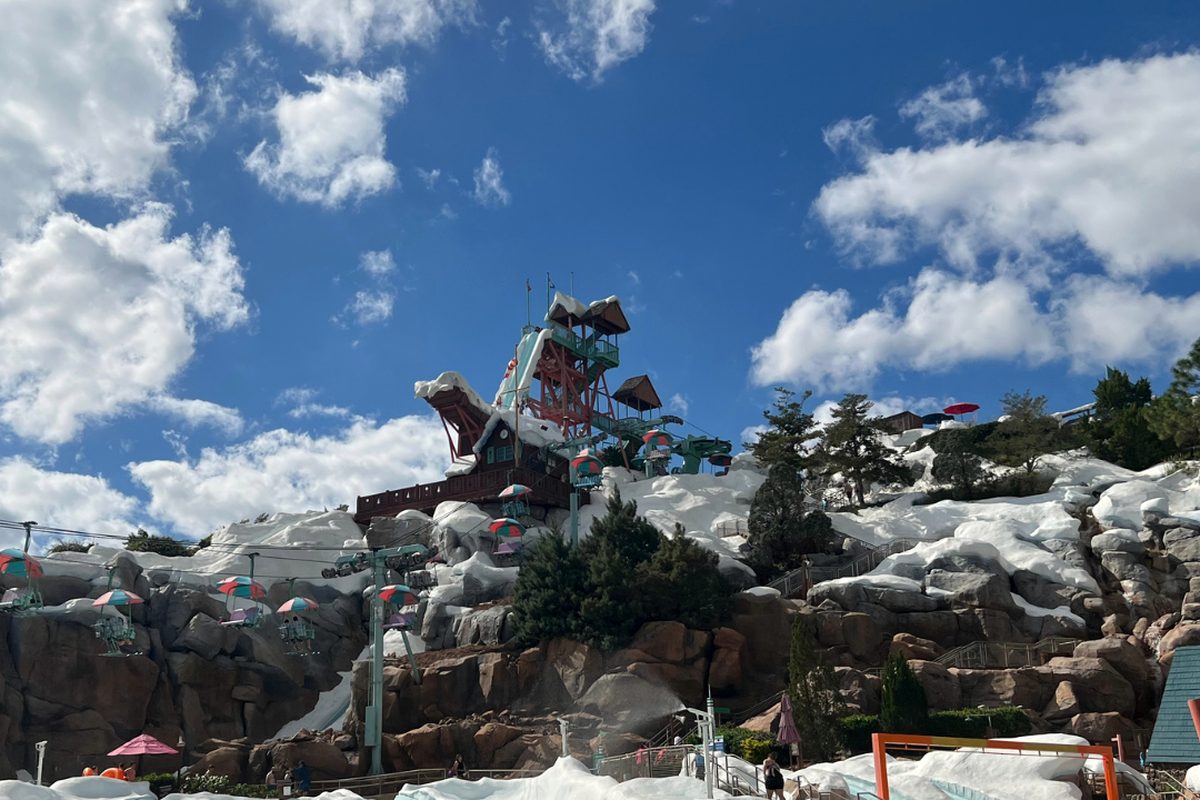
The whole park is built around one story, a tropical resort hit by a typhoon. The storm has left a shrimp boat, Miss Tilly, stranded on the peak of Mount Mayday, the tall mountain at the back, and every half hour a geyser shoots from it fifty feet into the air. The idea carries through the rides and the buildings, all wrecked-tropical scenery. If the children like a hunt, there are two Hidden Mickeys to hunt for. One is made of log ends set as path edging near the top of the climb to Humunga Kowabunga, and one is a hole in the rock at the back of the walk-through cave in Ketchakiddee Creek. There are no parades, stage shows, fireworks or scheduled character meets on an ordinary day, unlike at the theme parks, so the atmosphere here comes from the theming and the beach music rather than a show timetable.
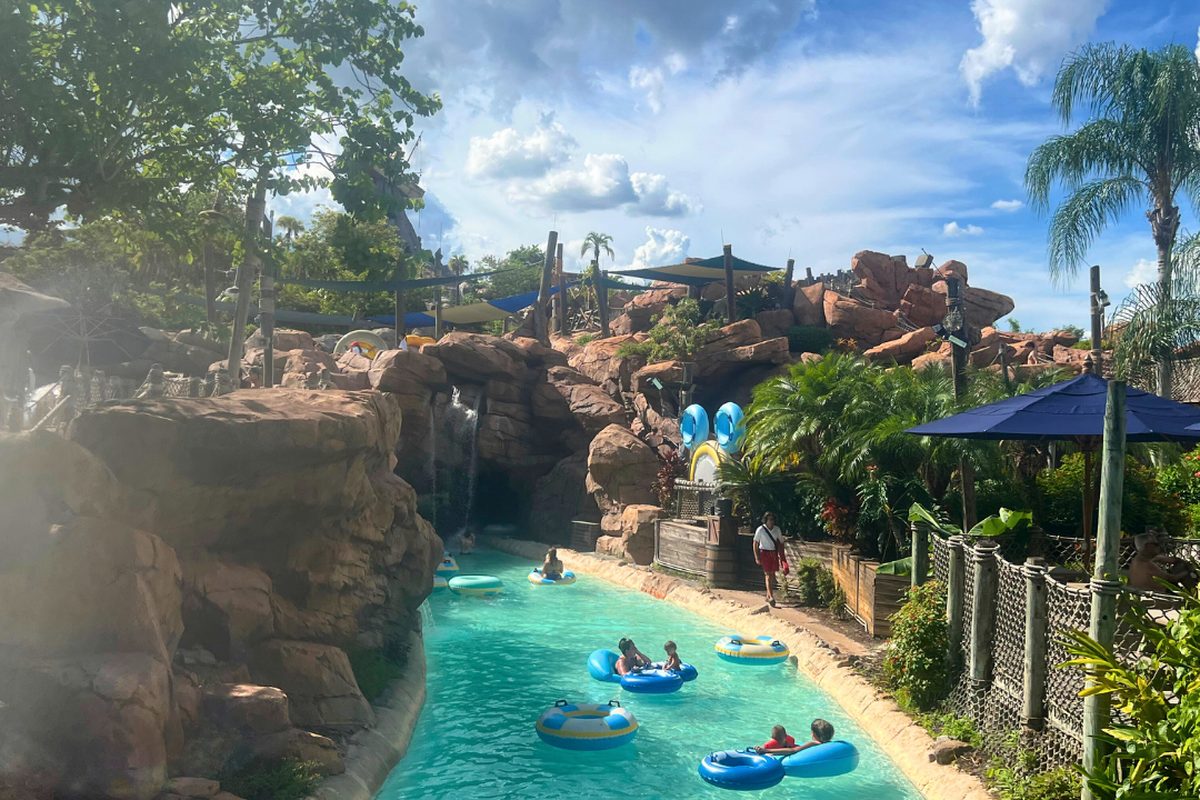
At the centre is the Surf Pool, the big wave pool, with a beach and loungers around it. Castaway Creek, the lazy river, loops the whole park, so a slow float is never far away. The bigger raft and body slides run down the slopes of Mount Mayday at the back. Ketchakiddee Creek, the children's area, is near the entrance and the main beach, so you don't have to walk a tired toddler deep into the park to reach it. Most of the food and the one shop are near the entrance and along the beach. There are a few pressed-coin machines dotted about too, the classic cheap souvenir, so it's worth keeping a bag of US quarters and pennies to hand if a child likes flattening one.
Paths are paved and flat. You can bring a pushchair in and park it by the loungers, though it can't go in the water or on any ride. Wagons aren't allowed, and a pushchair has to sit within Disney's size limit, no wider than about 31 inches (79 cm) and no longer than 52 inches (132 cm). You can't hire one here, unlike at the theme parks, so bring your own if you want one, or a few local firms deliver hire pushchairs to Orlando hotels if you'd rather not fly with one.
The slides, and which little ones can go on
They run from a family raft you can all ride together up to two near-vertical drops with a height limit.
The most family-friendly ride is Miss Adventure Falls, a slow raft that holds two to four people and takes about two minutes, the longest ride in the park. It has no height minimum, and a conveyor belt loads you into the raft, so nobody has to step into a moving boat with a child in their arms. An infant needs to be able to sit up unaided and hold the handles to ride. It's also the most popular thing in the park, with queues reaching half an hour or more by mid-morning, so it's an easy one to do first thing before the day fills up. Gangplank Falls is a similar family raft, shorter and simpler, down the side of Mount Mayday, though you carry your own raft to the top of that one.
Three tube slides come down the mountain. Keelhaul Falls is the tamest and usually the shortest queue, Mayday Falls is the longest and adds some speed bumps, and both are single-rider, so a child has to ride alone and be able to get themselves out of the splash pool at the bottom. That puts them out of reach of the youngest children and makes them a step for a water-confident four or five year old at the earliest.
The Storm Slides are three body slides where you lie on your back and wind through the rock. They set no height limit, but the exit pool is four feet deep and you ride them solo, so in practice they suit a child who's already comfortable on Bay Slides and can swim. Humunga Kowabunga is the extreme one, three enclosed slides that drop about fifty feet in near-darkness, and Crush 'n' Gusher is a water coaster where jets push a two-person raft uphill before the drops. Both set a 48-inch minimum, which younger children don't reach.
For British parents the number that matters is 122 centimetres, which is 48 inches, the figure you'll see on the signs. A typical five year old is a fair bit shorter than that, so the two big slides stay off-limits right across the young-child years. Everything else here sets no height minimum at all.
A dry walk up the mountainMountain Trail
There's one dry attraction, easy to walk past. Mountain Trail is a stair path that climbs Mount Mayday from a signed start near Gangplank Falls, a shaded five-minute walk with waterfalls running alongside and a view over the Surf Pool at the top, with Miss Tilly close by for a photo. Few people find it, so it stays quiet. The stairs rule out a pushchair, so it suits an older toddler who can manage a flight of steps with a hand to hold rather than a baby, and it makes a calm change of pace away from the busy pool decks.
Height rulesEvery attraction, and its height rule
| Attraction | Min. height | Max. height | What it is |
|---|---|---|---|
| Typhoon Lagoon Surf Pool | None | None | The wave pool. Life jackets advised, no inner tubes. |
| Castaway Creek | None | None | The lazy river. Free tubes in toddler sizes; keep a hand on any baby float. |
| Miss Adventure Falls | None | None | Family raft, two to four riders. Conveyor-belt boarding, so no stepping into a moving raft. An infant needs to sit up unaided and hold the handles. The busiest ride, so queues build by mid-morning. |
| Gangplank Falls | None | None | Family raft, up to four. You carry the raft to the top. |
| Keelhaul Falls | None | None | Single-rider tube slide, the tamest of the three. You get out of the splash pool on your own. |
| Mayday Falls | None | None | Single-rider tube slide, longer and faster than Keelhaul. |
| Storm Slides | None | None | Three body slides ridden solo. Exit pool four feet deep; more intense than they look. |
| Humunga Kowabunga | 122cm (48 in) | None | Three enclosed slides, near-vertical drop in the dark. The most intense ride here. |
| Crush 'n' Gusher | 122cm (48 in) | None | Water coaster with two-person rafts, jets pushing you uphill. |
| Bay Slides | None | 152cm (60 in) | Two small body slides for children. A child aged ten or under needs an adult at the base. |
| Ketchakiddee Creek | None | 122cm (48 in) | The children's play area. Adults may go in; only children under the limit use the equipment. |
| Mountain Trail | None | None | The park's only dry attraction, a five-minute stair climb up Mount Mayday to a view over the Surf Pool. Stairs throughout, so no prams. |
The Surf Pool, and its waves
A beach-style wave pool at the heart of the park, with real surf on the big cycles and calmer spells between them.
The Surf Pool is the centrepiece, one of the largest outdoor wave pools in North America at two and a half acres. It shelves from a zero-entry shore, like a beach, down to about six feet at the deep end where the waves break.
On an active surf cycle the waves reach six feet and can knock a standing adult over, and even the shallow edge feels a real push. This is not a paddling pool for a toddler during those cycles. The pool runs to a pattern through the day, a long stretch of big surf waves, then a few minutes of calm, then smaller bobbing waves, then calm again. A chalkboard at the beach edge posts the schedule, and the foghorn on Miss Tilly sounds when the big waves are about to start and when the pool drops back to calm.
For a young child the calm and bobbing spells are the windows to use, at the shallow edge, in a life jacket, with an adult right there. During the big-wave cycles, keep little ones out of the water and on the beach. Inner tubes aren't allowed in the Surf Pool. Older children who can swim well can bodysurf the big waves, which is the draw of the place for them.
The pool floor is deliberately textured so it isn't slippery, and it's rough enough to graze a small child who gets knocked down and tumbled, so keeping water shoes on in the water is worth doing as much as on the hot paths. There's also a real pull as the waves draw back, like the undertow on a beach, which can take a little one off balance even in shallow water. If you want calm water without the wave force, there are two sheltered coves at the edges of the pool, Blustery Bay on one side and Whitecap Cove on the other. Both are shallow zero-entry wades screened from the surf by rock, so if one is busy the other is usually quieter.
Every attraction is lifeguarded. Disney's water-park lifeguards are trained and audited to an outside standard, working to a rule of spotting a swimmer in trouble within ten seconds and reaching them within twenty, and Disney reports no drownings across its water parks over years of visits. That's a real safety net, though it doesn't take the place of your own eyes on a small child.
Before the park opens for the day, Disney runs surf sessions in the empty Surf Pool. Open Surf is for experienced surfers who bring their own board and are guaranteed a set number of waves, and Learn to Surf is a two-and-a-half-hour lesson with boards provided and land practice first. Both need a strong swimmer, the lesson takes children from age eight, and you book by phone ahead rather than turning up on the day, so it's one for an older child in the party rather than the little ones.
Where young children spend the day
A big children's water playground, a first set of slides scaled down for them and the lazy river.
Ketchakiddee Creek is the reason to bring young children to Typhoon Lagoon. It's a large play area built entirely at their scale, with more than ten things to run between. There are mini slides, child-height water jets and fountains, squirting crocodiles, seals and elephants, a leaky tugboat with water cannons the children work themselves, crawl tunnels, a cave with a waterfall to splash through, a small rapids channel, shallow wading pools for babies and a little sandy beach. The water is shallow throughout. There's no queue and no height minimum, and adults can go in with their children, though only children under 48 inches use the play equipment. A four year old can happily spend an hour or two here.
The toilets are outside the play area, so it's a short walk for a mid-play change. Ketchakiddee Creek is the one part of the park where shade isn't a fight. As well as beach umbrellas in the sand there are two large covered shelters, all included, so you don't have to reserve or fight for a shaded base here as you do out on the open beach.
A first slideBay Slides
Bay Slides are two small body slides at the edge of the Surf Pool, a scaled-down version of the big Storm Slides made as a first sliding experience for small children. They finish in Blustery Bay, a shallow, sheltered corner of the Surf Pool screened from the surf by rock. There's a 60-inch maximum, so they're for children rather than adults, and a child aged ten or under needs an adult over eighteen waiting at the bottom. The child rides alone, so they suit a water-confident three to five year old who can follow a simple instruction, rather than one who still needs holding.
A slow float round the parkCastaway Creek, the lazy river
Castaway Creek drifts a full loop around the park, about 610 metres, the longest attraction here. Free tubes wait at each of the five landing points, including smaller ones for toddlers, and you can join, get out and rejoin at any of them. Baby float tubes are allowed as long as a parent keeps a hand on the float the whole way round. The water is shallow and the current slow, and the route passes through misty rainforest, shady grottos and a cave under Mount Mayday with waterfalls overhead. It's the easiest thing in the park to do with a baby or toddler, and a good way to cool off in the heat of the day. Tubes can be harder to grab when it's busy, so the start and end of the day are the best times to get one.
What to bring, and what's there
Towels and life jackets are free, lockers and shade you pay for, and a cooler is worth packing.
Towels are now free for everyone, collected from Singapore Sal's shop at the entrance, so you don't need to bring your own or pay for them. Life jackets are free too, in every size down to infant, from self-service racks around the park, and they're the right choice for a non-swimmer. If you already own a life vest or a Puddle Jumper you can bring it, as long as it's US Coast Guard or UL approved. It's only the inflatable armband floats that are banned, for safety, because they hold a child's arms up, so if the child tips forward the arms can't come down and they can end up face down.
Swimwear with metal rivets, buckles or studs isn't allowed on any of the slides, as it scratches the flume. Denim and neoprene aren't allowed in Ketchakiddee Creek, on the Bay Slides, the Storm Slides or Humunga Kowabunga. A plain swimsuit or a rash vest keeps a child clear of both rules.
Lockers are near the entrance and near the far side of the park, in two sizes, hired by the day rather than the hour, and you set a PIN so you can get in and out as often as you like. There are changing rooms and showers by the entrance, next to the shop.
You can bring your own food and non-alcoholic drinks in, and coolers are allowed as long as one person can carry them, which is worth doing with young children. Glass and alcohol aren't allowed, with an exception for baby food jars. Reusable ice packs are fine but loose or dry ice isn't, so freeze a block pack rather than filling a cooler with ice. Any food counter will fill a water bottle for free.
For guaranteed shade you can reserve a Getaway Glen umbrella, the cheapest option, which comes with a couple of loungers, or one of the Beachcomber Shacks, a much bigger outlay that comes with seating, a locker, towels and a cooler of drinks. Free shade is first-come, so arrive early for a good spot. Whatever you do, pack water shoes, as the paths get very hot in the Florida sun and burn bare feet quickly.
Getting around with a wheelchairAccess for a wheelchair or a less mobile grandparent
Getting around is straightforward for a wheelchair user or a grandparent who can't walk far. The paths are flat, and both the Surf Pool and Castaway Creek shelve in from the beach with no step, which doubles as the way in for a water wheelchair. Guest Relations lends water wheelchairs free, leaving your ID as the deposit. Crush 'n' Gusher has a lift up to the loading deck with a cast member to help. The Disability Access Service used at the theme parks doesn't run at the water parks, but every attraction here is a single standby queue anyway, so there's no return-time system to miss.
Where to eat
Quick-service counters and snack stands, no restaurant to book and no character meals.
The food is all quick-service and casual, ordered at a counter and eaten at outdoor tables. There's nothing to book and no character meals here, unlike at the theme parks, so it's all walk-up rather than holding a reservation. Leaning Palms, near the entrance, is the biggest and has the widest choice, from burgers and rice bowls to hot dogs and salads, and it's the one counter set up to handle food allergies, so speak to a cast member there if that matters. Typhoon Tilly's on the far side does pulled pork, fried fish and salads. Smaller stands are dotted around, Snack Shack for Dole Whip pineapple soft-serve, Happy Landings for sundaes, Surf Doggies for hot dogs and pretzels, Lowtide Lou's over by Crush 'n' Gusher and a few walk-up bars.
For the things small children make a beeline for, there's a stand beside the Surf Pool doing funnel cakes, snow cones, candy floss and soft pretzels. There's also a Dippin' Dots cart and a Joffrey's stand selling mini doughnuts near the entrance. Two of the ice-cream stands do a sundae that comes in a keepsake container, which small children fix on: Happy Landings serves the Sand Pail Sundae in a souvenir bucket, and Snack Shack does a Dole Whip Bathtub Sundae in a little souvenir bathtub, both big enough to share. Disney has stopped the old refillable drinks mug at the water parks, though the refillable popcorn bucket is still going.
The children's menus follow the usual Disney pattern, with a main such as pizza, chicken strips or a sandwich, two sides and milk or water. You can order and pay ahead on the My Disney Experience app at the main counters and collect without queuing, which is the easiest way to feed a hungry toddler. For allergies, order in person rather than on the app.
Babies, and the day-to-day
No dedicated baby care here, a firm swim-nappy rule, and the Florida heat to plan around.
There's no Baby Care Center here, unlike at the four theme parks, so no dedicated nursing room, no bottle-warming and no baby supplies on sale. Bring what you need, so nappies, swim nappies, wipes, nappy bags and any milk or formula. There are baby changing tables in the toilets around the park, and parents nurse in the changing rooms or a shaded spot.
Children who aren't toilet-trained have to wear swim nappies in all the water, Ketchakiddee Creek included, and Disney does enforce it. Ordinary nappies aren't allowed in the pools. The shop may not stock swim nappies, so bring plenty from home.
First Aid is by Leaning Palms near the entrance, staffed by a nurse, and it can store medicine that needs refrigerating. For anything more serious there's an urgent-care clinic off-site, with transport arranged through First Aid.
Florida is hot, and a water park gives little escape from the sun beyond the shade you find or book. Put sun cream on before you arrive and top it up through the day, keep to the shade in the middle of the day and use the free water at the counters. The shop sells sun cream but at a premium, so bring your own, especially for a baby's skin. Summer afternoons often bring a short sharp thunderstorm. Light rain doesn't stop play, but the moment there's lightning the water attractions all close until it passes, so you either wait it out or leave and come back later.
With no Baby Care Center there's also nowhere indoor and air-conditioned to settle a baby down for a nap. Many families with a young child leave in the hottest part of the afternoon, take the nap back in the hotel room and return later on. If you do, ask for a hand stamp on your way out, and it lets you and everyone on the ticket walk back in the same day without paying again. The same stamp covers a trip out to sit through a thunderstorm.
If someone gets separatedA quick plan in case anyone gets lost
If a child wanders off in the crowd, staff take a lost child to a dedicated point near the entrance and keep them settled while they track you down, and they'll ask the child their own name and yours. Before you split a group up, pick a spot to meet, show the children where the entrance is and point out that staff can be spotted by their name badges, and write your mobile number on a toddler's wristband or tuck it into a waterproof case on their swim vest.
One more note for a child who finds the theme parks a lot to take in. A water park can be easier going, with no dark rides, no fireworks and no parade crush, just open air and the steady sound of water. The trade is the heat, the bright sun and the feel of sand and wet underfoot, so it suits some sensory-sensitive children and not others.
Getting there, and when to go
Buses or a short drive to reach it, and a few things to weigh on timing.
Typhoon Lagoon is on the eastern edge of the resort, next to Disney Springs. If you're driving, the car park is free, which makes it easy to load a pushchair, bags and a cooler, and driving is often the simplest option for a family with young children. On Disney transport it's buses only, with no monorail or Skyliner, and from most Disney hotels that means a bus to Disney Springs and then the Typhoon Lagoon bus, so allow a good half-hour or more. A Minnie Van or a taxi is the quicker door-to-door choice if the connection feels like too much with little ones. A few hotels get a direct bus in the busiest season, so it's worth checking your hotel's transport.
Choosing your dayWhen to go
The two water parks take turns closing to refurbish, so Typhoon Lagoon is shut for a stretch each year while Blizzard Beach covers, and then the other way round. One water park is always open, but not always this one, so check it's running on your dates before you plan a day here.
In the summer peak both parks open together, and for the youngest they split in a useful way. Ketchakiddee Creek is the bigger, more varied children's area and the surf here is the stronger of the two, so a water-loving toddler, or a family with older children to keep busy as well, is well served at Typhoon Lagoon. Blizzard Beach's children's area is smaller but semi-enclosed with only two ways in, which makes a wander-prone toddler easier to keep track of, and its wave pool makes much smaller waves, so a family mainly worried about a toddler slipping off, or wanting a calmer wave pool, might lean the other way.
When the park is open the crowds can build, filling fast on summer weekends and, on the hottest Saturdays, reaching capacity and closing the gates by early afternoon, so arrive at opening. Midweek is quieter than the weekend. For UK families, an autumn half-term trip often catches Typhoon Lagoon running on its own once the summer ends, with lower crowds and still-warm weather. Opening hours change with the season, so check the My Disney Experience app for the day you're going.
One for a summer trip with an older child: on select summer nights Disney runs H2O Glow After Hours, a separately ticketed evening event with all the attractions open, a DJ dance party, glow theming, some free snacks and a few characters. It runs roughly eight to eleven at night, so it's aimed at older children and adults rather than little ones who'd be well past bedtime. The nights, the character line-up and the price are set fresh each summer, so check the official Disney site if it appeals for the older ones in the party.
Loves and gripes
What families praise, and the complaints that come up most often.
What families rate most is Ketchakiddee Creek, which comes up again and again as one of the best children's water-play areas anywhere. Castaway Creek and the conveyor-belt boarding on Miss Adventure Falls get singled out as the easy, low-stress parts of the day with young children. The free towels and free life jackets, infant sizes included, are small things that make the day cheaper and simpler.
Parents most often flag scrapes from the Surf Pool floor when a child is tumbled by a wave, with some told by first aid it happens often. Shade runs out early too, the free loungers gone by mid-morning on a busy day, so you either get there at opening or pay for a reserved spot. There's no Baby Care Center, so you carry everything you need yourself. On the hottest summer Saturdays the park can fill and turn people away by early afternoon, so those are the days to be at the gate for opening.
Questions parents ask
The questions that come up most before a first visit, with the official links at the foot.
Do we need a separate ticket for Typhoon Lagoon?
For most UK families, no. The 14-Day and 7-Day Magic Tickets sold in the UK already include both water parks alongside the four theme parks, so a day here adds nothing to what you've paid. The separate-ticket question only comes up if you're on a US-style theme park ticket that doesn't have the water parks built in, in which case you'd need a one-day water park ticket or the Park Hopper Plus add-on. Children under three go in free. In the summer season Disney has also run a perk giving guests at its own hotels a free water park visit on their hotel check-in day, handy for the afternoon you arrive before the room's ready. The eligibility window is set fresh each summer, so check it's running for your dates, and note it doesn't cover the Swan and Dolphin, a Disney Springs area hotel or another non-Disney hotel on site. Check current ticket details on the official site.
Are swim nappies really required?
Yes. If purpose-made swim nappies are awkward to get hold of, snug plastic pants worn over an ordinary nappy work just as well in the water, so pack whichever is easier to lay your hands on.
How long should we plan with young children?
If everyone in your party is under about five, half a day tends to work better than a full one. The morning is usually the best of it, with Ketchakiddee Creek and a float round Castaway Creek before the early-afternoon heat and the Surf Pool crowd. A full day is doable with a rest in the middle, but small children are usually finished well before closing.
Can we do a water park and a theme park on the same day?
You can, though it's a lot with little ones. A water park day is tiring on its own, and adding a theme park usually means rushing one of them. Some families still like to drop in for a couple of hours either side of a rest, while others give the water park its own day. Either can work; the day just tends to run more calmly if you don't try to do both at full tilt.
Typhoon Lagoon photos
A first look at the park, with more to come.
Open the Typhoon Lagoon photo gallery →Useful links
- Typhoon Lagoon: the official park page for attractions, dining, tickets and live opening hours.
- Blizzard Beach: our guide to the resort's other water park.
- Tickets and passes: how UK tickets and the water park add-on work.
- Walt Disney World with little ones: our guide to the resort, its parks, hotels and getting there from the UK.
Last updated 9 July 2026.